AI and agri-startups can add ₹70,000 crore to India's farm economy: MoS Jitendra Singh
Synopsis
MoS Dr. Jitendra Singh put a striking number on AI's farm potential: ₹70,000 crore in value addition and ₹5,000 in annual savings per farmer. With India's startup count crossing 2.3 lakh, he argued the next entrepreneurial frontier isn't a city tech hub — it's the farm.
Key Takeaways
Jitendra Singh on Wednesday called AI and agri-startups critical to transforming India's agricultural economy .
AI-driven optimisation could save each farmer nearly ₹5,000 annually , adding an estimated ₹70,000 crore to the farm economy.
India's startup ecosystem has grown from 350 startups in 2015 to over 2.3 lakh today , making it the world's third-largest .
Tools such as satellite technology , drones , and precision irrigation are already enabling better farm decisions.
The Ministry of Science and Technology is funding research on climate-resilient crops , genomics, and pest-resistant varieties.
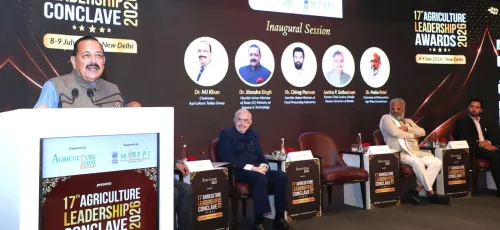
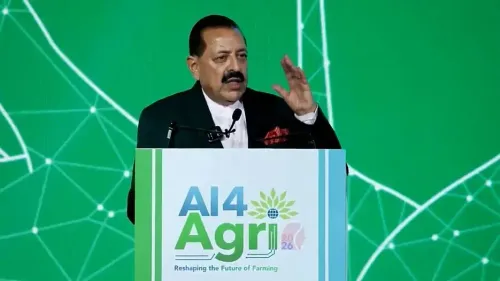
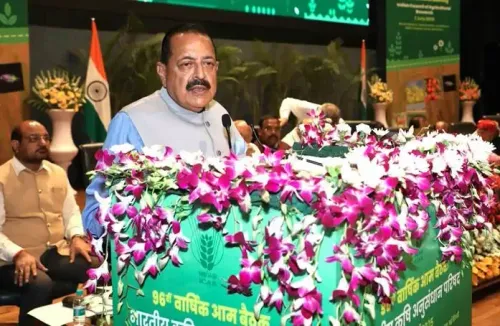
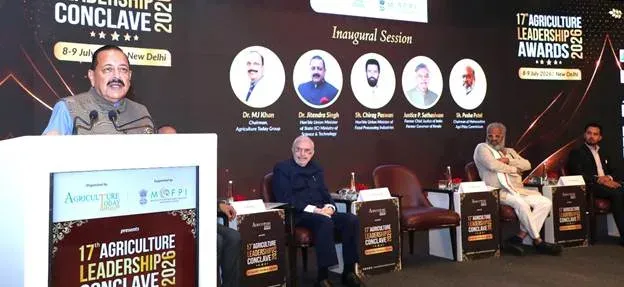
Union Minister of State Dr. Jitendra Singh on Wednesday said that Artificial Intelligence (AI)-driven interventions and science-led agri-startups hold the potential to substantially transform India's agricultural economy, raising farm productivity, boosting farmers' incomes, and generating large-scale rural employment. Speaking at a gathering in New Delhi, he underlined that weaving technology, innovation, and entrepreneurship into agriculture is essential for realising the vision of a Viksit Bharat by 2047.
India's Startup Surge and the Agriculture Opportunity
Dr. Singh highlighted that India's startup ecosystem has undergone a remarkable transformation over the past decade, expanding from roughly 350 registered startups in 2015 to over 2.3 lakh today — cementing the country's position as the world's third-largest startup ecosystem. However, he stressed that the next wave of this entrepreneurial revolution must be rooted in agriculture, where innovation can directly translate into better livelihoods for farmers and new job opportunities for rural youth.
The Minister pushed back against the prevailing notion that startups are the exclusive domain of the IT sector or large metropolitan cities. Agriculture, he argued, represents one of India's biggest untapped entrepreneurial frontiers. He added that practical knowledge, curiosity, and a willingness to learn frequently outweigh formal academic credentials — and that government support, scientific institutions, and digital learning platforms are steadily making advanced technologies accessible to rural communities.
How AI Could Save Farmers ₹5,000 Each Year
Emphasising the expanding role of AI in farming, Dr. Singh said artificial intelligence is fast becoming an indispensable tool for predictive crop management, precision irrigation, weather-based advisories, and efficient utilisation of agricultural inputs. Citing available estimates, he said AI-driven optimisation alone could help every farmer save nearly ₹5,000 annually, resulting in an estimated ₹70,000 crore value addition to the country's agricultural economy.
Notably, this figure positions AI not merely as a productivity enhancer but as a direct income-support mechanism for a farming community that has long struggled with thin margins and climate volatility. This comes amid growing policy consensus that technology adoption — rather than subsidy expansion alone — is the more sustainable path to doubling farm incomes.
Satellite, Drones, and Precision Farming Tools
The Minister outlined a suite of scientific tools already reshaping farm decision-making: satellite technology, advanced weather forecasting systems, drone-based surveys, resource mapping, and real-time advisory services. These tools, he said, are enabling farmers to make sharper, data-backed choices on sowing schedules, irrigation timing, and crop management practices.
Improved monsoon forecasting, in particular, was flagged as critical — allowing farmers to adapt to shifting rainfall patterns and select crop varieties better suited to emerging climatic conditions, thereby reducing weather-related losses.
Climate-Resilient Crops and the Science Push
Describing climate change as one of the gravest challenges confronting global agriculture, Dr. Singh said the Ministry of Science and Technology is backing extensive research across climate-resilient crop development, genomics, crop improvement, pest-resistant varieties, precision farming, and resource optimisation. The goal, he said, is to make Indian agriculture structurally more resilient and productive in the face of increasing environmental stress.
As India approaches its centenary of independence, the Minister's remarks signal a clear policy push to reframe agriculture — historically seen as a welfare sector — as a high-technology, high-opportunity domain capable of anchoring the country's rural economy for decades ahead.
Point of View
000 crore AI value-addition estimate is eye-catching, but its credibility hinges on the source and methodology of those 'cited estimates' — neither of which was made explicit. India has a long history of ambitious agri-tech announcements that stall at the last mile: poor rural connectivity, fragmented land holdings, and low digital literacy remain structural barriers that no startup pitch can paper over. The real question is whether the Ministry's science push will be paired with extension services capable of reaching the smallholder — who still constitutes the majority of India's farming households and who is least equipped to self-adopt precision tools.
NationPress
7 Oct 2026
Frequently Asked Questions
What did MoS Jitendra Singh say about AI in Indian agriculture?
Dr. Jitendra Singh said AI is becoming an essential tool for predictive crop management, precision irrigation, and weather-based advisories, and that AI-driven optimisation could save each farmer nearly ₹5,000 annually, adding an estimated ₹70,000 crore to India's agricultural economy.
How large is India's startup ecosystem today?
India's startup ecosystem has grown from approximately 350 registered startups in 2015 to over 2.3 lakh today, making it the world's third-largest. The Minister said the next phase of this growth must be driven by agriculture rather than just IT or metro-based ventures.
Which technologies are being used to modernise Indian farming?
Satellite technology, drone-based surveys, advanced weather forecasting, resource mapping, and real-time advisory services are among the tools enabling Indian farmers to make better decisions on sowing, irrigation, and crop management.
What is the government doing about climate change's impact on agriculture?
The Ministry of Science and Technology is supporting research on climate-resilient crops, genomics, crop improvement, pest-resistant varieties, precision farming, and resource optimisation to make Indian agriculture more resilient to environmental stress.
Why does the Minister believe agri-startups matter for rural India?
Dr. Singh argued that agriculture is one of India's biggest untapped entrepreneurial opportunities, capable of improving farmers' incomes while creating employment for rural youth — and that practical knowledge often matters more than formal qualifications in this space.