BHASHINI showcases multilingual AI health tools at GDHS 2026
Synopsis
India's BHASHINI platform took centre stage at the Global Digital Health Summit 2026, demonstrating how indigenous multilingual AI — already embedded in AIIMS and JIPMER workflows — could bridge the language gap at the heart of Indian healthcare. With the Army's 'Dhanwantri' system and voice-based clinical documentation live and running, this is less a tech showcase and more a proof-of-deployment moment.
Key Takeaways
BHASHINI showcased multilingual AI and voice-based healthcare tools at the Global Digital Health Summit 2026 in New Delhi on 21 November 2026 .
Institutional partners included AIIMS , JIPMER , and the Directorate General of Medical Services, Indian Army . e-BHASHINI is integrated with e-Sushrut HMIS at JIPMER for voice-based clinical documentation of IPD notes and discharge instructions.
The Army's 'Dhanwantri' system converts doctors' spoken notes into typed text using BHASHINI's capabilities. 'Shrutlekh' enables real-time multilingual transcription and translation in healthcare settings.
Community tools Data Daan and Granthika support building Indian-language AI datasets through public participation.
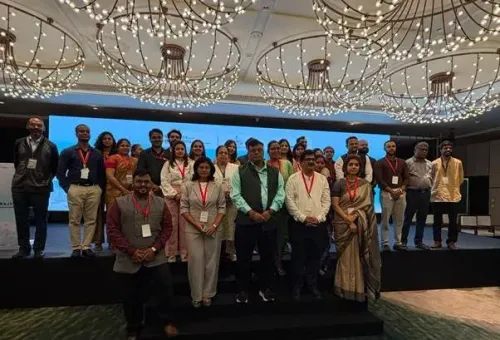
The Digital India BHASHINI Division (DIBD), operating under the Ministry of Electronics and Information Technology (MeitY), presented its multilingual artificial intelligence ecosystem and healthcare-focused language technologies at the Global Digital Health Summit (GDHS) 2026 in New Delhi on 21 November 2026. The showcase demonstrated how voice-based and multilingual AI tools can reshape healthcare delivery across India's linguistically diverse population.
What Was Demonstrated
Live demonstrations at BHASHINI's exhibition stall covered a range of language technology capabilities — including speech-to-text, text-to-speech, translation, and real-time multilingual transcription — applied directly to healthcare workflows. Institutional partners at the stall included the All-India Institute of Medical Sciences (AIIMS), the Jawaharlal Institute of Postgraduate Medical Education and Research (JIPMER), and the Directorate General of Medical Services, Indian Army.
Key Healthcare Integrations
The integration of e-BHASHINI with the e-Sushrut Hospital Management Information System (HMIS) at JIPMER was highlighted as enabling voice-based documentation of clinical histories, IPD notes, and discharge instructions. At AIIMS, BHASHINI's speech technologies are being used to bridge language gaps in doctor-patient conversations.
The Directorate General of Medical Services (Army) demonstrated 'Dhanwantri', a system that converts doctors' spoken clinical notes into typed text, supporting voice-based medical documentation in defence healthcare settings. 'Shrutlekh', BHASHINI's speech-to-text capability, was separately showcased as enabling real-time multilingual transcription and translation across healthcare domains.
Broader Ecosystem on Display
Beyond healthcare-specific tools, the exhibition featured the BHASHINI mobile application for translation and voice tasks, Data Daan — a community-driven initiative for contributing language data to strengthen Indian-language AI systems — and 'Granthika', a guided platform for collecting and digitising written and oral language resources through community participation.
What Officials Said
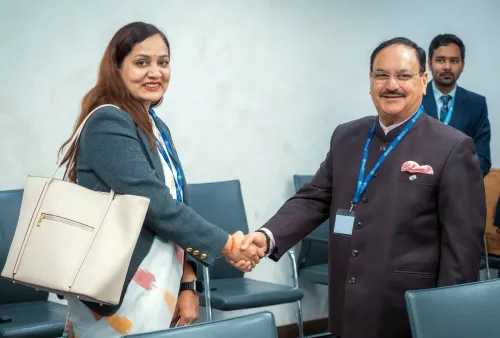
Amitabh Nag, CEO of Digital India BHASHINI, said: 'These applications reflect the potential of India's indigenous language technology ecosystem to make healthcare processes more efficient, accessible and inclusive. Through BHASHINI, we are working towards a future where technology understands not just the information being communicated, but also the linguistic diversity of the people it serves.'
Notably, the summit underscores a broader push by the Centre to embed homegrown language AI into public health infrastructure — a domain where language barriers have historically constrained both care delivery and documentation quality. With India's healthcare system spanning over 22 scheduled languages and hundreds of dialects, the deployment of multilingual AI at institutions such as AIIMS and JIPMER could mark a meaningful inflection point in how clinical workflows are managed at scale.
Point of View
JIPMER, and the Indian Army are not pilot partners, they are live deployments. That said, the gap between demonstration and scale remains a persistent challenge for India's language AI programmes. The real measure will be whether voice-based clinical documentation reduces documentation burden and errors in high-volume public hospitals, not just at flagship institutions. India's multilingual reality makes this a genuinely consequential infrastructure bet — but announcements of ecosystem readiness have preceded actual adoption before.
NationPress
21 Nov 2026
Frequently Asked Questions
What is BHASHINI and what did it showcase at GDHS 2026?
BHASHINI is a multilingual AI platform run by the Digital India BHASHINI Division under MeitY. At the Global Digital Health Summit 2026 in New Delhi, it showcased speech-to-text, text-to-speech, translation, and real-time multilingual transcription tools, with live healthcare use cases from AIIMS, JIPMER, and the Indian Army.
How is BHASHINI being used in hospitals like JIPMER and AIIMS?
At JIPMER, e-BHASHINI is integrated with the e-Sushrut Hospital Management Information System to enable voice-based documentation of clinical histories, IPD notes, and discharge instructions. At AIIMS, BHASHINI's speech technologies help facilitate doctor-patient conversations across different languages.
What is the 'Dhanwantri' system demonstrated by the Indian Army?
'Dhanwantri' is an application deployed by the Directorate General of Medical Services (Army) that converts doctors' spoken clinical notes into typed text using BHASHINI's speech technology, supporting voice-based medical documentation in defence healthcare.
What is 'Shrutlekh' and how does it work in healthcare?
'Shrutlekh' is BHASHINI's speech-to-text capability that enables real-time multilingual transcription and translation. In healthcare settings, it supports communication across language barriers between patients and providers.
What community tools did BHASHINI present at the summit?
BHASHINI presented 'Data Daan', a community-driven initiative for contributing language data to strengthen Indian-language AI, and 'Granthika', a guided platform for collecting and digitising written and oral language resources through community participation.