BHASHINI AI supports multilingual access in academic and research settings
Synopsis
At IIT Delhi's ETD-2026 symposium, India's government-backed BHASHINI platform — with over 10 billion AI inferences and support for 36 Indian languages — demonstrated how AI-powered document translation and real-time speech tools could finally make the country's vast academic knowledge accessible beyond English, with a live showcase of tools built for documents up to 500 pages.
Key Takeaways
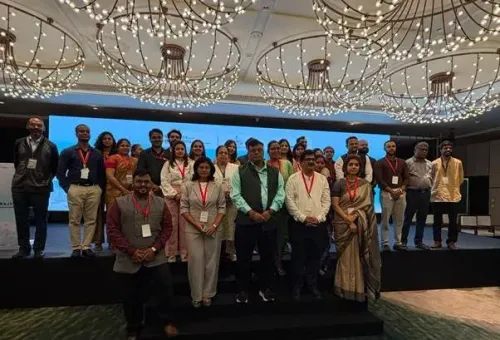
BHASHINI participated in the 29th ETD-2026 Symposium at IIT Delhi from 23–25 October 2026 .
The platform has recorded over 10 billion cumulative AI inferences and supports 36 Indian languages for text and 23 for voice.
Shrutlekh , BHASHINI's real-time speech transcription tool, was demonstrated live for academic settings including lecture halls and seminars.
BHASHINI Pragati , built for the Comptroller and Auditor General of India (CAG) , handles structured document translation for files of 100–500 pages .
BHASHINI's website translation plugin now covers more than 800 government websites .
Officials indicated future engagement with universities and research institutions to pilot multilingual solutions for theses and dissertations.
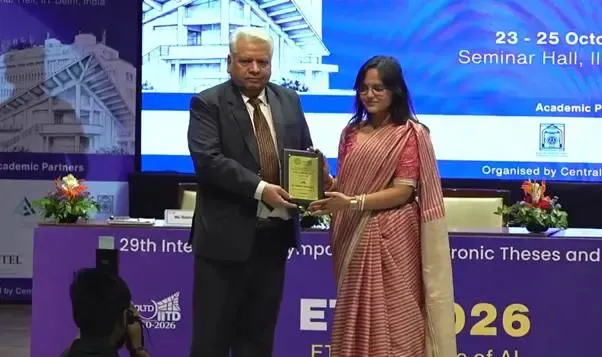
The Digital India BHASHINI Division (DIBD), operating under the Digital India Corporation (DIC) and the Ministry of Electronics and Information Technology (MeitY), showcased its multilingual artificial intelligence capabilities at the 29th International Symposium on Electronic Theses and Dissertations (ETD-2026), held at the Indian Institute of Technology (IIT) Delhi from 23 to 25 October 2026. Government officials highlighted how voice-first multilingual AI, speech-to-text, translation, optical character recognition (OCR), and document translation can expand access to academic and research content across Indian languages.
What BHASHINI's AI Ecosystem Offers
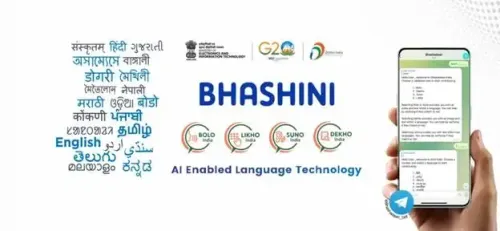
According to an official statement, BHASHINI has recorded over 10 billion cumulative AI inferences to date. The platform currently supports 36 Indian languages for text, 23 Indian languages for voice, and 35 international languages. Its website translation plugin enables multilingual access across more than 800 government websites, positioning it as one of the largest language-tech deployments in India's public sector.
BHASHINI's broader ecosystem integrates language datasets, AI models, application programming interfaces (APIs), and end-user applications to address a range of language technology use cases — from citizen services to, now, higher education and research repositories.
Session Highlights at ETD-2026
Baishali Chakraborty, representing DIBD at the symposium, led a dedicated session on BHASHINI's Language-First Digital Public Infrastructure (DPI) and its potential to help higher education institutions, libraries, and research repositories overcome language barriers. A live demonstration of Shrutlekh — BHASHINI's real-time speech transcription tool — illustrated simultaneous translation capabilities, with potential applications in lecture halls, research seminars, and academic conferences.
A key focus was extending AI-powered translation to electronic theses and dissertations (ETDs), including lengthy and specialised academic documents. BHASHINI Pragati, a document translation workbench developed for the Comptroller and Auditor General of India (CAG), was presented as a proof of concept for structured document translation. The workbench supports documents spanning 100 to 500 pages, with built-in quality checks and data security considerations, according to the official statement.
What Officials Said
Harshad Sharma, Senior Manager (Finance) at DIBD, said: 'Making research and scholarly knowledge accessible across Indian languages is an important step towards a more inclusive knowledge ecosystem.' Sharma added that 'BHASHINI's multilingual AI capabilities, including document translation and speech technologies, can help universities, libraries and research repositories reach wider audiences,' and noted that sustained engagement with academic institutions would be essential to developing reliable multilingual solutions for theses, dissertations, and other research content.
Why This Matters for Indian Academia
India's higher education system spans thousands of institutions where students and researchers often work in regional languages, yet most ETD repositories and digital libraries remain predominantly English-first. BHASHINI's intervention at ETD-2026 signals a policy intent to bridge that gap using publicly funded AI infrastructure. Notably, this participation comes as the government accelerates its Digital India programme and positions language technology as a core pillar of equitable digital access.
The next steps, according to officials, will involve direct engagement with universities and research institutions to understand specific multilingual requirements and to pilot reliable AI-driven solutions at scale.
Point of View
But research repositories remain largely English-gated. The 10-billion-inference milestone is impressive for a public-sector AI platform, but cumulative inferences tell us nothing about accuracy rates or user retention, which are the metrics that will determine whether universities actually adopt these tools. The CAG use case for BHASHINI Pragati is a strong institutional proof of concept, but scaling from a single government auditor to thousands of heterogeneous academic institutions is a qualitatively different challenge. Without published benchmarks on translation quality for domain-specific academic language, the platform's promise remains aspirational.
NationPress
25 Oct 2026
Frequently Asked Questions
What is BHASHINI and what does it do?
BHASHINI is India's government-backed multilingual AI platform, developed by the Digital India BHASHINI Division (DIBD) under MeitY. It supports 36 Indian languages for text, 23 for voice, and 35 international languages, offering tools including speech-to-text, real-time translation, OCR, and document translation for both citizen services and, increasingly, academic use.
What was BHASHINI's role at the ETD-2026 Symposium at IIT Delhi?
BHASHINI participated in the 29th International Symposium on Electronic Theses and Dissertations held at IIT Delhi from 23–25 October 2026, where representatives demonstrated live multilingual AI tools including Shrutlekh for real-time speech transcription and BHASHINI Pragati for large-document translation. The session focused on expanding multilingual access to academic content such as theses and dissertations.
What is BHASHINI Pragati and who uses it?
BHASHINI Pragati is a document translation workbench originally developed for the Comptroller and Auditor General of India (CAG). It is designed to handle structured documents of 100 to 500 pages, with built-in quality checks and data security measures, and was presented at ETD-2026 as a model for academic document translation.
How many government websites does BHASHINI currently support?
BHASHINI's website translation plugin currently enables multilingual access across more than 800 government websites, according to an official statement released at the ETD-2026 symposium.
What are the next steps for BHASHINI in the academic sector?
According to Senior Manager Harshad Sharma of DIBD, BHASHINI plans direct engagement with universities, libraries, and research repositories to understand their specific multilingual requirements and co-develop reliable AI solutions for accessing theses, dissertations, and other research content across Indian languages.