China liquidity trap warning: Low rates, record savings signal growth crisis

Synopsis
China's economy grew just 4.3% in Q2 2026 — its weakest in three-and-a-half years — even as banks flooded the system with 10.72 trillion yuan in new loans. With over 80% of surveyed consumers preferring to save rather than spend and home prices falling for 36 straight months, the data points to a textbook liquidity trap that monetary policy alone cannot fix.
Key Takeaways
China's GDP grew 4.3 per cent in Q2 2026 , missing Beijing's ~5 per cent annual target — the weakest quarterly expansion in nearly 3.5 years .
Banks extended 10.72 trillion yuan in new loans in the first half of 2026, yet domestic demand remained weak.
More than 80 per cent of surveyed consumers said they prefer saving over spending despite record-low borrowing costs.
The one-year loan prime rate stands at 3 per cent ; the five-year mortgage-linked rate at 3.5 per cent .
New home prices fell 3.3 per cent year-on-year in June 2026 — the 36th consecutive month of decline.
Nearly 70 per cent of Chinese household wealth is tied to real estate, amplifying the confidence shock.
China is showing mounting signs of sliding into a liquidity trap, with record-low interest rates, ample bank liquidity, and aggressive credit expansion all failing to revive consumer spending, business investment, or broader economic growth, according to recent economic data and the Dunham report. The warning signals come as the world's second-largest economy struggles to meet its own growth benchmarks.
Growth Misses the Mark
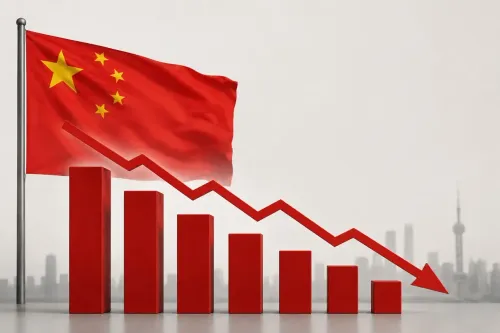
China's economy expanded 4.3 per cent in the second quarter of 2026, falling short of Beijing's annual growth target of approximately 5 per cent and marking the weakest quarterly performance in nearly three-and-a-half years, according to the Dunham report. The shortfall is striking given the scale of monetary stimulus the People's Bank of China (PBOC) has deployed — keeping borrowing costs at historic lows while pushing banks to extend fresh credit.
What a Liquidity Trap Means
A liquidity trap arises when interest rates are already very low and financial institutions hold ample funds to lend, yet households and businesses remain reluctant to borrow, invest, or spend. In this scenario, monetary policy loses much of its traction — additional liquidity injected into the system simply does not translate into economic activity. Economists have long flagged Japan's 'lost decade' as the defining modern case; analysts now argue China may be tracing a similar trajectory.
Credit Flows In, Demand Stays Out
China's broad money supply (M2) grew 8.6 per cent year-on-year at the end of May 2026, while banks extended 10.72 trillion yuan in new loans during the first six months of 2026. Despite this liquidity surge, domestic demand has remained subdued. Recent surveys indicate that more than 80 per cent of respondents would rather increase savings than consumption — a striking figure that underscores how weak consumer confidence has become even as benchmark lending rates sit near record lows. The one-year loan prime rate currently stands at 3 per cent, while the five-year mortgage-linked rate is 3.5 per cent.
Property Slump Deepens the Wound
The prolonged correction in China's property sector has compounded the demand problem. New home prices declined 3.3 per cent year-on-year in June 2026, marking the 36th consecutive month of falling prices. With nearly 70 per cent of household wealth tied to real estate, the sustained downturn has eroded consumer confidence and sharply curtailed discretionary spending. This is not a short-term shock — three years of unbroken price declines have structurally altered how Chinese households perceive their financial security.
What Comes Next
Analysts warn that if Beijing cannot engineer a credible demand recovery, further rate cuts and credit expansion may prove counterproductive — reinforcing the savings instinct rather than reversing it. Fiscal stimulus and structural reforms targeting household income and social safety nets are increasingly cited as the more viable lever. How Beijing responds in the second half of 2026 will likely determine whether this slowdown deepens into a prolonged stagnation.
Point of View
But the more uncomfortable truth is that the PBOC is running out of conventional road. Three years of falling home prices have done something rate cuts cannot easily undo — they have made Chinese households feel poorer in structural, not cyclical, terms. Beijing's instinct has been to push more credit; the data suggests the problem is not supply of money but demand for it. Until China builds a credible social safety net that reduces the precautionary savings motive, monetary easing risks becoming noise. The Japan parallel is imperfect but instructive: Tokyo waited a decade before accepting that fiscal and structural reform — not rate policy — was the only exit.
NationPress
19 Oct 2026
Frequently Asked Questions
What is a liquidity trap and why is China at risk?
A liquidity trap occurs when interest rates are very low and banks have ample funds to lend, but households and businesses still refuse to borrow or spend. China fits this pattern: the PBOC has cut rates to historic lows and banks issued 10.72 trillion yuan in new loans in the first half of 2026, yet consumer spending and business investment remain weak.
How fast did China's economy grow in Q2 2026?
China's economy grew 4.3 per cent in the second quarter of 2026, according to the Dunham report. This was below Beijing's annual target of around 5 per cent and the slowest quarterly expansion in nearly three-and-a-half years.
Why are Chinese consumers saving instead of spending?
Recent surveys show more than 80 per cent of respondents prefer to increase savings rather than consumption. The primary driver is a collapse in confidence linked to 36 consecutive months of falling home prices, which have eroded household wealth given that nearly 70 per cent of Chinese household assets are tied to real estate.
What are China's current interest rates?
The one-year loan prime rate stands at 3 per cent, while the five-year mortgage-linked rate is 3.5 per cent — both near historic lows. Despite these cheap borrowing costs, credit demand from households and businesses has not responded meaningfully.
What could Beijing do to escape a liquidity trap?
Analysts increasingly argue that monetary easing alone is insufficient. Fiscal stimulus and structural reforms — particularly measures to strengthen social safety nets and boost household income — are seen as more effective levers to revive consumer confidence and discretionary spending in the second half of 2026.