Haryana's Budget 2026-27: Aiming for Rural Growth with Rs 2.23 Crore
Synopsis
Haryana's Chief Minister Nayab Singh Saini has unveiled a budget of Rs 2.23 crore for 2026-27, with a focus on the rural economy. This budget aims to enhance infrastructure and agricultural support, marking a significant step towards a prosperous future.
Key Takeaways
Rs 2.23 crore budget proposed for 2026-27.
10.28 percent increase from last year's budget.
Focus on strengthening the rural economy .
Creation of Haryana Agri DISCOM for farmers.
Target of a one-trillion-dollar economy by 2047.
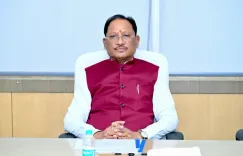
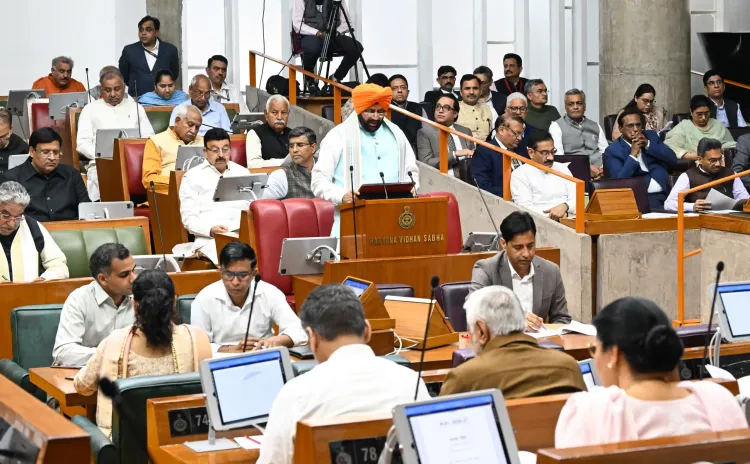
Chandigarh, March 2 (NationPress) The Chief Minister of Haryana, Nayab Singh Saini, unveiled a state budget of Rs 2.23 crore for the fiscal year 2026-27, marking a 10.28 percent increase from the revised figure of Rs 2.02 crore for 2025-26, with an emphasis on bolstering the rural economy.
He introduced the establishment of a new power distribution entity, called Haryana Agri DISCOM, specifically aimed at serving the agricultural community.
During his second budget presentation, CM Saini, who also oversees the Finance Department, projected a fiscal deficit of Rs 40,293.17 crore, equivalent to 2.65 percent of the Gross Domestic Product (GDP). He noted that the revenue deficit is estimated at 0.87 percent of the GDP, while the effective revenue deficit is pegged at 0.41 percent. Capital expenditure is anticipated to be 1.86 percent, with effective capital expenditure estimated at 2.32 percent.
Wearing his traditional Sikh turban, the Chief Minister stressed the importance of increasing capital investments to foster infrastructure development.
The proposed capital expenditure is set at Rs 28,205 crore, making up 12.6 percent of the total budget, while effective capital expenditure is projected at Rs 35,216 crore, or 15.7 percent of the budget. This represents an increase from Rs 27,650 crore in 2025-26, which constituted 13.6 percent of the overall budget.
The Chief Minister underscored Haryana's crucial position in India's expanding economy, with a bold objective for the state to reach a one-trillion-dollar economy by 2047.
For the first time in the state's history, he noted that 98 percent of the total budget was effectively utilized in the past fiscal year.
CM Saini asserted that Haryana's economic landscape is improving, claiming that the state now boasts the highest per capita income among major states. The per capita income of Haryana has surged from Rs 1,47,382 in 2014-15 to Rs 3,24,958 in 2023-24 (provisional estimate). In 2024-25 (quick estimate), it is expected to rise to Rs 3,58,171, while the national average is only Rs 2,19,575. For 2025-26 (advance estimate), this number is projected to climb further to Rs 3,95,618.
The fiscal deficit has increased by 2.75 percent from 2014 to 2024, contrasting sharply with the 44 percent rise during the prior government's term, he stated.
Additionally, losses from government enterprises have decreased by a factor of three, he reported.
The budget includes plans for primary agricultural credit societies. Currently, only 33 out of 804 societies are profitable, and the government aims to turn 300 societies into profit by diversifying their operations to include petrol stations.
Regular Gram Sabha meetings will now cover six specified topics—development, de-addiction, drinking water, sanitation, solid waste management, and inspection maintenance.
Members of the Legislative Assembly (MLAs) are now allowed to join these grassroots discussions. The newly formed Haryana Agri DISCOM will oversee 5,084 agricultural feeders, ensuring reliable power supply for 7.12 lakh consumers, while also providing tubewell connections for farmers.
The two existing electricity distribution companies are Uttar Haryana Bijli Vitran Nigam (HBVN) and Dakshin Haryana Bijli Vitran Nigam (DHBVN).
For industrialists, the budget proposes the creation of a specialized fund of Rs 500 crore called ‘Saksham’ aimed at enhancing infrastructure in targeted cities, stimulating industrial activities, and fortifying the local economy.
Point of View
The budget reflects a commitment to driving economic growth and improving the livelihoods of residents.
NationPress
13 Oct 2026
Frequently Asked Questions
What is the total budget proposed by Haryana CM Saini?
The total budget proposed by Haryana CM Saini is Rs 2.23 crore for the fiscal year 2026-27.
What percentage increase does this budget represent?
This budget represents a 10.28 percent increase over the revised estimate of Rs 2.02 crore for the previous fiscal year.
What is the focus of the new budget?
The new budget focuses on strengthening the rural economy and enhancing infrastructure.
What is the projected fiscal deficit for this budget?
The projected fiscal deficit for this budget is Rs 40,293.17 crore, which is 2.65 percent of the GDP.
How does Haryana's per capita income compare to the national average?
Haryana's per capita income is significantly higher, estimated at Rs 3,24,958 compared to the national average of Rs 2,19,575.