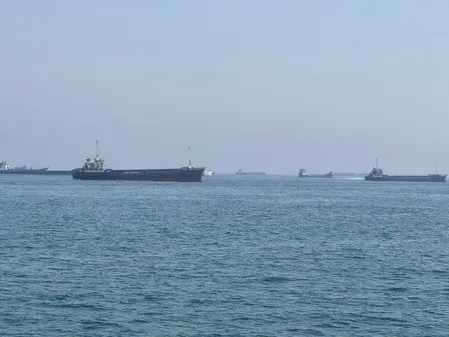
Hormuz vessel traffic hits 78 transits, recovers to 57% of pre-war levels
Synopsis
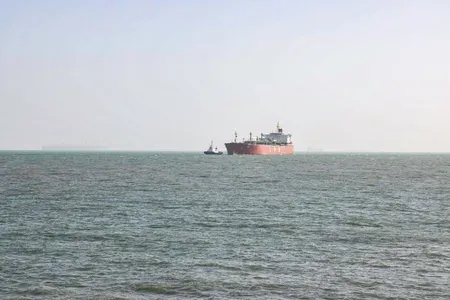
For the first time since the US-Iran war disrupted global energy shipping, the Strait of Hormuz has logged a post-war daily record of 78 vessel transits — reaching 57% of pre-war volumes. An Oman-IMO safe corridor is doing much of the heavy lifting, but eight 'dark' vessels and continued Iranian-linked traffic signal that full normalisation remains some distance away.
Key Takeaways
The Strait of Hormuz recorded a post-war daily high of 78 vessel transits , recovering to 57 per cent of pre-war volumes, per S&P Global .
A new safe corridor announced by Oman and the IMO attracted 33 vessels — over 40 per cent of the day's traffic — with 25 travelling outbound.
Eight vessels were detected operating 'dark' during passage through the strait.
Inbound movements made up 37 per cent of traffic; 41 per cent of inbound ships were linked to Iran .
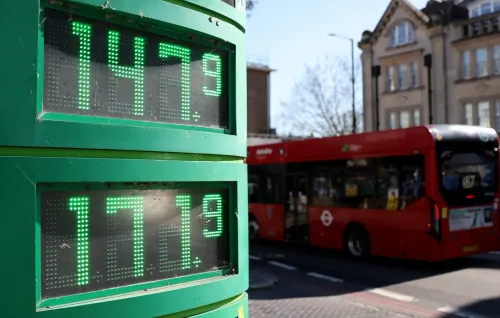
Brent crude fell 2 per cent to $73.75 a barrel and WTI dropped 2 per cent to $70.42 a barrel as supply concerns eased.
Vessel traffic through the Strait of Hormuz has reached a new post-war daily record of 78 transits, recovering to approximately 57 per cent of pre-war daily volumes, according to a report by S&P Global released on Friday, 27 June 2025. The milestone signals an early but cautious normalisation of one of the world's most critical maritime chokepoints following the US-Iran war.
Safe Corridor Drives Recovery
The rebound in transits follows a joint initiative by Oman and the International Maritime Organization (IMO), which announced a new safe corridor for vessels transiting close to the Omani coastline. More than 40 per cent of the day's transits — 33 vessels — used this route, with 25 of them travelling outbound. The corridor has provided an alternative to routes that pass nearer Iran's territorial waters, though some ships continued to use those lanes. Notably, eight vessels were detected operating 'dark' — with their tracking systems switched off — during passage, a practice associated with sanctions evasion or risk avoidance.
Breakdown of Ship Movements
Total traffic comprised a diverse mix of vessel types: 22 oil and chemical tankers, 21 bulk carriers, 12 cargo ships, seven container ships, four LPG tankers, and two LNG tankers. Inbound movements accounted for 37 per cent of total traffic, with 41 per cent of inbound ships linked to Iran.
On 24 June, ten crude tankers transited the strait — comprising five VLCCs and three Suezmax vessels moving outbound, and two VLCCs crossing inbound. Of these, only the VLCC AMAK, sanctioned by the US, is linked to Iran. Among the 12 product tankers that moved through the strait — evenly split between inbound and outbound — only one bitumen tanker, the VIRAJ, is linked to Iran, the S&P Global report noted.
Signs of Early Normalisation
The S&P Global report observed that while most outbound vessels had been trapped inside the Gulf since the onset of hostilities, a subset of the recent movements involved ships that entered more recently and are now exiting. According to the report, this points to 'early signs of normalisation and a gradual re-establishment of freedom of navigation patterns.' This comes amid what analysts describe as a fragile but measurable return to commercial shipping activity in a corridor that handles a significant share of global energy flows.
Oil Prices Fall on Easing Supply Fears
Global crude oil prices dropped sharply on Friday, on track to post steep weekly losses, as easing supply concerns in the Strait of Hormuz outweighed fresh geopolitical tensions following an attack on a cargo vessel near Oman. Brent crude futures fell $1.51, or 2 per cent, to $73.75 a barrel, while US West Texas Intermediate (WTI) crude declined $1.50, or approximately 2 per cent, to $70.42 a barrel. The price drop reflects market expectations that a sustained reopening of Hormuz could ease the supply premium that had built up during the conflict period.
Point of View
Not a resolution — vessels are rerouting to avoid Iranian waters, not because the underlying geopolitical risk has been resolved. The presence of eight dark-operating ships and continued Iranian-linked inbound traffic suggests the strait remains a contested space. Oil markets are pricing in optimism; the shipping data counsels more caution.
NationPress
25 Sept 2026
Frequently Asked Questions
What is the current status of vessel traffic through the Strait of Hormuz?
As of late June 2025, vessel traffic through the Strait of Hormuz has reached a post-war daily record of 78 transits, recovering to approximately 57 per cent of pre-war daily volumes, according to an S&P Global report. The recovery is partly attributed to a new safe corridor established near the Omani coast.
What is the Oman-IMO safe corridor and how does it work?
The safe corridor is a designated shipping lane close to the Omani coastline, jointly announced by Oman and the International Maritime Organization (IMO) to provide vessels a safer alternative to routes passing near Iran's territorial waters. On the record transit day, 33 vessels — over 40 per cent of total traffic — used this route.
Why were eight vessels operating 'dark' in the Strait of Hormuz?
Eight vessels were detected with their Automatic Identification System (AIS) transponders switched off during passage, a practice known as 'going dark.' This is commonly associated with sanctions evasion or attempts to avoid detection, and it signals that risk and compliance concerns persist in the strait despite the partial recovery.
How have global oil prices reacted to the Hormuz traffic recovery?
Brent crude fell $1.51, or 2 per cent, to $73.75 a barrel on Friday, while WTI crude dropped approximately 2 per cent to $70.42 a barrel, as easing supply concerns in the Strait of Hormuz outweighed fresh geopolitical tensions from an attack on a cargo vessel near Oman.
Which vessel types are currently transiting the Strait of Hormuz?
Total traffic on the record day included 22 oil and chemical tankers, 21 bulk carriers, 12 cargo ships, seven container ships, four LPG tankers, and two LNG tankers, according to the S&P Global report.