India must double exports to hit $2 trillion target by FY31: Commerce Ministry
Synopsis
India's total exports hit a record $863 billion in FY26 — yet a senior Commerce Ministry official has warned that reaching the $2 trillion target by FY31 demands more than doubling that pace. The message from the CII Manufacturing Conclave: incremental gains won't cut it. India needs a structural overhaul — and a geopolitical identity shift from 'China plus one' to a self-defined global manufacturing power.
Key Takeaways
India's total exports reached an all-time high of $863 billion in FY26 , up from $468 billion in 2014-15 .
Commerce Ministry Additional Secretary Yashvir Singh said India must more than double its export pace to hit the $2 trillion target by FY31 .
Singh called on India to move beyond the China-plus-one framing and position itself as a trusted, resilient global manufacturing partner.
China's share of global manufacturing value added rose from 3% in 1990 to nearly 28% in 2024 , raising supply-chain concentration risks worldwide.
The WTO appellate body's paralysis and rising reciprocal tariffs are fracturing the multilateral trade order, creating both risk and opportunity for India.
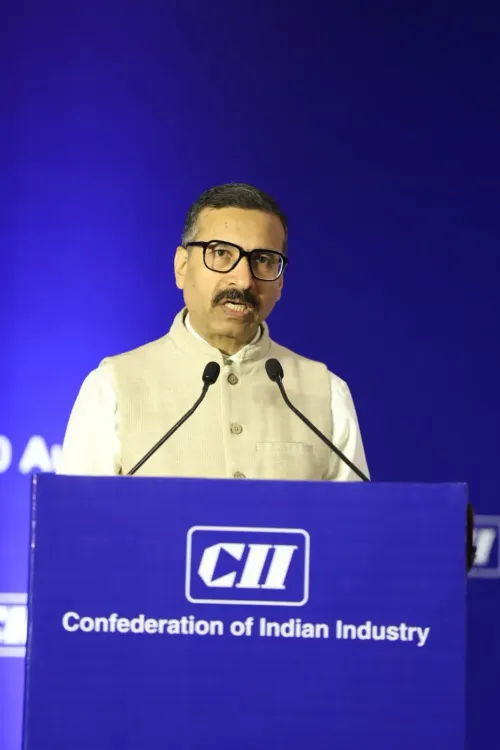
Commerce Ministry Additional Secretary Yashvir Singh on Thursday, 20 August said India will need to more than double its current export trajectory to reach its $2 trillion total exports target by FY31, warning that incremental progress alone will not be enough and that a fundamental structural transformation of the country's manufacturing and trade ecosystem is required. Singh made the remarks while addressing the CII Manufacturing Conclave in New Delhi.
Where India Stands Today
India's total exports reached an all-time high of $863 billion in FY26, up sharply from $468 billion in 2014-15. While the trajectory marks significant progress, Singh underscored that the leap to $2 trillion by 2030 is of an entirely different magnitude. 'The ambition of $2 trillion of total exports by 2030 demands that we more than double our current trajectory. That acceleration will not come from incremental improvements. It requires structural transformation,' he said.
India as a Trusted Global Manufacturing Partner
Singh cautioned against a narrow interpretation of the China-plus-one strategy, arguing that India should not merely position itself as a substitute supply-chain node. Instead, he called for India to emerge as a self-defined, resilient manufacturing destination with transparent and reliable supply networks. 'Let us not be China plus one. Let us be India, the trusted partner, the resilient manufacturer and the next great engine of global growth,' he said.
Fractures in the Global Trade Order
Singh's address came against the backdrop of deepening strains in the multilateral trading system. He pointed to sharp differences at the World Trade Organisation's (WTO) 14th Ministerial Conference and the continued paralysis of the WTO's appellate body as evidence of structural realignment in global trade governance. The most-favoured-nation (MFN) principle, he noted, is increasingly being tested by reciprocal tariffs and the unilateral expansion of security exceptions. 'Export restrictions on critical minerals are being weaponised. Technology choke points are being deliberately engineered. Trade is no longer just an economic instrument. It has become a tool of geographic statecraft,' Singh said.
China's Manufacturing Dominance and India's Opening
Singh highlighted the scale of concentration risk in global supply chains, noting that China's share of global manufacturing value added rose from around 3% in 1990 to nearly 28% in 2024. Beijing has also established a dominant position in the processing and refining of critical minerals including rare earths, graphite, and magnesium. This concentration, Singh argued, has become a major economic security concern for importing nations — and a strategic opening for India.
What Comes Next
The Commerce Ministry's remarks signal that achieving the FY31 export target will require policy interventions beyond trade facilitation — including deeper manufacturing competitiveness, supply-chain reliability, and diplomatic positioning in a fragmenting global order. Industry bodies attending the CII conclave are expected to engage with the ministry on a roadmap in the coming months.
Point of View
But the gap between aspiration and execution remains wide: India's share of global manufacturing value added is still a fraction of China's 28%. The real test is whether the structural transformation Singh calls for — supply-chain reliability, manufacturing depth, trade diplomacy — is backed by specific, time-bound policy commitments, or remains a conclave-circuit rallying call.
NationPress
5 Oct 2026
Frequently Asked Questions
What is India's $2 trillion export target and when is the deadline?
India has set an ambition to achieve $2 trillion in total exports by FY31 (financial year ending March 2031). Commerce Ministry Additional Secretary Yashvir Singh said reaching this target will require more than doubling the country's current export trajectory, which stood at a record $863 billion in FY26.
How much did India export in FY26?
India's total exports reached an all-time high of $863 billion in FY26, compared with $468 billion in 2014-15. While this marks significant growth, officials say the pace must accelerate sharply to meet the $2 trillion goal by FY31.
What did the Commerce Ministry mean by 'structural transformation'?
Yashvir Singh used the term to signal that incremental improvements in trade facilitation or logistics will not be sufficient. Structural transformation implies deeper changes — manufacturing competitiveness, supply-chain reliability, and a repositioning of India as a self-defined global manufacturing partner rather than simply an alternative to China.
What is the China-plus-one strategy and how does India fit in?
The China-plus-one strategy refers to the global corporate trend of diversifying supply chains away from China to reduce concentration risk. Singh argued India should not merely slot into this role as a substitute, but instead build its own identity as a 'trusted partner and resilient manufacturer' with transparent supply networks.
Why is the global trade environment a concern for India's export ambitions?
Singh pointed to the paralysis of the WTO's appellate body, fractures at the WTO's 14th Ministerial Conference, rising reciprocal tariffs, and the weaponisation of export restrictions on critical minerals as signs that the multilateral trade order is under stress. These developments create uncertainty for export-dependent economies, even as they open strategic openings for India.