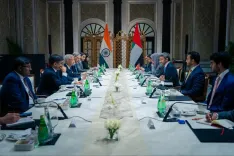
India-New Zealand FTA could double $2.8 bn trade in 2-2.5 years: BRICS Chamber chief
Synopsis
The India-New Zealand FTA could cut the timeline to double bilateral trade from five years to just two to two-and-a-half years, according to BRICS Chamber of Commerce and Industry chief Harvansh Chawla — but he warns that exporters still lack the cheap financing needed to capitalise on the opportunity, calling on banks and the government to act before the window opens.
Key Takeaways
BRICS Chamber of Commerce and Industry Chairman Harvansh Chawla said the India-New Zealand FTA could double bilateral trade in 2 to 2.5 years , ahead of the official 5-year target.
India's current annual trade with New Zealand stands at approximately $2.8 billion .
The FTA's trade impact may take 6 months to 1 year to become visible after implementation, Chawla said.
He projected that trade growth would generate employment and allow businesses to expand, citing an example of a ₹100 crore company growing to ₹125 crore .
Chawla called for lower interest rates on export financing and expanded government schemes to ensure small and mid-sized exporters can fulfil incoming orders.
The proposed India-New Zealand Free Trade Agreement (FTA) could double bilateral annual trade well ahead of schedule — in two to two-and-a-half years rather than the targeted five — according to BRICS Chamber of Commerce and Industry Chairman Harvansh Chawla, who made the assessment on Tuesday, 20 October 2026, in New Delhi. India's current annual trade with New Zealand stands at approximately $2.8 billion, and the official target is to double that figure over the next five years.
Chawla's Key Projections
'As I mentioned, I believe our target of doubling trade within five years could be achieved in just two to two-and-a-half years,' Chawla said. He also projected that the two nations would become 'very important trading partners for each other' in the years ahead, adding that New Zealand's significance for India — and India's for New Zealand — would grow substantially once the agreement takes effect.
He cautioned, however, that the FTA's visible impact on trade flows may take six months to a year to materialise after implementation, even if the longer-term trajectory is sharply upward.
Employment and Business Growth Outlook
Beyond headline trade numbers, Chawla argued that the agreement carries meaningful employment implications. 'As our trade doubles, employment will also increase. New factories will be set up and businesses will expand. For instance, a company with a turnover of ₹100 crore today could see it rise to ₹125 crore. This will have a positive impact on everyone,' he said.
This comes amid a broader push by India to lock in trade agreements with developed economies, following the landmark FTAs with the UAE and Australia in recent years. A deal with New Zealand would extend India's free-trade footprint into the South Pacific.
Call for Stronger Government Support to Exporters
Chawla stressed that the gains from the FTA would not automatically reach Indian traders without targeted policy intervention. He specifically called for dedicated export financing schemes with lower interest rates, noting that liquidity remains the single biggest constraint for Indian exporters. 'Indian traders currently need cash the most. The government should introduce schemes specifically to support exports. Schemes already exist, but they need to be expanded,' he said.
He added: 'Interest rates on export financing must be reduced. Traders may receive orders, but they need funds to execute them, which largely come from banks. Banks should introduce more flexible schemes for exporters with lower interest rates.' The remarks highlight a persistent structural gap between India's trade policy ambitions and on-the-ground financing access for small and mid-sized exporters.
Where the FTA Stands
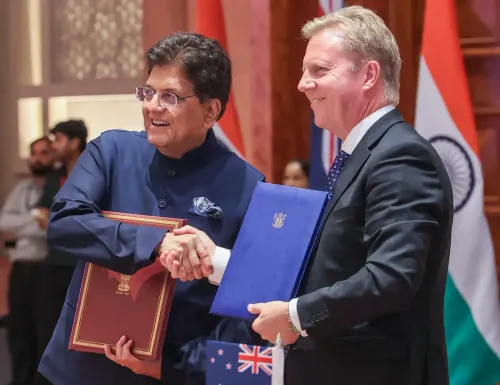
Notably, the India-New Zealand FTA is still in negotiation and has not yet been formally concluded or signed. Chawla's projections are forward-looking assessments of the deal's potential, contingent on successful implementation. The two countries have engaged in multiple rounds of talks, and momentum has reportedly picked up following high-level diplomatic engagements. All timelines cited are estimates, not official government commitments.
With India's trade diplomacy intensifying across multiple geographies, the outcome of FTA negotiations with New Zealand will be closely watched by exporters in sectors such as dairy, kiwi fruit and processed foods — areas where bilateral complementarities are significant.
Point of View
Similarly hailed as transformative, has seen slower-than-projected trade uptake in its first two years, partly because of exactly the financing gap he identifies. The structural problem is not the absence of agreements but the absence of cheap, accessible credit for mid-tier exporters who are positioned to benefit most. If the government does not move on export financing reform in parallel with the FTA negotiations, the headline trade-doubling target — whether achieved in two years or five — may benefit large conglomerates far more than the factory-floor businesses Chawla invokes. The real indicator to watch will be SME export credit disbursement, not aggregate trade volumes.
NationPress
20 Oct 2026
Frequently Asked Questions
What is the India-New Zealand Free Trade Agreement?
The India-New Zealand FTA is a bilateral trade deal currently under negotiation that aims to eliminate or reduce tariffs and trade barriers between the two countries. Once implemented, it is expected to significantly boost bilateral trade, which currently stands at around $2.8 billion annually.
How quickly could the India-New Zealand FTA double bilateral trade?
BRICS Chamber of Commerce and Industry Chairman Harvansh Chawla estimates that the FTA could double bilateral trade in two to two-and-a-half years — well ahead of the official five-year target. He cautioned that visible impact on trade flows may still take six months to a year to appear after implementation.
What is India's current annual trade with New Zealand?
India's current annual bilateral trade with New Zealand stands at approximately $2.8 billion. The stated government target is to double this figure within five years, though Chawla believes the FTA could accelerate that timeline significantly.
What concerns did Chawla raise about Indian exporters?
Chawla highlighted that Indian exporters face a significant liquidity crunch and called on the government and banks to introduce more flexible, lower-interest financing schemes. He said existing export support schemes need to be expanded so that traders can fund orders received as a result of the FTA.
Which sectors stand to benefit most from the India-New Zealand FTA?
Sectors with strong bilateral complementarities — including dairy, kiwi fruit, processed foods, and manufactured goods — are expected to see the most significant impact. Employment growth through new factory setups and business expansion is also anticipated as trade volumes rise.