India's poverty rate drops to 2.6% vs Pakistan's stagnation: Report
Synopsis
A new IOL analysis reveals India lifted an estimated 496 million people above the lower-middle-income poverty line between 2011 and 2023 — cutting its poverty rate from 27.1% to just 2.6%. The report attributes the gap with Pakistan not to religion or ideology, but to institutional quality, policy consistency, and productive investment — a distinction that carries significant weight for how both nations are assessed by global development economists.
Key Takeaways
India's poverty rate fell to 2.6 per cent in 2023 from 27.1 per cent in 2011 , according to an IOL analysis.
The share of Indians below the $4.20-a-day poverty line dropped from 57.7 per cent to 16.1 per cent over the same period.
An estimated 496 million people were lifted above the lower-middle-income threshold — one of the largest such achievements globally.
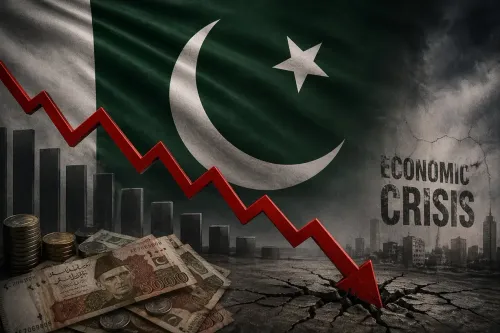
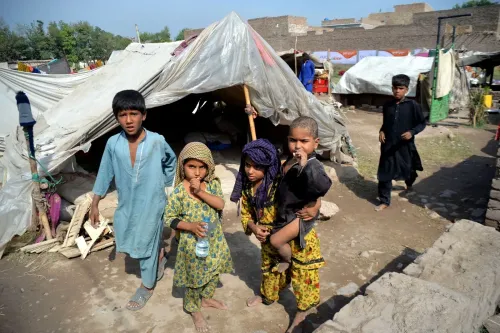
Pakistan continues to face political instability, fiscal pressure, weak job creation, and low labour productivity growth.
The report attributes divergent outcomes to institutional quality , economic policy , and productive investment — not religion or ideology.
Both nations are urged to pursue greater regional trade and economic cooperation for long-term prosperity.
India's poverty rate fell dramatically to 2.6 per cent in 2023 from 27.1 per cent in 2011, while Pakistan continues to struggle with entrenched economic challenges — marking an increasingly sharp divergence in the development trajectories of the two South Asian neighbours since Partition in 1947, according to a new analysis by IOL. The report describes India's turnaround as one of the largest poverty-reduction achievements in modern global history.
Scale of India's Poverty Reduction
The analysis highlights that the proportion of Indians living below the lower-middle-income poverty line of $4.20 a day declined sharply to 16.1 per cent in 2023 from 57.7 per cent in 2011. This improvement lifted an estimated 496 million people above that threshold over the period — a feat the report says stands out on a global scale.
'India's developmental story is therefore about more than reducing poverty. It is about how a country carrying an exceptionally complex historical inheritance has pursued economic transformation while managing profound internal divisions and continuing geopolitical pressures,' the analysis noted.
What Drove India's Progress
According to the report, sustained investments in infrastructure, agriculture, industrialisation, technology, and financial inclusion have been the primary engines behind India's poverty decline. The analysis attributes the gains to consistent policy direction over multiple decades rather than any single intervention. Notably, the report cautions against attributing outcomes to religion or ideology, arguing instead that institutional quality, economic policy, and productive investment have been the decisive variables.
Pakistan's Contrasting Challenges
The report paints a starkly different picture for Pakistan, citing a cycle of political instability, fiscal strain, weak job creation, and slower productivity growth as persistent drags on economic progress. 'Pakistan's successive military interventions, political instability, weak job creation, fiscal pressures and limited growth in labour productivity have complicated its efforts to establish sustained economic progress,' the analysis states.
Both nations inherited broadly comparable colonial legacies and developmental challenges at independence, the report acknowledges — making the subsequent divergence a matter of policy choices and institutional evolution rather than starting conditions.
Persistent Gaps Within India
While underscoring India's achievements, the analysis does not shy away from ongoing challenges. Inequality, unemployment, and regional disparities remain significant, and the report argues that long-term prosperity will ultimately hinge on creating productive employment, strengthening institutions, and broadening economic opportunity across all segments of the population.
A Case for Regional Cooperation
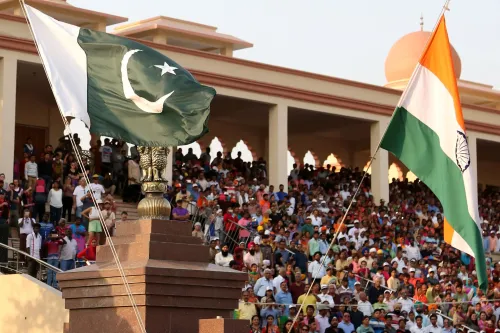
Despite framing the comparison as a divergence, the report concludes on a constructive note — arguing that both India and Pakistan stand to gain from greater regional trade, economic cooperation, and knowledge-sharing. The findings arrive at a moment of heightened India-Pakistan geopolitical tension, lending added weight to its recommendation that neighbourhood rivalry need not preclude mutual economic benefit.
Point of View
But the more consequential finding in this report is the institutional argument — that India's edge over Pakistan stems from policy consistency and productive investment, not civilisational or religious factors. That framing matters because it implies Pakistan's trajectory is reversible if political stability and institutional capacity improve. For India, the 496-million figure is a genuine achievement, yet the report's own caveats on inequality and unemployment signal that poverty reduction at the aggregate level has not translated uniformly across regions or demographics. The real policy challenge now is depth, not breadth.
NationPress
21 Nov 2026
Frequently Asked Questions
What does the IOL report say about India's poverty reduction?
The IOL analysis found that India's poverty rate fell from 27.1 per cent in 2011 to 2.6 per cent in 2023, lifting an estimated 496 million people above the lower-middle-income poverty line of $4.20 a day. The report describes it as one of the largest poverty-reduction achievements in modern global history.
How does India's development compare to Pakistan's since Partition?
Both countries inherited similar colonial legacies in 1947, but their outcomes have sharply diverged. India sustained long-term investments in infrastructure, agriculture, and financial inclusion, while Pakistan has faced recurring cycles of military intervention, political instability, and weak job creation, according to the report.
Why does the report say India outperformed Pakistan economically?
The report argues that institutional quality, economic policy, and productive investment — not religion or ideology — are the decisive factors. India's consistent policy direction across multiple decades gave it a structural advantage over Pakistan's more turbulent governance history.
Does India still face development challenges despite the progress?
Yes. The report acknowledges that inequality, unemployment, and regional disparities remain significant challenges within India. It cautions that long-term prosperity depends on creating productive employment and expanding economic opportunity more broadly.
What does the report recommend for India and Pakistan going forward?
The analysis recommends greater regional trade, economic cooperation, and knowledge-sharing between India and Pakistan, arguing that both countries stand to gain from collaboration. It emphasises that building productive employment and strengthening institutions are essential for sustained progress on both sides.