India to convert gas-fired urea plant to green ammonia, target 1.1 mn tonnes
Synopsis
India is converting a gas-fired ammonia and urea plant to run on renewables — potentially creating one of the world's largest green-ammonia facilities at 1.1 million tonnes a year. Backed by a $100 million ADB-Japan loan under the new ACCEL initiative, the project could reshape India's fertiliser sector and reduce its exposure to global gas price shocks.
Key Takeaways
India will convert a natural gas-fuelled ammonia and urea plant to renewable energy, targeting annual output of 1.1 million tonnes of green ammonia.
The project will be developed by AM Green Ammonia (India) Private Limited , backed by a $100 million loan from ADB's LEAP 2 fund, financed by JICA .
This is the first joint investment by ADB and Japan under the ACCEL initiative, launched in May 2026 .
India surpassed 300 GW of installed non-fossil fuel power capacity as of July 2026 , with a 500 GW target by 2030 .
ADB President Masato Kanda said the project can 'help reshape this industry' by producing ammonia with 'far lower emissions.'
India will convert an existing natural gas-fuelled ammonia and urea plant to run entirely on renewable energy, aiming to create one of the world's largest green-ammonia facilities with an annual output target of approximately 1.1 million tonnes, according to a new report by Singapore-based Asian Power. The project marks a significant step in India's push to decarbonise its fertiliser sector and reduce dependence on fossil fuel-based industrial inputs.
Project Details and Developer
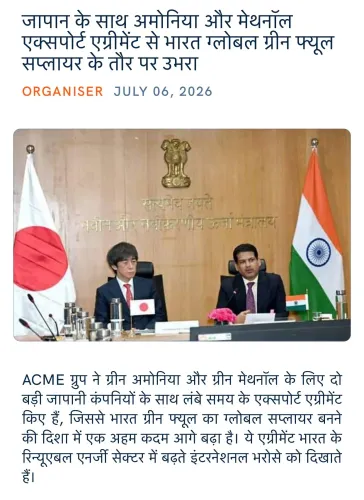
The facility will be developed by AM Green Ammonia (India) Private Limited, the report said. The project is backed by a $100 million loan from the Leading Asia's Private Infrastructure Fund 2 (LEAP 2), which is financed by the Japan International Cooperation Agency (JICA) and administered by the Asian Development Bank (ADB). This represents the first joint investment by ADB and Japan under the Action for Creating Energy Security for Long-term Resilience (ACCEL) initiative.
What Is ACCEL
ACCEL was jointly launched by the Asian Development Bank (ADB) and the Government of Japan in May 2026 as a regional initiative designed to help Asia-Pacific nations and businesses manage high energy costs, fuel price volatility, and supply constraints. According to ADB, the initiative operates on two tracks: short-term corporate liquidity support — particularly for small and medium-sized enterprises — and longer-term investment in diversified, sustainable energy systems.
What ADB Said
ADB President Masato Kanda was quoted in the publication as saying: 'By using renewable energy instead of fossil fuels, India can produce it with far lower emissions and at a scale that can help reshape this industry.' The statement underscores the strategic importance both multilateral financiers attach to green ammonia as a hydrogen-carrier and fertiliser feedstock.
India's Renewable Energy Context
The project lands at a moment when India's clean energy build-out is gathering pace. The country crossed 300 GW of installed non-fossil fuel-based electricity generation capacity as of July 2026, adding roughly 55.29 GW of non-fossil capacity during the financial year FY26. The government has set a target of 500 GW of non-fossil fuel capacity by 2030, with solar and wind energy expected to be the primary drivers. Notably, green ammonia — produced by splitting water via electrolysis powered by renewables rather than by steam methane reforming — is seen as a critical pathway for decarbonising both agriculture and hard-to-abate industrial sectors.
Why This Matters
India is the world's second-largest consumer of urea, and the sector is heavily import-dependent and subsidy-intensive. Converting existing gas-based infrastructure to green feedstocks could, over time, reduce fiscal pressure on fertiliser subsidies and insulate the country from global natural gas price shocks — a vulnerability exposed sharply during the 2022 energy crisis. The AM Green Ammonia project, if it meets its output target, would rank among the world's largest green-ammonia operations, positioning India as a potential exporter alongside domestic supply. The next milestone to watch is financial close and the timeline for plant conversion.
Point of View
And without a clear subsidy or carbon-pricing bridge, the economics depend heavily on continued multilateral concessional financing. India's fertiliser sector is already one of the largest subsidy line items in the Union Budget; decarbonising it is strategically sound but fiscally non-trivial. The real test will be whether AM Green Ammonia can demonstrate a replicable unit economics model that does not permanently depend on ADB or JICA support.
NationPress
21 Oct 2026
Frequently Asked Questions
What is the India green ammonia plant project?
India plans to convert an existing natural gas-fuelled ammonia and urea plant to run on renewable energy, aiming for an annual output of approximately 1.1 million tonnes of green ammonia. The project will be developed by AM Green Ammonia (India) Private Limited and is among the largest such facilities proposed globally.
Who is financing the green ammonia plant in India?
The project is backed by a $100 million loan from the Leading Asia's Private Infrastructure Fund 2 (LEAP 2), financed by the Japan International Cooperation Agency (JICA) and administered by the Asian Development Bank (ADB). It is the first joint investment by ADB and Japan under the ACCEL initiative.
What is the ACCEL initiative?
ACCEL — Action for Creating Energy Security for Long-term Resilience — was launched by ADB and the Government of Japan in May 2026 to help Asia-Pacific nations manage high energy costs, fuel price swings, and supply constraints. It supports both short-term corporate liquidity and longer-term sustainable energy development.
Why does green ammonia matter for India?
India is among the world's largest urea consumers and relies heavily on fossil fuel-based ammonia production. Shifting to green ammonia — made using renewable-powered electrolysis — could reduce emissions, lower subsidy exposure to global gas price volatility, and support India's 500 GW non-fossil fuel energy target by 2030.
Where does India stand on its renewable energy targets?
India crossed 300 GW of installed non-fossil fuel electricity generation capacity as of July 2026, adding around 55.29 GW in FY26 alone. The government's target is 500 GW of non-fossil fuel capacity by 2030, with solar and wind energy serving as the primary contributors.