India ranks 3rd globally in clean industrial projects with $433 bn pipeline
Synopsis
India has quietly built the world's third-largest clean industrial project pipeline — $433 billion across 65 projects in 11 states. Green ammonia alone accounts for 49 of those projects. The pipeline grew 30% in just six months. The question now is whether India can convert announcements into operational scale before the global clean-industry race narrows.
Key Takeaways
India ranks 3rd globally in clean industrial project pipeline by number of projects, behind China and the United States .
The pipeline is valued at an estimated $433.07 billion , spanning 65 projects across 4 sectors and 11 states .
The pipeline expanded by approximately 30 per cent in the past six months, driven by green hydrogen and renewable energy-based manufacturing.
Green ammonia dominates with 49 projects ; SAF, green methanol, and low-carbon aluminium are also growing segments.
Major projects include AM Green's Kakinada developments, ACME's Odisha green ammonia plant, and Vedanta's low-carbon aluminium operations.
Experts flag execution — policy support, financing, and market demand — as the critical bottleneck going forward.
India has emerged as the world's third-largest hub for clean industrial projects, with a pipeline valued at an estimated $433.07 billion, according to the latest Global Project Tracker published by Mission Possible Partnership. The report, released on Monday, 8 June, places India behind only China and the United States in terms of clean industrial project pipeline by number of projects.
Scale and Scope of the Pipeline
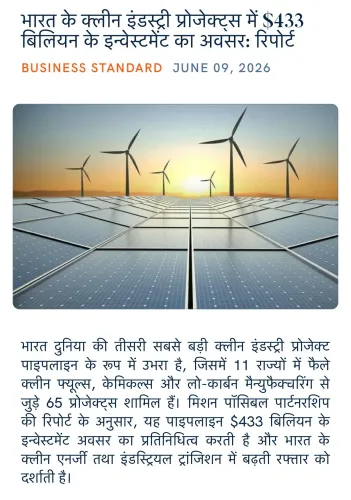
India's clean industrial pipeline now spans 65 projects across four sectors and 11 states, covering clean fuels, chemicals, and low-carbon manufacturing. The pipeline has expanded by approximately 30 per cent over the past six months, driven by rising investments in green hydrogen, renewable energy-based manufacturing, and energy security-focused industrial policies.
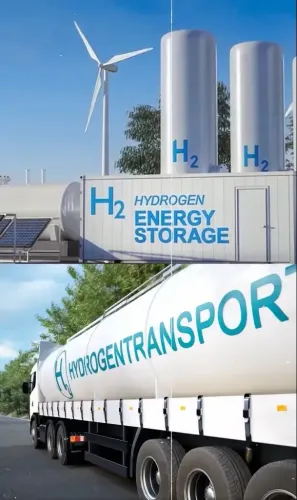
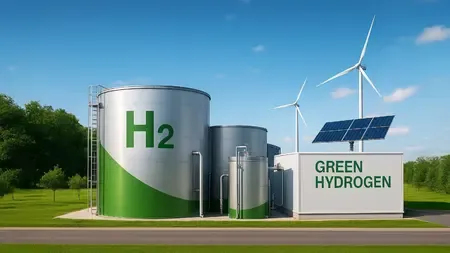
Green ammonia dominates the pipeline with 49 projects, followed by growing activity in sustainable aviation fuel (SAF), green methanol, and low-carbon aluminium — signalling diversification across emerging clean fuel and materials segments.
Key Projects and States
Major projects highlighted in the report include AM Green's Kakinada developments, ACME's green ammonia project in Odisha, Indian Oil's SAF initiatives, NTPC's Pudimadaka proposals, and Vedanta's low-carbon aluminium operations in Odisha and Chhattisgarh.
Key states hosting these projects include Odisha, Andhra Pradesh, Gujarat, Karnataka, Tamil Nadu, Maharashtra, Rajasthan, Madhya Pradesh, Haryana, Himachal Pradesh, and Chhattisgarh.
What Global Experts Said
Faustine Delasalle, CEO of Mission Possible Partnership and Executive Director of the Industrial Transition Accelerator, said clean industry is moving from promise to pace. 'Clean industry is moving from promise to pace, with the number of projects reaching final investment decision more than doubling over the past year,' she said. She added: 'In an increasingly fragmented and unstable environment, fossil fuel dependence has shown time and time again to mean exposure to price shocks, supply disruption and economic crises.'
Yash Kashyap, India Lead at the Industrial Transition Accelerator, noted that India is building one of the world's most significant early-stage clean-industry pipelines, with strong multi-sector momentum. He said the key challenge now is to move from announcements to execution by strengthening policy support, financing mechanisms, and market demand. 'India has the potential to become an important global hub for clean manufacturing, fuels and exports over the coming decade if it can convert its renewable energy advantage into industrial scale,' Kashyap said.
India's Place in the Global Energy Transition
The report positions India as part of a new 'industrial sunbelt' of renewable energy-rich economies, alongside other nations seeking to reduce fossil fuel dependence and build resilient, low-cost manufacturing ecosystems. Clean industrial projects worldwide are reportedly reaching final investment decisions at the fastest pace on record, with China currently leading deployment. This comes amid a broader global shift in industrial supply chains as countries seek to de-risk energy exposure and build sovereign manufacturing capacity.
The Road Ahead
Analysts and industry leaders agree that India's renewable energy advantage is a structural asset, but converting a pipeline of announcements into operational industrial capacity will require coordinated policy support, deeper financing mechanisms, and credible demand signals. Whether India can sustain this momentum and close the gap with China and the US will be closely watched over the next decade.
Point of View
PLI for solar, state-level MoUs — but the gap between pipeline value and commissioned capacity has historically been wide. The 30% growth in six months reflects policy signalling and investor interest, not deployed capital. With green ammonia accounting for 49 of 65 projects, the pipeline is also heavily concentrated in a single segment whose global demand market is still nascent. India's 'industrial sunbelt' framing is strategically sound, but the execution risk Yash Kashyap flags is not a footnote — it is the story.
NationPress
24 Oct 2026
Frequently Asked Questions
What is India's clean industrial project pipeline?
India's clean industrial project pipeline refers to a collection of 65 active or planned clean energy and low-carbon manufacturing projects valued at an estimated $433.07 billion, spread across 11 states and four sectors. The data comes from Mission Possible Partnership's Global Project Tracker, published on 8 June 2025.
Which country ranks above India in clean industrial projects?
China and the United States rank above India, which holds third place globally by number of clean industrial projects in the pipeline. China currently leads in deployment, while India is described as part of an emerging 'industrial sunbelt' of renewable energy-rich economies.
Which sector dominates India's clean industrial pipeline?
Green ammonia dominates India's clean industrial pipeline with 49 of the 65 listed projects. Sustainable aviation fuel, green methanol, and low-carbon aluminium are also growing segments, indicating increasing diversification.
Which Indian states are leading in clean industrial projects?
Key states hosting clean industrial projects include Odisha, Andhra Pradesh, Gujarat, Karnataka, Tamil Nadu, Maharashtra, Rajasthan, Madhya Pradesh, Haryana, Himachal Pradesh, and Chhattisgarh, according to the Mission Possible Partnership report.
What are the key challenges for India's clean industry growth?
According to Yash Kashyap of the Industrial Transition Accelerator, the primary challenge is moving from announcements to execution. This requires stronger policy support, deeper financing mechanisms, and credible market demand to convert India's renewable energy advantage into industrial scale.