Giriraj Singh: India Emerges as Global Green Fuel Supplier
Synopsis
Union Textiles Minister Giriraj Singh has flagged India's emergence as a global green fuel supplier following ammonia and methanol export agreements with Japan, building on the National Green Hydrogen Mission and India's 2070 net-zero commitment.
Key Takeaways
Union Textiles Minister Giriraj Singh shared on July 6, 2026 that India has emerged as a global green fuel supplier via ammonia and methanol export agreements with Japan .
The deals align with India's National Green Hydrogen Mission , approved in January 2023 , which targets domestic production and export of green hydrogen derivatives.
Japan is seeking low-carbon feedstocks to decarbonise its shipping, fertiliser, and heavy industry sectors, making it a key offtake partner for India.
Stakeholders set to benefit include India's renewable energy exporters, the fertiliser industry, and the maritime shipping sector.
India's 2070 net-zero commitment underpins its strategic push to become a major exporter of green fuels on the global stage.
Next steps include scaling production incentives under the Green Hydrogen Mission and potential formalisation at the next India-Japan bilateral summit .
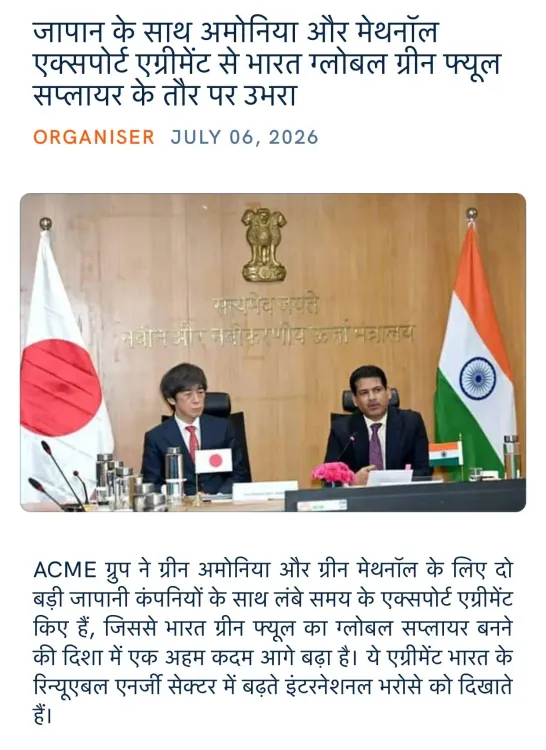
Union Textiles Minister Giriraj Singh on Monday, July 6, 2026, highlighted a landmark development in India's clean energy diplomacy, sharing that India has emerged as a global green fuel supplier following ammonia and methanol export agreements with Japan. The post, shared via the NaMo App, signals India's growing role in the international green hydrogen value chain.
Context
Giriraj Singh shared the development with the caption 'जापान के साथ अमोनिया और मेथनॉल एक्सपोर्ट एग्रीमेंट से भारत ग्लोबल ग्रीन फ्यूल सप्लायर के तौर पर उभरा' — meaning, 'With ammonia and methanol export agreements with Japan, India has emerged as a global green fuel supplier.' The announcement underscores a deepening of the India-Japan bilateral energy relationship, with India positioning itself as a reliable exporter of low-carbon fuels derived from renewable energy sources.
Japan, which has limited domestic renewable energy capacity and a strong industrial demand for low-carbon feedstocks, has been actively seeking long-term supply partnerships for green ammonia and methanol to decarbonise its shipping, fertiliser, and heavy industry sectors.
Policy Backdrop
The agreements align directly with India's National Green Hydrogen Mission, approved in January 2023, which set ambitious targets for the domestic production and export of green hydrogen and its derivatives — including green ammonia and methanol. The mission was designed to leverage India's vast renewable energy potential, particularly solar and wind, to produce hydrogen at competitive costs.
India's broader energy strategy is anchored to its 2070 net-zero commitment made at COP26, with green hydrogen exports identified as a key pillar. Bilateral deals of this nature serve a dual purpose: they provide guaranteed offtake markets for Indian producers while helping partner nations like Japan meet their own decarbonisation targets.
Earlier India-Japan energy dialogues had laid the groundwork for cooperation on hydrogen supply chains, and these export agreements represent a concrete commercial outcome of those diplomatic efforts.
Stakeholders and Impact
The agreements are expected to benefit India's renewable energy exporters, who can now access a premium market for green fuel derivatives. The fertiliser industry, which is a major consumer of ammonia, could also see a shift in production dynamics as green ammonia becomes commercially viable at scale.
For the shipping industry, methanol is increasingly recognised as a viable low-emission marine fuel, and India's ability to supply it at scale positions the country as a strategic partner for Japan's maritime decarbonisation goals. Indian ports and coastal infrastructure may see investment to support export logistics.
Smaller renewable energy developers and green hydrogen start-ups operating under the National Green Hydrogen Mission's production-linked incentive framework stand to gain from the assured demand that such bilateral agreements create.
What's Next
Attention will now turn to the rollout of production incentives under the National Green Hydrogen Mission and whether the India-Japan framework will be formalised further at the next India-Japan bilateral summit. Scaling up green ammonia and methanol output will require significant investment in electrolyser manufacturing, renewable capacity addition, and port infrastructure.
India's ability to honour export commitments at competitive prices will be the key test of whether it can sustain its newly claimed position as a global green fuel supplier — a role that could reshape the country's energy export identity for decades to come.
Point of View
If substantiated at scale, would mark a qualitative shift in India's export identity from a commodities and services economy to a clean-energy supplier. This fits a broader pattern of the government using bilateral energy agreements to simultaneously advance domestic industrial policy — particularly the National Green Hydrogen Mission — and project strategic autonomy in a multipolar energy order. The real test, however, lies in execution: whether production incentives translate into commercially competitive green fuel output before Japan or other partners turn to rival suppliers.
NationPress
5 Oct 2026
Frequently Asked Questions
What is India's green fuel export agreement with Japan about?
India has reached ammonia and methanol export agreements with Japan, positioning itself as a global green fuel supplier by leveraging its renewable energy capacity to produce low-carbon fuels for Japan's industrial and shipping sectors.
What is the National Green Hydrogen Mission?
The National Green Hydrogen Mission is a central government scheme approved in January 2023 that sets targets for producing and exporting green hydrogen and its derivatives, including green ammonia and methanol, using India's renewable energy resources.
Why does Japan need green ammonia and methanol from India?
Japan has limited domestic renewable energy capacity and high industrial demand for low-carbon feedstocks to decarbonise sectors like shipping, fertilisers, and heavy industry, making India — with its large solar and wind potential — a strategic supply partner.
What did Giriraj Singh say about India and Japan green fuel deal?
Union Textiles Minister Giriraj Singh posted on July 6, 2026, that India has emerged as a global green fuel supplier following ammonia and methanol export agreements with Japan, sharing the development via the NaMo App.
How does India's green fuel deal with Japan relate to its climate goals?
The agreements directly support India's 2070 net-zero commitment , with green hydrogen exports identified as a key pillar of the country's long-term clean energy and climate strategy.