India's decade of economic catch-up worth celebrating, says economist Kyunghoon Kim
Synopsis
Economist Kyunghoon Kim says India's post-pandemic growth run — five straight years above 7 per cent and a GDP approaching $4 trillion — is the second-best five-year stretch since 1960. With the IMF, ADB, and World Bank all upgrading forecasts, the question is no longer whether India is growing fast, but whether it can address the structural gaps that growth alone won’t fix.
Key Takeaways
Economist Kyunghoon Kim called India’s decade-long economic progress ‘worth celebrating’ in a post on X on 18 October 2026 .
India recorded more than 7 per cent growth in each of five consecutive years from 2021 to 2025, after a 5.8 per cent contraction during Covid-19.
The 7.83 per cent average annual growth rate for 2021–2025 is the second-highest five-year average since 1960 , just below the 7.89 per cent clocked in 2003–2007.
The IMF , ADB , and World Bank have all recently upgraded India’s growth forecast to above 7 per cent for the current and next year.
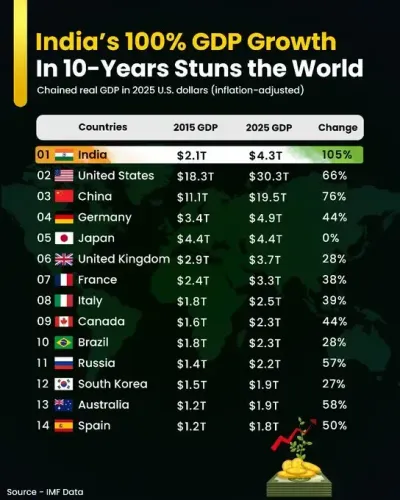
India’s GDP has grown from just over $1 trillion in 2007 to near $4 trillion today, meaning each percentage point of growth represents a vastly larger absolute gain.
Top economist Kyunghoon Kim on Sunday, 18 October 2026, praised India's sustained economic progress over the past decade, calling the country's growth trajectory and medium-term outlook “worth celebrating” for a nation of 1.4 billion people. Kim's remarks, shared on social media platform X, come amid a broader chorus of institutional upgrades to India's growth forecasts.
What Kim Said
“My conclusion remains the same: India faces many challenges, but its economic catch-up, especially over the past decade, and positive medium-term growth outlook are worth celebrating. For a country of 1.4 billion people, this progress matters enormously,” Kim wrote in his post.
The economist acknowledged that India continues to grapple with significant structural challenges, but argued that these should not overshadow the scale of the country's economic transformation in recent years.
Global Institutions Back India's Growth Story
Kim's endorsement follows his earlier observation that nearly all major multilateral lenders — including the International Monetary Fund (IMF), the Asian Development Bank (ADB), and the World Bank — have recently revised their growth forecasts for India upward to above 7 per cent for both the current year and the next. According to Kim, the consistency of these upgrades reflects a broad-based confidence in India's macroeconomic fundamentals.
Post-Pandemic Rebound and Five Consecutive Years Above 7%
India's economy contracted by 5.8 per cent during the Covid-19 pandemic before rebounding sharply by 9.7 per cent in 2021. The country then sustained growth of more than 7 per cent in each of the following four years — a stretch Kim noted matches the strong run recorded between 2003 and 2007, when India first emerged as one of the world's fastest-growing major economies.
Kim highlighted that the simple average annual growth rate of 7.83 per cent during 2021–2025 is the second-highest five-year average since 1960, marginally below the 7.89 per cent recorded during the 2003–2007 cycle. Notably, many economists — including Kim himself — repeatedly revised their forecasts upward as quarterly GDP data consistently outperformed expectations.
India's Economy at a Different Scale Today
Kim also drew attention to the changing magnitude of India's economic output. The country's GDP, which stood at just over $1 trillion in 2007, is now approaching the $4 trillion mark. As Kim pointed out, the same percentage growth rate today translates into a far larger absolute expansion in output than it did two decades ago — underscoring the compounding significance of sustained high growth at this scale.
What This Means Going Forward
With India positioned as the world's fifth-largest economy and multiple global institutions projecting continued above-7-per-cent growth, the trajectory reinforces the country's standing as a key engine of global economic expansion. Whether India can sustain this momentum — while addressing unresolved structural challenges in employment, manufacturing depth, and income inequality — will define the next chapter of its economic story.
Point of View
But it risks being read as a blanket endorsement. Five consecutive years above 7 per cent is genuinely rare in modern economic history, and the near-$4 trillion GDP milestone does change the arithmetic of compounding. Yet the same stretch has seen manufacturing’s share of GDP stagnate, job quality remain uneven, and income inequality widen in certain measures. The IMF-ADB-World Bank consensus on above-7-per-cent growth is encouraging, but institutional forecasters have a documented tendency to upgrade India after the fact rather than ahead of it. The harder question — which Kim himself acknowledges — is whether the challenges he brackets as secondary will eventually constrain the very trajectory he is praising.
NationPress
18 Oct 2026
Frequently Asked Questions
What did economist Kyunghoon Kim say about India's economy?
Kim said India’s economic catch-up over the past decade and its positive medium-term growth outlook are ‘worth celebrating’ for a country of 1.4 billion people. He made these remarks in a post on X on 18 October 2026, while also acknowledging that India continues to face several structural challenges.
How fast has India's economy grown in recent years?
India sustained growth of more than 7 per cent in each of the five years from 2021 to 2025, following a sharp rebound of 9.7 per cent in 2021 after a 5.8 per cent pandemic-era contraction. The 7.83 per cent average annual growth rate for this period is the second-highest five-year average since 1960.
Which global institutions have upgraded India's growth forecast?
The IMF, the ADB, and the World Bank have all recently revised their growth forecasts for India upward to above 7 per cent for the current year and the next. Kim cited this broad-based institutional consensus as further validation of India’s growth story.
How big is India's economy today compared to 2007?
India’s GDP has grown from just over $1 trillion in 2007 to nearly $4 trillion today. Kim noted that this larger base means the same percentage growth rate now translates into a much bigger absolute expansion in output than it did two decades ago.
How does India's current growth run compare to its earlier high-growth period?
India’s 2021–2025 growth average of 7.83 per cent per year closely mirrors the 7.89 per cent recorded during 2003–2007, when India first gained recognition as one of the world’s fastest-growing major economies. The current run is the second-best five-year stretch on record since 1960.