Khavda Solar Park: India's 30 GW desert project eyes world's largest tag by 2029
Synopsis
India is building the world's largest solar park in the salt deserts of Gujarat — and analysts say the model could rewrite how emerging economies power their growth. With 30 GW planned at Khavda and installed solar capacity already past 150 GW, India is on track to be the first major economy to industrialise primarily on sunlight, not coal.
Key Takeaways
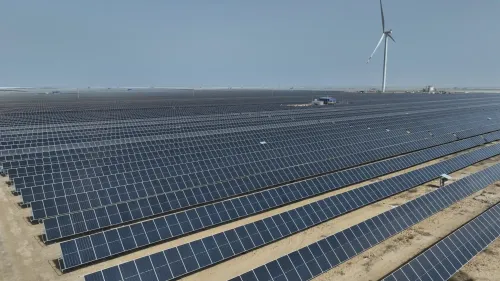
The Khavda Solar Park in Gujarat's Rann of Kutch spans nearly 280 square miles and is set to become the world's largest solar project by 2029 .
Once complete, it will host 60 million solar panels and generate 30 GW of electricity — enough to power a country the size of Austria .
India's installed solar capacity crossed 150 GW in March 2025 , growing at roughly 40 percent annually .
Non-fossil fuel sources exceeded 50 percent of India's installed power capacity for the first time last year.
The IEA projects solar will meet nearly half of India's additional electricity demand through 2030 .
Energy strategist Kingsmill Bond of Ember says India's solar model could serve as a blueprint for other emerging economies.
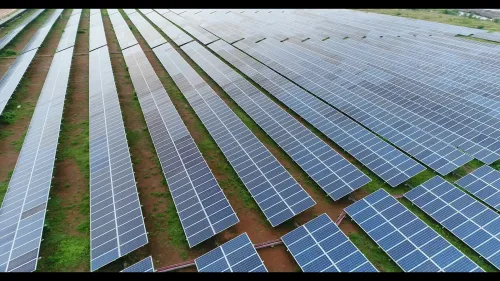
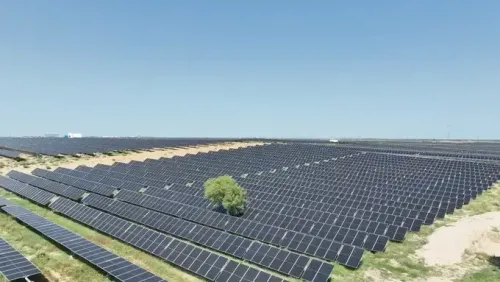
India's Khavda Solar Park in the Rann of Kutch, Gujarat, is on course to become the world's largest solar power project by 2029, according to a report by Yale E360 cited by Grist. Spread across nearly 280 square miles near the India-Pakistan border, the facility is rapidly converting the region's white salt deserts into one of the planet's most ambitious renewable energy hubs.
Scale of the Project
Once fully operational, the Khavda site will host close to 60 million solar panels and generate 30 gigawatts (GW) of electricity — sufficient to power an entire country the size of Austria. The project is the centrepiece of India's accelerating solar drive, which has seen installed solar capacity grow at roughly 40 percent annually, crossing 150 GW in March 2025.
India's Solar Trajectory
By 2030, India is expected to double its current solar capacity as the country works to meet surging electricity demand while reducing dependence on fossil fuels. According to the International Energy Agency (IEA), nearly half of India's additional electricity demand between now and 2030 is projected to be met through solar energy. Another quarter is likely to come from wind, hydroelectric, and nuclear sources.
Energy analysts believe India could become the first major economy to industrialise primarily on solar power rather than coal — a path no large economy has taken before. Kingsmill Bond, energy strategist at UK-based think tank Ember, framed the shift starkly: 'China built on coal; India is building on sun,' he said, adding that India's model could inspire other emerging economies seeking rapid growth without sharply increasing carbon emissions.
A Sharp Reversal From Coal Dependence
India's solar ascent marks a dramatic departure from its position just a decade ago, when the fuel played only a marginal role in the country's energy mix. Shortly after coming to power in 2014, Prime Minister Narendra Modi had pledged to double coal output by 2020. India also resisted international pressure at successive climate summits to phase out coal, arguing that developing nations still needed fossil fuels to lift populations out of poverty.
That calculus has since shifted. Falling solar panel prices and India's naturally high solar irradiance gradually rewired the country's energy strategy. Since the COP26 climate summit in Glasgow, the pace of solar installations has accelerated sharply. Notably, last year non-fossil fuel sources accounted for more than half of India's installed power generation capacity for the first time on record.
A Blueprint for Emerging Economies
The Khavda project and India's broader solar expansion are being closely watched by developing nations that face a similar dilemma: how to power rapid economic growth without locking in decades of carbon-intensive infrastructure. Bond and other analysts argue that India's cost-driven, utility-scale solar model — built on competitive tariffs and large land parcels — offers a replicable template. Whether the grid infrastructure, financing, and policy stability needed to sustain this model can be exported remains an open question, but the numbers so far are difficult to dismiss.
With the Khavda park still under development and India's 2030 capacity targets approaching, the next few years will test whether the country can maintain its installation pace while ensuring reliable supply to a grid still partly dependent on coal.
Point of View
But the framing of it as a clean break from coal deserves scrutiny. Coal still dominates actual electricity generation even as renewables lead on installed capacity — a distinction that matters enormously for emissions accounting. The Khavda project is genuinely historic in scale, but the 'blueprint for emerging economies' narrative glosses over what made it possible: large contiguous land, state-backed land acquisition, and a domestic manufacturing push that most developing nations cannot replicate easily. The more honest question is not whether India's model is inspiring, but whether it is transferable — and on that, the report is silent.
NationPress
14 Oct 2026
Frequently Asked Questions
What is the Khavda Solar Park and where is it located?
The Khavda Solar Park is a large-scale renewable energy project being built in the Rann of Kutch, Gujarat, near the India-Pakistan border. Spanning nearly 280 square miles, it is expected to become the world's largest solar power project by 2029, generating 30 GW of electricity from close to 60 million solar panels.
How much solar capacity has India installed so far?
India's installed solar capacity crossed 150 GW in March 2025, growing at approximately 40 percent annually. The country aims to double that figure by 2030 to meet rising electricity demand while reducing fossil fuel dependence.
Why is India's solar model considered a blueprint for emerging economies?
Energy strategist Kingsmill Bond of Ember argues that India is demonstrating a path to rapid industrialisation using solar rather than coal — unlike China or Western nations. This is significant for developing countries that need economic growth without locking in high-carbon infrastructure.
When did India's shift away from coal begin?
The shift accelerated after the COP26 summit in Glasgow, though falling solar panel prices had been gradually changing India's energy strategy for several years before that. As recently as 2014, Prime Minister Narendra Modi had pledged to double coal output by 2020.
What role will solar play in India's electricity demand through 2030?
According to the International Energy Agency (IEA), nearly half of India's additional electricity demand between now and 2030 is expected to be met through solar energy, with another quarter likely coming from wind, hydroelectric, and nuclear sources.