KOSPI falls 0.8% to 6,749 as oil-driven inflation fears rattle Seoul
Synopsis
South Korea's KOSPI slid 0.8% on 8 October even as the country posted its second-largest current account surplus on record. The split tells the real story: a semiconductor-powered export boom is running headlong into global inflation anxiety and Fed rate-hike fears driven by elevated crude prices — and right now, fear is winning.
Key Takeaways
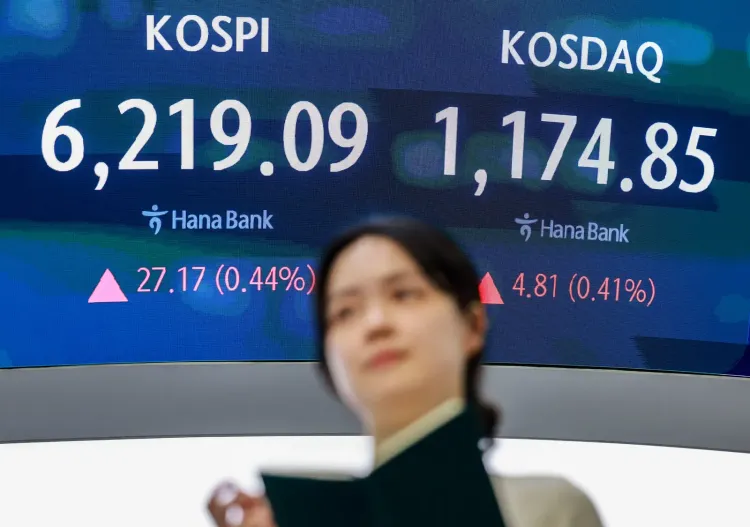
KOSPI fell 54.22 points (0.8%) to 6,749.68 as of 11:20 am on 8 October 2026 .
Elevated oil prices and US Federal Reserve rate-hike fears drove investor caution in Seoul.
Institutions and foreigners sold a combined net 1.12 trillion won ; retail investors absorbed 834.66 billion won .
Hyundai Motor fell 3.05% ; Hanwha Aerospace dropped 5.86% ; Samsung SDI rose 3.74% .
South Korea's August current account surplus hit US$46.1 billion — the second-highest on record — per Bank of Korea data.
The January–August 2026 cumulative surplus reached US$279.2 billion , nearly four times the year-earlier level; annual surplus forecast at US$450 billion .
The Korea Composite Stock Price Index (KOSPI) extended losses on Thursday, 8 October 2026, slipping 54.22 points, or 0.8 percent, to 6,749.68 as of 11:20 am local time, dragged by elevated oil prices that are fanning fresh inflation concerns and casting doubt on the trajectory of US Federal Reserve interest rate policy.
What Triggered the Slide
The benchmark index opened marginally higher — up 0.07 percent — before reversing course almost immediately, tracking an overnight Wall Street pullback. The Dow Jones Industrial Average fell 0.66 percent on Wednesday, while the tech-heavy Nasdaq Composite declined 0.22 percent. Analysts point to rising crude prices as the principal catalyst, with higher energy costs threatening to keep consumer inflation elevated and prompting fears that the Fed may be compelled to raise rates further before year-end.
Institutional and Foreign Selling Weigh on Sentiment
Selling pressure was concentrated among institutions and foreign investors. Institutions offloaded a net 457.28 billion won (approximately US$342 million) worth of shares, while foreigners sold a net 666.37 billion won. Retail investors stepped in on the other side, absorbing a net 834.66 billion won in stocks, though not enough to arrest the decline.
Large-Caps: Mixed Picture
Blue-chip performance was uneven. Market giant Samsung Electronics shed 0.56 percent, while top carmaker Hyundai Motor fell sharply by 3.05 percent. Defence conglomerate Hanwha Aerospace was among the session's biggest losers, dropping 5.86 percent, and shipping firm HMM declined 2.57 percent. On the positive side, chipmaker SK Hynix advanced 1.33 percent and battery manufacturer Samsung SDI climbed 3.74 percent, buoyed by continued optimism around the global semiconductor upcycle.
Won Steady; Current Account Surplus Near Record
The Korean won was trading at 1,337.35 won per US dollar as of 11:20 am, firming slightly by 1.65 won from the previous session's close. Separately, the Bank of Korea (BOK) on Thursday reported that South Korea's current account surplus reached US$46.1 billion in August — the second-highest figure on record — up US$4 billion from July and a dramatic US$36.2 billion jump compared with August 2025. The surplus has remained above the US$40 billion mark for three consecutive months, following US$42 billion in July and a record US$49.73 billion in June. Cumulatively, the January–August 2026 current account surplus totalled US$279.2 billion, nearly quadrupling from the same period a year earlier.
BOK Outlook and What's Next
A BOK official said the August surplus figures were 'in line with the forecast,' adding that the annual current account surplus is on track to reach the projected US$450 billion. The juxtaposition of a record-high current account surplus with a sliding equity market underscores the divergence between South Korea's robust export engine — driven largely by semiconductors — and the investor caution stemming from global inflation and rate-hike anxiety. Markets will closely watch the next US Fed communications and any fresh movement in crude oil prices for directional cues.
Point of View
Which keeps rate-cut hopes on ice. What is striking is the contrast: South Korea is running a near-record current account surplus on the back of a semiconductor upcycle, yet equities are retreating because US macro anxiety drowns out domestic fundamentals. For Indian investors watching Korean markets as a bellwether for Asian tech sentiment, the SK Hynix and Samsung SDI gains amid broader weakness suggest smart money is still backing the chip cycle — but is not willing to hold the broader index against a Fed headwind.
NationPress
8 Oct 2026
Frequently Asked Questions
Why did the KOSPI fall on 8 October 2026?
The KOSPI declined 0.8% to 6,749.68 primarily because elevated oil prices are stoking inflation concerns, raising fears that the US Federal Reserve may need to raise interest rates further. An overnight Wall Street pullback — with the Dow down 0.66% and the Nasdaq down 0.22% — compounded the negative sentiment in Seoul.
Which South Korean stocks fell the most on 8 October?
Hanwha Aerospace was the sharpest decliner, dropping 5.86%, followed by Hyundai Motor at 3.05% and HMM at 2.57%. Samsung Electronics also fell 0.56%, while SK Hynix and Samsung SDI bucked the trend with gains of 1.33% and 3.74% respectively.
What was South Korea's current account surplus in August 2026?
South Korea's current account surplus reached US$46.1 billion in August 2026, the second-highest on record, up US$4 billion from July, according to Bank of Korea data. Compared with August 2025, the figure surged by US$36.2 billion, driven by robust semiconductor exports.
What is South Korea's current account surplus forecast for the full year 2026?
The Bank of Korea projects the annual current account surplus for 2026 to reach US$450 billion. The January–August cumulative surplus already stands at US$279.2 billion, nearly quadrupling from the same period in 2025.
How did institutional and foreign investors react to the Seoul market dip?
Institutions sold a net 457.28 billion won and foreign investors sold a net 666.37 billion won worth of stocks during the session. Retail investors partially absorbed this selling pressure, buying a net 834.66 billion won, but the index still closed sharply lower.