KOSPI surges 1.76% to 5,768 as institutional buying offsets AI spending concerns
Synopsis
Seoul's KOSPI pulled off a dramatic intraday reversal on 19 October, recovering from a 3.17% opening drop to close 1.76% higher — a near-300-point swing. Institutional players bet on bargain large-caps even as the broader market grappled with growing scepticism over whether AI infrastructure spending can justify its enormous cost, ahead of earnings from Tesla and Meta.
Key Takeaways
KOSPI closed up 99.96 points ( 1.76% ) at 5,768.01 on 19 October , reversing a 3.17% opening loss.
Institutions bought a net 574.66 billion won (~ US$432 million ); retail investors sold a net 1.09 trillion won .
Hyundai Motor jumped 4.49% ; Samsung Electronics rose 1.16% ; SK hynix gained 0.39% .
Shipbuilders HD Hyundai Heavy Industries and Hanwha Ocean bucked the trend, falling 1.71% and 1.23% respectively.
The Korean won firmed to 1,330.3 per US dollar; bond yields rose, with the five-year benchmark at 4.014% .
Markets remain cautious ahead of Tesla and Meta earnings and the 3 November US midterm elections .
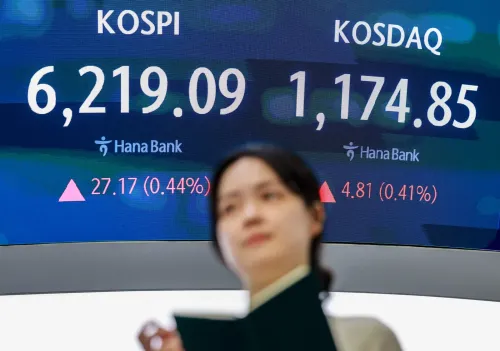
South Korea's benchmark Korea Composite Stock Price Index (KOSPI) closed up 99.96 points, or 1.76 percent, at 5,768.01 on Monday, 19 October, recovering sharply from an intraday low of 5,488.41 after opening 3.17 percent lower. The turnaround was driven by institutional buying, even as investors remained cautious about whether massive spending on artificial intelligence (AI) infrastructure would deliver adequate returns.
Institutional Buying Drives Recovery
Institutions purchased a net 574.66 billion won (approximately US$432 million) worth of shares during the session. In contrast, foreign investors offloaded a net 37.87 billion won, while retail investors sold a net 1.09 trillion won, according to market data. The divergence underscores a deliberate bargain-hunting strategy by institutional players following weeks of sharp declines.
Brokerage firm IBK Securities noted: 'Some investors appear to have bought large-cap stocks in search of bargains following sharp declines in recent weeks, helping the index move into positive territory despite reservations centred on massive spending on AI infrastructure.'
Tech and Auto Stocks Lead Gains
Technology names were among the session's key contributors. Market bellwether Samsung Electronics rose 1.16 percent to 218,000 won, while chipmaking rival SK hynix gained 0.39 percent to 1.28 million won. Automaker Hyundai Motor was a standout performer, jumping 4.49 percent to 326,000 won, and defence group Hanwha Aerospace advanced 1.91 percent to 905,000 won.
The shipbuilding sector bucked the positive trend. HD Hyundai Heavy Industries slipped 1.71 percent to 345,500 won, and Hanwha Ocean declined 1.23 percent to 64,200 won.
Currency and Bond Market Moves
The Korean won strengthened slightly, quoted at 1,330.3 won per US dollar as of 3:30 pm local time, up from 1,331.4 won at the close of the previous session. Bond prices edged lower as yields climbed — the yield on three-year South Korean Treasurys rose 2.3 basis points to 3.877 percent, while the five-year benchmark government bond yield climbed 2.6 basis points to 4.014 percent.
Overhangs: Earnings Season and US Elections
Despite the recovery, analysts flagged multiple near-term uncertainties. Key earnings reports from Tesla and Meta Platforms are due later this week, and investors are also eyeing the 3 November US midterm elections. Persistent uncertainty over the trajectory of US interest rates continues to weigh on global risk sentiment, analysts said. This combination of AI-spending scepticism and macro uncertainty means any sustained rally faces meaningful headwinds.
Point of View
And it will be sharpened, not softened, by this week's earnings from Tesla and Meta. South Korean tech is disproportionately exposed to that debate: Samsung and SK hynix are deep in the AI memory supply chain, meaning any demand signal from US hyperscalers lands directly on Seoul's index. The won's marginal strengthening and rising bond yields suggest that, for now, this is a cautious bounce, not a trend reversal.
NationPress
19 Oct 2026
Frequently Asked Questions
Why did the KOSPI rise on 19 October despite opening sharply lower?
The KOSPI recovered from a 3.17% opening drop to close up 1.76% at 5,768.01, driven by institutional buying of a net 574.66 billion won worth of large-cap stocks that had fallen sharply in recent weeks. IBK Securities attributed the turnaround to bargain-hunting, even as concerns over AI infrastructure spending returns persisted.
Which stocks performed best on the KOSPI on 19 October?
Hyundai Motor was the top large-cap gainer, jumping 4.49% to 326,000 won. Samsung Electronics rose 1.16% and SK hynix climbed 0.39%, while Hanwha Aerospace advanced 1.91%. Shipbuilders HD Hyundai Heavy Industries and Hanwha Ocean were among the session's notable losers.
What are the key risks still facing South Korean markets?
Analysts cited three main overhangs: uncertainty over AI infrastructure spending returns, upcoming earnings from Tesla and Meta Platforms due this week, and the 3 November US midterm elections. Continued ambiguity over US interest rate direction also remains a dampener on global risk appetite.
How did the Korean won and bond yields move on 19 October?
The Korean won firmed slightly to 1,330.3 per US dollar at 3:30 pm from 1,331.4 at the previous close. Bond yields edged up, with the three-year Treasury yield rising 2.3 basis points to 3.877% and the five-year benchmark climbing 2.6 basis points to 4.014%.
What is the significance of AI spending concerns for South Korean tech stocks?
South Korea's leading chipmakers — Samsung Electronics and SK hynix — are core suppliers to global AI infrastructure buildouts. Growing investor scepticism about whether hyperscaler AI spending will generate sufficient returns creates direct earnings risk for these firms, which carry outsized weight in the KOSPI index.