Minister Highlights Importance of Strong Clinical Foundations Before Embracing AI in Healthcare

Synopsis
Union Minister Dr. Jitendra Singh has released the updated 'Pediatric Gastroenterology, Hepatology and Nutrition' textbook, emphasizing the critical role of a solid clinical foundation in medical education before integrating AI technologies.
Key Takeaways
Strong Clinical Foundation: Essential before embracing AI in medical education.
AI's Role: Should serve as an enabler, not a replacement.
Updated Content: The second edition covers recent advancements and expands key areas.
Continuous Education: Ongoing upgrades to medical education systems are vital.
Target Audience: The textbook is designed for pediatric trainees and specialists.
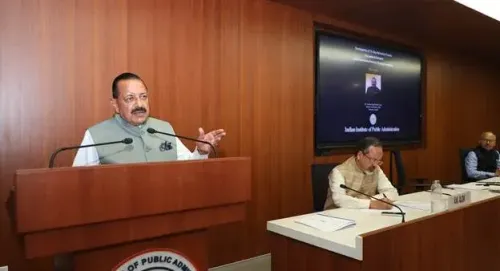
New Delhi, April 14 (NationPress) Union Minister Dr. Jitendra Singh unveiled the second edition of the postgraduate textbook titled 'Pediatric Gastroenterology, Hepatology and Nutrition' on Tuesday. He emphasized that once a robust clinical foundation is established, artificial intelligence (AI) can become a significant enabler, assistant, and facilitator in healthcare.
The minister highlighted the importance of a solid clinical foundation in medical education, despite the increasing influence of AI. He stated that technology should complement core medical education rather than replace it.
Dr. Singh advised caution against early dependence on AI without a thorough understanding of fundamental medical principles, warning that it could undermine the learning experience and hinder the development of skilled clinicians.
He pointed out the rapid growth of medical knowledge and the significant rise in research and publications, making it essential for medical education to prioritize conceptual clarity and hands-on clinical training.
While acknowledging that technology has enhanced information access, he reiterated that medical education must remain grounded in foundational principles and practical experiences.
The minister urged for ongoing upgrades to medical education systems to address emerging challenges, including technological integration and the growing complexity of diseases.
He stressed that aspiring medical professionals should first establish strong foundational knowledge before delving into specialized areas.
Additionally, the second edition of the textbook has been updated to include recent advancements and now consists of 45 chapters, focusing on crucial topics such as inflammatory bowel disease, neuro-gastroenterology, celiac disease, and cow’s milk protein allergy.
New areas of interest have also been added, including the role of genetics in gastrointestinal and liver diseases, along with endoscopy and liver transplantation.
This textbook serves as a vital resource for trainees in pediatrics, specialists in pediatric gastroenterology, and practicing pediatricians.
Point of View
It's clear that the intersection of technology and healthcare demands careful consideration. Dr. Jitendra Singh's remarks underscore the need to prioritize foundational medical knowledge amidst the rise of AI. A balanced approach can ensure that future clinicians are not only technologically savvy but also well-grounded in essential medical principles.
NationPress
26 Sept 2026
Frequently Asked Questions
What is the significance of the second edition of the textbook?
The second edition of the textbook includes recent advancements and expands to 45 chapters, covering essential topics in pediatric gastroenterology, hepatology, and nutrition.
How does AI play a role in healthcare according to the minister?
The minister views AI as a valuable enabler in healthcare, but emphasizes the necessity of a strong clinical foundation before its integration.
What areas does the updated textbook cover?
The textbook covers key areas such as inflammatory bowel disease, neuro-gastroenterology, celiac disease, cow's milk protein allergy, and genetics in gastrointestinal diseases.
What is the minister's stance on AI in medical education?
Dr. Singh advocates for technology to complement medical education rather than replace traditional core learning, stressing the importance of understanding fundamental medical principles.
Who is the target audience for this textbook?
The textbook is aimed at trainees in pediatrics, specialists in pediatric gastroenterology, and practicing pediatricians.