NCDEX launches RAINMUMBAI, India's first weather derivatives contract, on 29 May

Synopsis
India has never had an exchange-traded, regulator-approved way to price monsoon risk — until now. NCDEX's RAINMUMBAI, launching 29 May, lets farmers, banks, utilities and construction firms hedge against Mumbai rainfall deviations using a scientifically structured CDR model backed by 30 years of IMD data. It is a quiet but consequential step toward treating climate as a financial variable.
Key Takeaways
NCDEX will launch RAINMUMBAI on 29 May 2025 — India's first SEBI -approved, exchange-traded weather derivatives contract.
The contract tracks deviations from Mumbai's monsoon Long-Period Average (LPA) across June–September using a Cumulative Deviation Rainfall (CDR) model.
Data sources include IMD surface rainfall and AWS readings from Santacruz and Colaba , benchmarked against a 30-year (1991–2020) dataset.
The instrument is cash-settled , enabling transparent, data-driven payouts without physical loss assessment.
Target users include farmers , banks , construction firms , power utilities , and logistics operators .
Developed in collaboration with IIT Bombay and anchored in IMD data; a market maker will provide liquidity support.
NCDEX has launched RAINMUMBAI, India's first SEBI-approved, exchange-traded weather derivatives contract, set to go live on 29 May 2025. Developed in collaboration with IIT Bombay and anchored in India Meteorological Department (IMD) data, the product allows participants to hedge financial exposure arising from monsoon rainfall variability in a fully regulated framework.
What RAINMUMBAI Is and How It Works
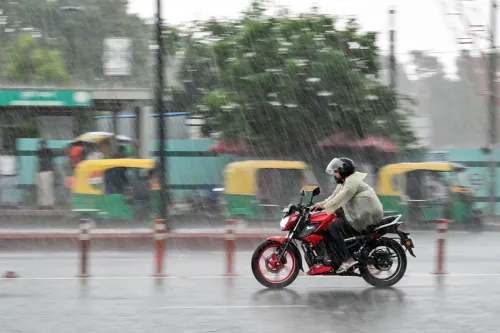
A weather derivative is a financial instrument whose payout is linked to a measurable weather variable — in this case, cumulative rainfall at a specific location over a defined period. RAINMUMBAI tracks deviations in Mumbai's rainfall from its Long-Period Average (LPA) across the monsoon season, spanning June to September.
The contract is built on a scientifically structured Cumulative Deviation Rainfall (CDR) model. It draws on IMD surface rainfall data and Automatic Weather Station (AWS) observations from Santacruz and Colaba, benchmarked against a 30-year historical dataset (1991–2020 LPA). Rainfall is recorded on a standard 24-hour cycle from 8:30 am to 8:30 am in line with IMD norms.
The instrument is cash-settled, meaning payouts are determined by data rather than physical loss assessments — enabling faster and more transparent risk resolution.
Who It Is Designed For
According to NCDEX, the contract targets a broad range of stakeholders: farmers, construction companies, power utilities, logistics operators, and banks with agricultural loan exposure. The product is positioned as a complement to — and extension of — traditional risk tools such as crop insurance and government relief programmes, offering a market-based mechanism to price and transfer monsoon risk.
Liquidity support will be provided through a designated market maker to facilitate smoother participation in the contract.
What the Exchange and IMD Said
Arun Raste, Managing Director and CEO of NCDEX, said: 'India has lived with monsoon uncertainty for centuries. RAINMUMBAI provides every stakeholder with a regulated, scientific tool to manage this uncertainty.'
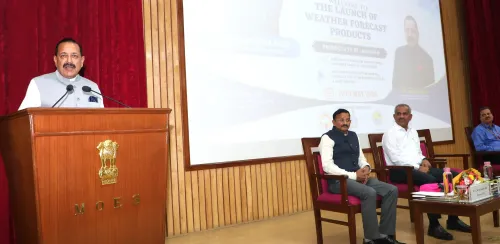
Bikram Singh, Head of the Regional Meteorological Centre (RMC), IMD Mumbai, said reliable and standardised weather data is essential for such financial instruments, noting that IMD's long-term datasets and observational systems enable transparent rainfall indices and represent 'science meeting finance in a regulated marketplace.'
Broader Significance for India's Climate-Risk Ecosystem
This launch is widely seen as a foundational step toward a broader climate-risk management ecosystem in India and the emergence of a new asset class linked to weather-related financial exposure. Notably, weather derivatives are well-established in developed markets — the Chicago Mercantile Exchange (CME) has offered temperature-based derivatives since the late 1990s — but India has not had an exchange-traded, regulator-approved equivalent until now.
The contract converts monsoon variability from an unpredictable challenge into a measurable, tradable financial risk — a structural shift in how India's agriculture-linked economy could manage its oldest and most persistent source of uncertainty. With the monsoon season weeks away, the timing of the 29 May launch is deliberate, and market participants will be watching early trading volumes closely.
Point of View
Slow, and often underfunded instruments. RAINMUMBAI is a structurally different proposition: it prices risk in real time, in a regulated marketplace, using verifiable data. The harder question is adoption. Weather derivatives in developed markets took years to build liquidity even with sophisticated institutional participants. India's target users — farmers and small logistics operators — will need significant financial literacy infrastructure before this becomes more than an institutional hedging tool. The IIT Bombay-IMD collaboration gives the product scientific credibility, but the real test is whether NCDEX can build a deep enough order book to make the hedge economically meaningful.
NationPress
6 Oct 2026
Frequently Asked Questions
What is the NCDEX RAINMUMBAI weather derivatives contract?
RAINMUMBAI is India's first SEBI-approved, exchange-traded weather derivatives contract, launched by NCDEX and set to go live on 29 May 2025. It allows participants to hedge financial exposure linked to deviations in Mumbai's monsoon rainfall from its historical Long-Period Average, using a cash-settled Cumulative Deviation Rainfall (CDR) model.
How does the RAINMUMBAI contract calculate payouts?
Payouts are based on the CDR model, which measures cumulative deviations in Mumbai's actual rainfall from its 30-year LPA (1991–2020) during the June–September monsoon season. Data is sourced from IMD surface readings and AWS observations at Santacruz and Colaba, recorded on a 24-hour cycle from 8:30 am to 8:30 am. The contract is cash-settled, so no physical loss assessment is required.
Who can use the RAINMUMBAI weather derivative?
NCDEX has designed the contract for a wide range of participants, including farmers, construction companies, power utilities, logistics operators, and banks with agricultural loan exposure. It is intended to complement existing tools like crop insurance and government relief by offering a market-based, regulated mechanism to transfer monsoon risk.
Why is this launch significant for India?
India has not previously had an exchange-traded, regulator-approved instrument to price and transfer weather risk. The launch marks the emergence of a new asset class linked to climate-related financial exposure, and represents a structural shift toward market-based climate-risk management — a space where developed markets like the US have operated since the late 1990s.
What role does the IMD play in the contract?
The IMD provides the underlying data that drives the contract's settlement. Rainfall is measured using IMD-standard rain gauges and AWS observations, recorded on a 24-hour cycle per IMD norms. The 30-year historical dataset (1991–2020 LPA) that benchmarks the CDR model is also drawn from IMD records. Bikram Singh, Head of IMD's Regional Meteorological Centre in Mumbai, has publicly endorsed the data framework underpinning the product.