Odisha rare earths and marine biotech drive India's science-led growth agenda

Synopsis
India's eastern coastline is being repositioned as a multi-domain science hub. A single high-level meeting between the Centre and Odisha has produced a roadmap spanning rare earths, marine biotech, life sciences, and space manufacturing — with 50 acres of new land already committed for a key research institute and a multi-university corridor already operational.
Key Takeaways
Dr Jitendra Singh and Odisha Minister Krushna Chandra Patra finalised an integrated science roadmap on 11 August in New Delhi .
The Institute of Life Sciences, Bhubaneswar will be expanded with an additional 50 acres of land provided by the Odisha State Government .
The OMBRIC platform already links IIT Bhubaneswar , NIT Rourkela , IISER Berhampur , Berhampur University , Fakir Mohan University , and ILS Bhubaneswar .
Odisha's Rare Earth resources are to be integrated into the Centre's proposed Rare Earth Corridor under a coordinated Central-state framework.
A Space Research and Manufacturing Centre in PPP mode with ISRO is under active exploration.
The overarching goal is to shift from isolated institutional efforts to a connected ecosystem covering ocean resources, critical minerals, life sciences, and space technology.
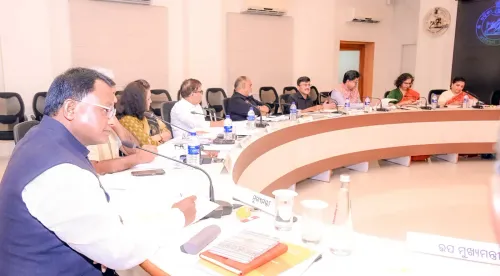
Union Minister of State for Science and Technology Dr Jitendra Singh on Tuesday, 11 August unveiled an integrated science and development roadmap for Odisha, linking the Centre's proposed Rare Earth Corridor with the state's marine and coastal resources, biotechnology ecosystem, space capabilities, and network of scientific institutions. The roadmap emerged from high-level discussions held in New Delhi between Dr Singh and Odisha Cabinet Minister for Science and Technology Krushna Chandra Patra.
Key Developments from the Meeting
A major outcome of the discussions was the finalisation of plans to expand the Institute of Life Sciences (ILS), Bhubaneswar, which falls under the Department of Biotechnology. The Odisha State Government has agreed to provide an additional 50 acres of land for the expansion, according to an official statement. The enhanced institutional footprint is expected to bolster research in life sciences and biotechnology, and support initiatives linked to the Bio-E3 framework — Biotechnology for Economy, Environment and Employment.
Marine Biotechnology and the OMBRIC Platform
Discussions placed significant emphasis on the Odisha Marine Biotechnology Research and Innovation Corridor (OMBRIC), being developed as a collaborative research platform. OMBRIC has already established institutional partnerships with IIT Bhubaneswar, Berhampur University, Fakir Mohan University, NIT Rourkela, IISER Berhampur, and the Institute of Life Sciences (ILS), Bhubaneswar. The proposed convergence between marine biotechnology and earth sciences is intended to deepen scientific understanding and enable sustainable utilisation of Odisha's extensive coastal resources.
Rare Earths, Nuclear Roadmap and Eastern Coastal Region
Dr Singh said the Eastern Coastal Region can play a significantly larger role in India's emerging nuclear and marine development roadmap, with Odisha well positioned to contribute through coordinated efforts between Central scientific institutions and the state government. The approach seeks to move beyond isolated institutional initiatives towards a connected ecosystem spanning ocean resources, critical minerals, life sciences, space technology, and technology-led economic development. Odisha's coastal districts are also being considered for participation in national marine-environment initiatives, according to the ministry.
Space Manufacturing and ISRO Integration
The meeting also explored integrating Odisha's existing space capabilities with ISRO, including the possibility of establishing a Space Research and Manufacturing Centre in public-private partnership (PPP) mode. Such a centre, if realised, would bring together government institutions, national space agencies, research organisations, and private industry under one collaborative framework, the ministry said.
What Comes Next
The roadmap signals a deliberate shift from ad hoc institutional efforts to a coordinated, multi-domain science ecosystem in Odisha. With the ILS expansion land already committed and OMBRIC partnerships in place, the next steps will likely involve formalising funding structures under the Bio-E3 and Rare Earth Corridor frameworks. How quickly the Centre and state translate these discussions into operational timelines will determine whether Odisha emerges as a genuine hub for science-led economic development on India's eastern coast.
Point of View
Marine biotech, life sciences, space — that have historically operated in silos. The 50-acre ILS expansion and OMBRIC's multi-university partnerships suggest real institutional momentum, not just ministerial intent. Yet the critical gap remains funding timelines and accountability structures: neither the Rare Earth Corridor nor the OMBRIC platform has a publicly committed outlay attached. India has a pattern of science corridors announced with fanfare that stall at the land-and-MoU stage. The eastern coast's strategic value — in critical minerals and blue economy — is real, but converting a roadmap meeting into measurable research output will require the kind of inter-ministerial coordination that has proved elusive in past science-economy linkage programmes.
NationPress
26 Sept 2026
Frequently Asked Questions
What is the Rare Earth Corridor proposed for Odisha?
The Rare Earth Corridor is a Central government proposal to systematically develop and utilise India's rare earth mineral resources, with Odisha identified as a key contributor given its coastal and mineral wealth. The corridor aims to integrate Odisha's rare earth exploration into a coordinated national framework involving Central scientific institutions and the state government.
What is OMBRIC and which institutions are part of it?
OMBRIC stands for the Odisha Marine Biotechnology Research and Innovation Corridor, a collaborative research platform being developed to harness the state's coastal and marine resources. It has established partnerships with IIT Bhubaneswar, Berhampur University, Fakir Mohan University, NIT Rourkela, IISER Berhampur, and the Institute of Life Sciences, Bhubaneswar.
Why is the Institute of Life Sciences, Bhubaneswar being expanded?
The Institute of Life Sciences is being expanded to strengthen Odisha's research capacity in life sciences and biotechnology, and to support initiatives under the Bio-E3 framework — Biotechnology for Economy, Environment and Employment. The Odisha State Government has committed an additional 50 acres of land for the expansion.
What is the Bio-E3 framework mentioned in the discussions?
Bio-E3 stands for Biotechnology for Economy, Environment and Employment, a framework under India's Department of Biotechnology that seeks to link biotech research directly to economic output, environmental sustainability, and job creation. The expanded ILS campus is intended to serve as a base for Bio-E3-linked initiatives in Odisha.
What is the proposed Space Research and Manufacturing Centre for Odisha?
The proposed centre would be developed in public-private partnership mode in collaboration with ISRO, bringing together government institutions, space agencies, research organisations, and industry. It is intended to integrate Odisha's existing space capabilities into the national space ecosystem, though formal timelines have not yet been announced.