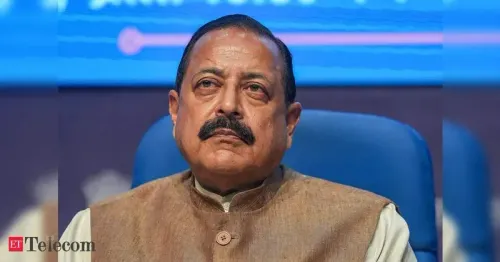
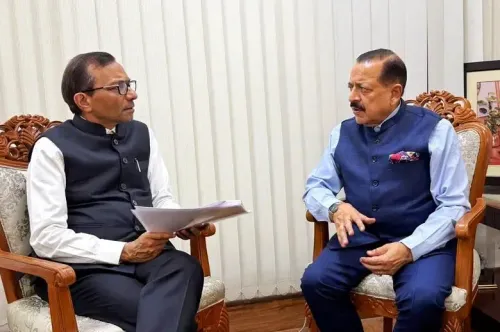
India's space sector privatisation curbs brain drain: Dr Jitendra Singh
Synopsis
Union Minister Dr Jitendra Singh told students in Varanasi that privatising India's space sector has kept skilled talent at home — with startups like Skyroot absorbing what might otherwise have emigrated. With GERD reportedly surging from ₹47,000 crore to ₹2.5 lakh crore and targets of 100 GW nuclear capacity by 2047, the government is betting that an open, multi-sector science policy is the answer to India's long-standing brain drain problem.
Key Takeaways
Dr Jitendra Singh said on 8 October 2026 that space-sector privatisation has reduced brain drain by creating domestic opportunities for young talent.
Private startup Skyroot was cited as an example of companies absorbing skilled scientific talent.
Indian satellites are providing disaster-preparedness data to Nepal , Bangladesh , Myanmar , and Sri Lanka .
GERD has reportedly risen from approximately ₹46,000–47,000 crore in 2013–14 to around ₹2–2.5 lakh crore .
India targets 100 GW of nuclear energy capacity by 2047 , with the nuclear sector also opened to private players.
The Deep Ocean Mission and Anusandhan National Research Foundation were highlighted as key emerging-science initiatives.
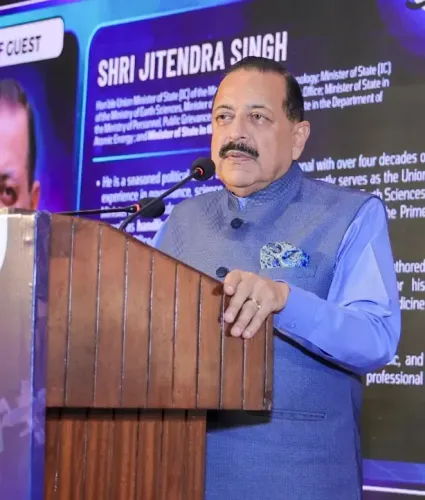
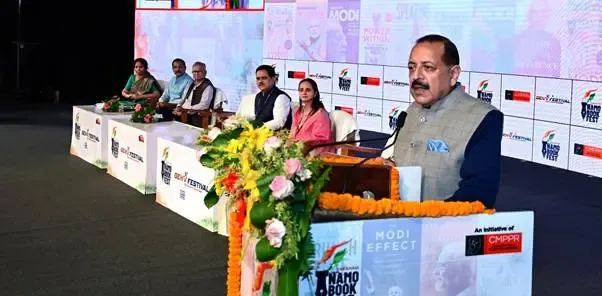
Union Minister of State for Science & Technology and Earth Sciences Dr Jitendra Singh on Thursday, 8 October 2026, said that opening India's space sector to private players has created fresh opportunities for young scientific and technical talent domestically, significantly reducing the impulse to seek employment abroad. The minister made the remarks while addressing students at the NaMo Book Fest in Varanasi.
Private Players and the New Space Ecosystem
According to the minister, the liberalisation of India's space sector has enabled private startups — including Skyroot — to absorb skilled talent and broaden the domestic space ecosystem. The transformation, he said, has shifted space from a predominantly government-led domain into a wider arena where young professionals and private enterprises can actively participate.
'The age of silos is over,' Dr Singh told students, stressing that government institutions, private industry, startups, academia, and research organisations must collaborate to build capabilities that can compete on a global scale.
Space Technology Beyond Rockets
Dr Singh emphasised that India's space story is no longer confined to rockets and launch missions. Indian satellites are now supplying critical data to neighbouring countries — including Nepal, Bangladesh, Myanmar, and Sri Lanka — to help them prepare for floods and other natural disasters. Space technology is also increasingly being deployed for infrastructure planning, project monitoring, and disaster management within India, according to a statement from the Department of Space.
An 'Era of Science': Policy Priority and Research Investment
The minister described the last 12–13 years as an 'era of science' in India, with technology receiving high policy priority and being used progressively to improve lives. He noted that while India has possessed scientific talent and human resources for decades, the enabling policy environment required to convert that potential into national capability has strengthened considerably in recent years.
Reflecting this shift, Gross Expenditure on Research and Development (GERD) has reportedly risen from approximately ₹46,000–47,000 crore in 2013–14 to around ₹2–2.5 lakh crore, according to the minister's remarks.
Deep Ocean Mission, Nuclear Sector and Emerging Frontiers
Dr Singh cited the Deep Ocean Mission and the Anusandhan National Research Foundation as key initiatives building capabilities in emerging scientific fields. Through the Deep Ocean Mission, India is exploring the scientific and economic potential of its ocean resources, which have remained largely unexplored, he said.
The minister also referred to the opening of the nuclear sector to private participation, noting India's target of 100 GW of nuclear energy capacity by 2047. Nuclear power, he argued, is emerging as an important clean-energy source for future requirements, including artificial intelligence infrastructure and data centres.
What This Signals for India's Science Agenda
The minister's address underscores a broader policy push to convert India's scientific talent base into a globally competitive industrial and research capability. With multiple frontier sectors — space, deep ocean, nuclear, and research funding — being opened up or scaled simultaneously, the government is signalling that science and technology are central to its vision for India's economy through 2047.
Point of View
Not merely absorb graduates. The GERD figures cited by the minister are striking, but independent verification of that near-fivefold rise is warranted before it is treated as a settled benchmark. Meanwhile, extending the same 'open ecosystem' logic simultaneously to space, nuclear, and deep ocean is ambitious; execution bandwidth across all three frontiers — each with distinct regulatory, safety, and investment challenges — is the test the government has not yet fully addressed.
NationPress
8 Oct 2026
Frequently Asked Questions
What did Dr Jitendra Singh say about India's space sector and brain drain?
Dr Jitendra Singh said that opening India's space sector to private players has created domestic opportunities for young scientific and technical talent, reducing the need to seek employment abroad. He made these remarks on 8 October 2026 at the NaMo Book Fest in Varanasi.
Which private space companies did the minister mention?
The minister specifically cited Skyroot as an example of a private startup that has been able to absorb skilled talent and broaden India's domestic space ecosystem following the sector's liberalisation.
How is India using space technology for disaster management?
Indian satellites are providing data on floods and other natural disasters to neighbouring countries including Nepal, Bangladesh, Myanmar, and Sri Lanka, helping them with preparedness. Space technology is also used domestically for infrastructure planning and project monitoring.
What is India's nuclear energy target by 2047?
India is targeting 100 GW of nuclear energy capacity by 2047. The minister noted the nuclear sector has also been opened to private participation, with nuclear power seen as a clean-energy source for future AI infrastructure and data centres.
How has India's research expenditure changed in recent years?
According to Dr Jitendra Singh, India's Gross Expenditure on Research and Development (GERD) has reportedly risen from around ₹46,000–47,000 crore in 2013–14 to approximately ₹2–2.5 lakh crore, reflecting increased policy priority for science and technology.