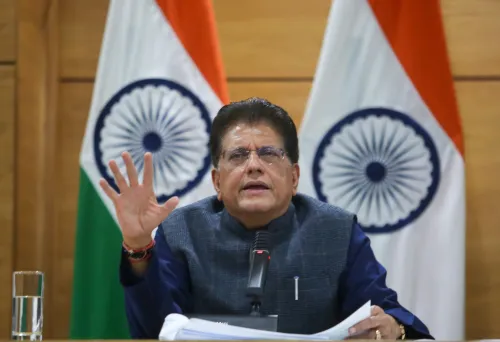
Piyush Goyal hits out at Opposition for distorting India's 7.8% GDP growth
Synopsis
Commerce Minister Piyush Goyal publicly challenged the Opposition's reading of India's GDP data at the ACMA annual session, calling their 7.8% growth critique a methodological misreading. MOSPI backed him up with a formal FAQ, clarifying that the shift from a 2011-12 to a 2022-23 base year — not political manipulation — explains the revised Q1 figure that critics claim was engineered to flatter growth.
Key Takeaways
Commerce Minister Piyush Goyal accused the Opposition of misleading citizens on India's economic growth at the ACMA 66th Annual Session on 2 September .
Goyal cited India's 7.8% GDP growth rate, calling the country 'one oasis in the desert' amid global turbulence.
The Opposition alleged the government revised Q1 2025-26 GDP down from ₹86 lakh crore to ₹80 lakh crore to inflate current growth; without it, growth would be just 2.6% in current prices, critics claimed.
MOSPI formally refuted the claim, stating the two figures belong to different GDP series — old series ( 2011-12 base ) versus new series ( 2022-23 base ) — and are not directly comparable.
MOSPI clarified the revision reflects standard methodological updates , not a deliberate manipulation of data.
Commerce and Industry Minister Piyush Goyal on Wednesday, 2 September accused the Opposition of deliberately misleading Indian citizens by downplaying the country's economic performance, even as India maintains its position as the world's fastest-growing major economy. His remarks came at the 66th Annual Session of the Automotive Component Manufacturers Association of India (ACMA) in New Delhi.
Goyal's Remarks at ACMA Session
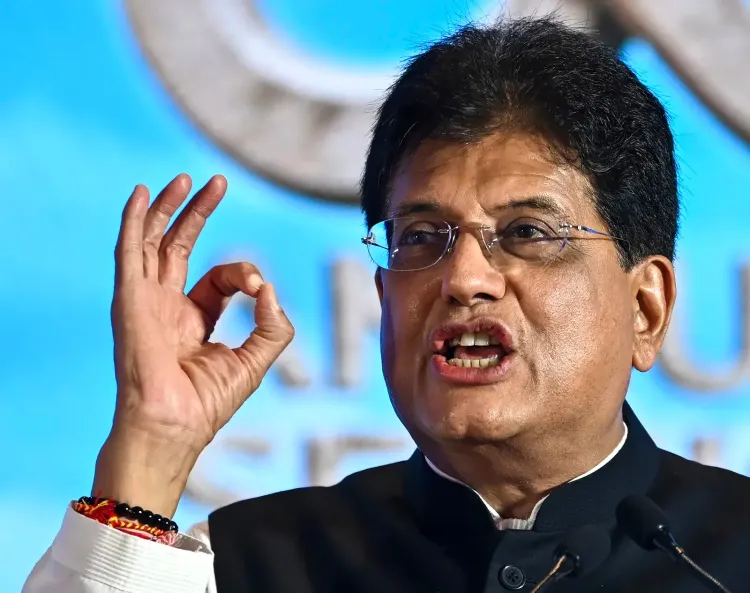
Addressing industry leaders, Goyal described India as 'one oasis in the desert' amid global economic turbulence, asserting that the country has remained firmly on its growth trajectory. 'The naysayers can say what they want... 7.8 per cent growth is a reality,' he said.
The minister charged that Opposition leaders were attempting to 'find holes' in the Centre's economic data without understanding the methodological basis of GDP measurement. He argued they were making an invalid comparison — pitting growth figures from an older GDP series against those from a newly revised series with a different base year.
The Base Year Controversy Explained
At the heart of the dispute is a claim that the government revised down last year's Q1 GDP — from ₹86 lakh crore to ₹80 lakh crore — to artificially inflate the current year's growth figure, and that without this change, growth in current prices would have been just 2.6 per cent.
The Ministry of Statistics and Programme Implementation (MOSPI) formally refuted this claim on Wednesday through an official FAQ. According to the Ministry, the Q1 GDP estimate for 2026-27 has been calculated using the new GDP series with 2022-23 as the base year, which cannot be directly compared with the ₹86 lakh crore figure from the old series that used 2011-12 as the base year. A valid like-for-like comparison, MOSPI stated, can only be made with the ₹80 lakh crore figure derived from the new series.
MOSPI Defends Revision Methodology
MOSPI clarified that the change in the Q1 2025-26 estimate does not represent a downward revision engineered to make current-year growth appear stronger. Instead, it reflects successive methodological and data revisions inherent to any GDP series update — a standard statistical practice followed globally.
Notably, base year revisions in India's GDP series are not new: the shift from 2004-05 to 2011-12 also generated similar comparability concerns at the time. The current transition to a 2022-23 base year is the latest such update.
Broader Context and What's Next
The exchange underscores a recurring tension in Indian economic discourse — where legitimate statistical methodology becomes a political flashpoint. With India's GDP growth narrative central to the ruling party's electoral messaging, Opposition scrutiny of data revisions is likely to intensify ahead of upcoming state elections.
Economists and independent analysts are expected to weigh in on the comparability question as MOSPI releases further documentation on the new series methodology.
Point of View
The distinction rarely survives the news cycle. MOSPI's clarification is technically sound: comparing figures across different base-year series is a methodological error, not evidence of manipulation. What the episode reveals, however, is the government's vulnerability on economic communication. If opposition talking points about a 2.6% growth figure are gaining traction, the onus is on MOSPI and the Finance Ministry to proactively explain series changes before they become political ammunition — not after. India's fastest-growing-major-economy tag is real, but the credibility of that claim depends on transparent, accessible data communication that does not require a minister to explain base years at an industry event.
NationPress
2 Sept 2026
Frequently Asked Questions
What did Piyush Goyal say about India's GDP growth at the ACMA session?
Commerce and Industry Minister Piyush Goyal said India's 7.8% GDP growth is a verified reality and accused the Opposition of misguiding citizens by comparing GDP figures from incompatible series. He made the remarks at the ACMA 66th Annual Session on 2 September in New Delhi.
What is the Opposition's claim about India's GDP data revision?
The Opposition alleged that the government revised down Q1 2025-26 GDP from ₹86 lakh crore to ₹80 lakh crore to make the current year's growth appear higher, and that without this revision, growth in current prices would have been only 2.6% .
How did MOSPI respond to the GDP revision controversy?
MOSPI issued a formal FAQ on 2 September clarifying that the ₹86 lakh crore figure belongs to the old GDP series with a 2011-12 base year , while the ₹80 lakh crore figure is from the new series using a 2022-23 base year . The two are not directly comparable, and the revision reflects standard methodological updates, not data manipulation.
What is a GDP base year and why does it matter?
A GDP base year is the reference year used to calculate real economic output, allowing for inflation-adjusted comparisons over time. When the base year changes — as it has now from 2011-12 to 2022-23 — historical GDP figures are recalculated using the new methodology, making older series figures incompatible with the new series.
Is India still the world's fastest-growing major economy?
According to government data cited by Minister Goyal, India continues to hold the position of the world's fastest-growing major economy with a 7.8% growth rate , even amid ongoing global economic uncertainty.