What Factors Led to a 1% Growth in the South Korean Economy in 2025?
Click to start listening
Synopsis
Discover why the South Korean economy achieved a mere 1% growth in 2025, despite strong exports. The fourth quarter saw a surprising contraction, raising questions about the construction sector's impact. What does this mean for future growth?
Key Takeaways
- South Korea's GDP growth for 2025 was just 1%.
- The construction sector faced significant challenges.
- Exports contributed positively, but less than in previous years.
- Private spending increased, indicating some resilience.
- The economy is projected to grow by 1.8% in 2026.
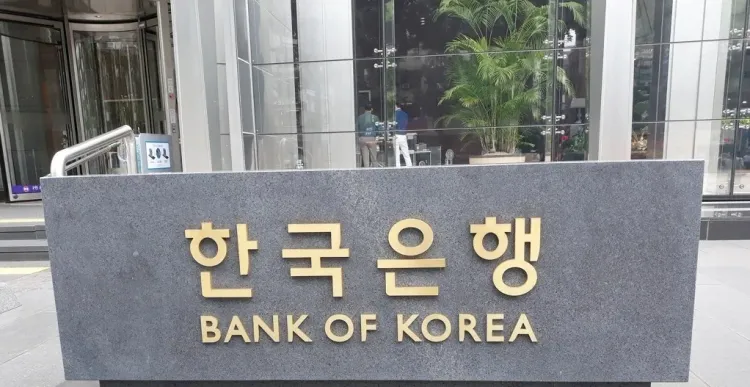
Seoul, Jan 22 (NationPress) The South Korean economy witnessed a 1% growth last year, spurred by strong exports, yet encountered negative growth in the fourth quarter due to a downturn in the construction sector, according to data released by the central bank on Thursday.
The nation’s real gross domestic product (GDP) for 2025 aligned with the Bank of Korea's (BOK) previous prediction, although the growth rate decreased from a 2% expansion the prior year, based on preliminary figures from the central bank.
This marked the slowest growth rate since 2020, when the economy shrank by 0.7% due to the COVID-19 pandemic, falling short of the potential growth rate of approximately 1.8%.
In the October to December timeframe, Asia's fourth-largest economy surprisingly contracted by 0.3% from the preceding quarter, marking its first contraction in six months and the weakest quarterly performance since the end of 2022.
Earlier, the BOK had projected a 0.2% expansion for the fourth-quarter GDP.
According to BOK official Lee Dong-won during a press briefing, "The slowdown was primarily due to base effects resulting from robust third-quarter growth and weakness in construction investment." He noted that high construction costs and administrative disruptions caused by a fire at the state data center negatively impacted construction investment.
On a year-on-year basis, GDP grew by 1.5% in the fourth quarter, down from a 1.8% increase in the prior quarter.
The economy had previously contracted unexpectedly by 0.2% in the first quarter, influenced by a domestic political crisis stemming from then-President Yoon Suk Yeol's martial law declaration, alongside uncertainties from U.S. President Donald Trump's significant tariff measures, which adversely affected consumer spending and export growth.
However, the economy rebounded in the second and third quarters, achieving growth rates of 0.7% and 1.3% respectively, aided by government stimulus initiatives and strong exports, particularly in the thriving semiconductor sector.
For the entirety of 2025, exports rose by 4.1% compared to the previous year, a slowdown from the 6.8% increase in 2024.
Estimates indicate that semiconductor exports accounted for approximately 0.9 percentage points of economic growth last year, BOK reported.
Private spending increased by 1.3%, up from 1.1% growth the year prior.
Conversely, construction investment fell sharply by 9.9%, compared to a 3.3% contraction in 2024, while facility investment showed a 2% year-on-year increase.
Lee remarked, "Excluding construction, the economy would have achieved a 2.4% annual growth rate."
In the fourth quarter, exports declined by 2.1% from the previous quarter, largely due to reduced demand for automobiles and machinery, while imports decreased by 1.7%.
Construction investment dropped by 3.9%, representing the steepest quarterly decline since the fourth quarter of 2024, while facilities investment fell by 1.8%, primarily driven by reductions in transport equipment, including automobiles.
Private consumption saw a minor increase of 0.3%, while government spending rose by 0.6%, according to the available data.
The BOK indicated that domestic demand reduced fourth-quarter GDP growth by 0.1 percentage points, whereas net exports contributed to a 0.2 percentage-point contraction.
By sector, manufacturing declined by 1.5% due to weaknesses in transport equipment and machinery, while the electricity, gas, and water supply sector fell by 9.2%.
Construction also saw a 5% contraction, while agriculture, forestry, and fisheries experienced a 4.6% rise, and the services sector grew by 0.6%.
Looking ahead, the BOK anticipates the economy will expand by 1.8% this year, attributing this to the ongoing semiconductor upcycle and sustained export strength.
Lee stated, "The economy is expected to grow at a quicker rate in 2026 compared to last year, driven by continued rises in private consumption and exports, along with increased government spending due to a larger budget."
He also mentioned that enhanced government investment in social overhead capital and the construction of semiconductor facilities are projected to alleviate growth constraints in the construction sector.
Point of View
I emphasize that despite the challenges faced by the South Korean economy, particularly in the construction sector, the overall growth indicates resilience. It's crucial for policymakers to analyze these trends to bolster economic stability moving forward.
NationPress
22/01/2026