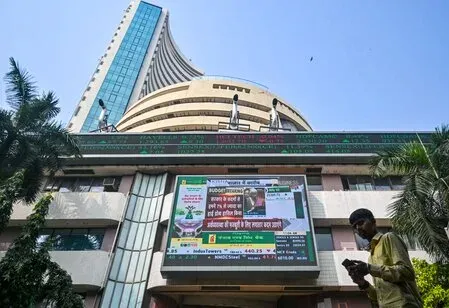
Sensex drops 539 points as Hormuz tensions stall diplomatic progress
Synopsis
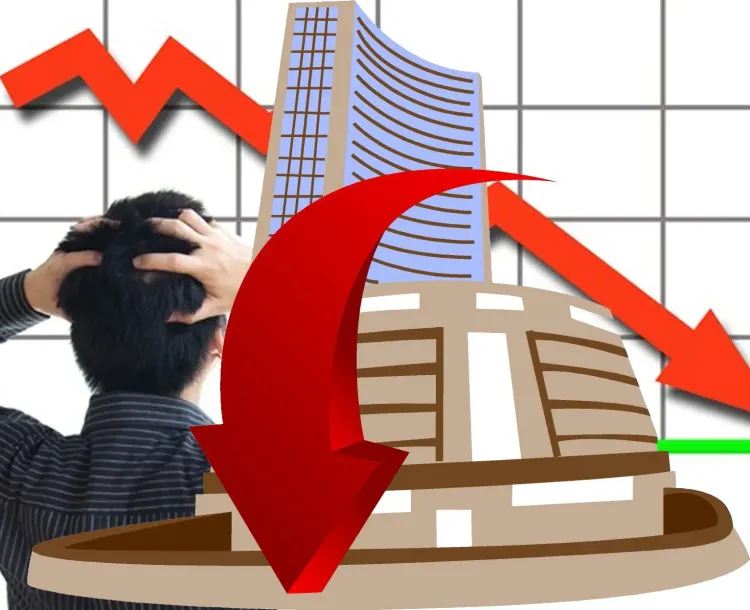
Indian equities logged their sharpest geopolitical-driven drop in recent sessions as Hormuz negotiations went nowhere, pulling the Sensex down 539 points. With the Nifty breaking below its 50EMA and the Fed's Jackson Hole speech looming, the next 48 hours could determine whether this is a brief pullback or the start of a more sustained risk-off move.
Key Takeaways
Sensex closed 539 points lower at 76,933 on 27 August , falling 0.70% intraday.
Nifty50 ended at 24,090 , down 116 points or 0.48% .
Nifty Bank shed 273 points to settle at 57,509 .
Stalled Strait of Hormuz negotiations were the primary trigger for the selloff.
Nifty Cement was the worst sectoral loser, down 1.33% ; pharma and private banks bucked the trend with marginal gains.
Markets are awaiting the US Fed chair's Jackson Hole address for cues on rates and global capital flows.
The BSE Sensex fell 539 points, or 0.70%, to close at 76,933 on Thursday, 27 August, as stalled negotiations over the Strait of Hormuz drained investor confidence and pushed Indian equities into broad-based losses. The Nifty50 shed 116 points, or 0.48%, settling at 24,090.
Key Losses Across Indices
Nifty Bank tanked 273 points, or 0.47%, closing at 57,509. The broader market tracked the benchmarks closely: the Nifty Midcap 100 slipped 0.10%, the NSE Smallcap 100 declined 0.13%, and the Nifty Next 50 dipped 0.21%.
Among sectoral indices on the National Stock Exchange (NSE), only private bank, pharma, and consumer durables managed marginal gains. Nifty Cement led sectoral losses at 1.33%, followed by Nifty Media at 0.89%, Nifty Metals at 0.86%, and Nifty PSU Bank at 0.94%.
What Is Driving the Selloff
'Expiry-led volatility and the lack of a diplomatic breakthrough in the Middle East continue to keep markets range-bound in the near term,' an analyst said. 'While a degree of higher energy prices is largely factored into earnings expectations, the recent moderation in crude oil prices and long-term bond yields is supporting the inflation outlook.'
Technically, analysts note that the Nifty has slipped below its rising channel on the daily timeframe, signalling a build-up of bearishness. The index has also fallen below the 50-day exponential moving average (50EMA), confirming a weakening trend — a development that could invite further caution from short-term traders.
Rupee and FII Flows
The Indian rupee (INR) edged lower against the US dollar (USD), rebounding to near ₹95.50 after touching a 10-day low of ₹95.40 in the previous session. Despite the currency softness, foreign institutional investor (FII) inflows have remained supportive. 'FII inflows and resilient earnings momentum remain supportive for Indian equities, particularly mid-caps, where several segments are relatively insulated from global uncertainties and continue to benefit from strong domestic demand trends,' a market participant said.
What Markets Are Watching Next
All eyes are now on the US Federal Reserve chair's upcoming address at Jackson Hole, which is expected to offer signals on inflation, interest rates, and the broader policy trajectory. Any hawkish tilt could dampen global risk sentiment and redirect capital flows away from emerging markets, including India. Notably, this is the third consecutive session in which geopolitical uncertainty over the Strait of Hormuz has weighed on domestic equities.
Point of View
A currency variable, and increasingly a sentiment variable for FII flows. The Nifty breaking below its 50EMA on a day of expiry-led volatility is a technical red flag that passive bulls should not dismiss. More importantly, with the Fed's Jackson Hole remarks still pending, markets are pricing in two sources of uncertainty simultaneously — a combination that historically compresses risk appetite sharply in the short term.
NationPress
11 Oct 2026
Frequently Asked Questions
Why did the Sensex fall on 27 August?
The Sensex fell 539 points to 76,933 on 27 August primarily due to a lack of diplomatic progress in negotiations over the Strait of Hormuz, which eroded investor confidence. Expiry-led volatility on derivatives markets added to the pressure.
Which sectors were hit hardest on the NSE?
Nifty Cement was the worst-performing sector, falling 1.33%, followed by PSU Bank at 0.94%, Media at 0.89%, and Metals at 0.86%. Private bank, pharma, and consumer durables were the only sectors to post marginal gains.
What is the significance of the Nifty falling below the 50EMA?
The Nifty slipping below its 50-day exponential moving average (50EMA) is a technical signal that the underlying trend is weakening. Analysts say it also broke below a rising channel on the daily chart, indicating increased bearishness in the near term.
How did the Indian rupee perform on 27 August?
The rupee traded lower against the US dollar, recovering to near ₹95.50 after hitting a 10-day low of ₹95.40 in the previous session. Currency softness added to the cautious mood in equity markets.
What event are investors watching next?
Markets are closely tracking the US Federal Reserve chair's upcoming speech at Jackson Hole, which is expected to signal the direction of US interest rates and inflation policy. Any hawkish commentary could reduce capital flows into emerging markets like India.