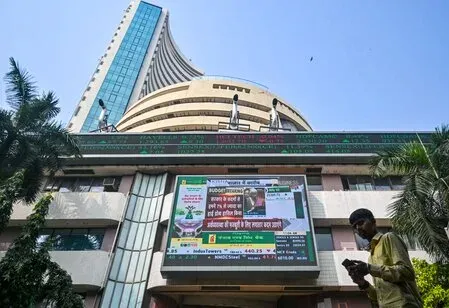
Sensex, Nifty slip on rising oil prices amid Strait of Hormuz blockade fears

Synopsis
Indian markets closed in the red on 14 August as crude oil prices surged on reports the US may extend its Strait of Hormuz naval blockade indefinitely. With India among the world's largest oil importers, the geopolitical overhang is more than a market wobble — it is a direct threat to the inflation and current account trajectory.
Key Takeaways
Sensex fell 71 points to close at 78,009.25 on 14 August ; Nifty50 declined 29.85 points to 24,366.00 .
Rising crude oil prices, driven by reports of an indefinite US naval blockade at the Strait of Hormuz , were the primary trigger.
Tata Motors Passenger Vehicles , Jio Financial Services , and ONGC were the top Nifty losers.
Nifty MidCap fell 0.53% ; Nifty SmallCap declined 0.69% .
Nifty Consumer Durables bucked the trend, gaining nearly 1% ; Nifty Pharma and Nifty Realty were among the worst sectoral performers.
Analysts flagged 24,300–24,250 as the immediate Nifty support zone.
Indian equity benchmarks ended marginally lower on Friday, 14 August, as crude oil prices climbed after reports emerged that the United States may extend its naval blockade at the Strait of Hormuz indefinitely, stoking fresh concerns over energy supply disruptions and inflation. The BSE Sensex fell 71 points, or 0.09%, to settle at 78,009.25, while the Nifty50 declined 29.85 points, or 0.12%, to close at 24,366.00.
Nifty Technical Outlook
Analysts noted that the Nifty traded largely below the 24,400 zone through most of the session. The 24,300 region emerged as a key buying-interest area, and recovery attempts in the second half briefly pushed the index to an intraday high of 24,405 — but the move met immediate supply pressure, underscoring persistent resistance at higher levels. 'On the downside, 24,300–24,250 remains the immediate support,' an analyst noted.
What Spooked the Market
The primary trigger was a surge in crude oil prices following reports of a potentially indefinite US naval blockade at the Strait of Hormuz — a critical chokepoint for global energy shipments. As one of the world's largest oil-importing nations, India is particularly exposed to crude price spikes, which translate directly into higher import costs and inflationary pressure. Geopolitical uncertainty in the Middle East further dampened risk appetite across domestic markets.
Top Losers and Sectoral Performance
Among Nifty constituents, Tata Motors Passenger Vehicles, Jio Financial Services, and Oil and Natural Gas Corporation (ONGC) were the session's top losers, weighing on the headline indices. The broader market also came under pressure — the Nifty MidCap index ended 0.53% lower, while the Nifty SmallCap index declined 0.69%. Sectoral performance was mixed: the Nifty Consumer Durables index outperformed, gaining nearly 1% on selective buying in discretionary consumption stocks, while Nifty Pharma and Nifty Realty were among the worst-performing sectoral gauges.
Macro Cushions Limiting the Damage
Despite the headline decline, market experts pointed to several stabilising factors in the domestic macro environment. 'The stability in the rupee, moderation in India's 10-year bond yield, and a gradual improvement in FII participation are providing support to the domestic macro-environment and supporting the inflation trajectory,' a market expert said. Investors are expected to remain closely focused on further developments in the Middle East and their ripple effects on global energy markets heading into the next week.
Point of View
And any prolonged US naval presence there reorders global energy pricing. For India, which imports roughly 85% of its crude needs, a sustained crude spike is simultaneously an inflation problem, a current account problem, and a fiscal problem. The rupee's current stability and FII flows provide a buffer, but they are sentiment-driven and can reverse quickly. Markets are pricing in a geopolitical wobble; they may need to price in a structural energy shock.
NationPress
29 Sept 2026
Frequently Asked Questions
Why did the Sensex and Nifty fall on 14 August?
The Sensex fell 71 points and the Nifty declined 29.85 points on 14 August after crude oil prices rose on reports that the United States may extend its naval blockade at the Strait of Hormuz indefinitely. This raised concerns about energy supply disruptions and higher import costs for India.
What is the Strait of Hormuz and why does it matter for Indian markets?
The Strait of Hormuz is a narrow waterway between the Persian Gulf and the Gulf of Oman, through which a significant share of the world's crude oil is transported. For India — one of the world's largest oil importers — any disruption there directly raises import costs, fuels inflation, and pressures the current account deficit.
Which stocks were the biggest losers on Nifty on 14 August?
Tata Motors Passenger Vehicles, Jio Financial Services, and ONGC were the top losers among Nifty constituents during the session, dragging the benchmark indices lower.
What are the key support levels for the Nifty going forward?
Analysts identified the 24,300–24,250 band as the immediate support zone for the Nifty. The index briefly touched an intraday high of 24,405 but faced supply pressure, with resistance continuing at higher levels.
Were there any sectors that gained despite the overall market decline?
Yes, the Nifty Consumer Durables index outperformed, gaining nearly 1% on selective buying in discretionary consumption stocks. However, Nifty Pharma and Nifty Realty were among the worst-performing sectoral indices on the day.