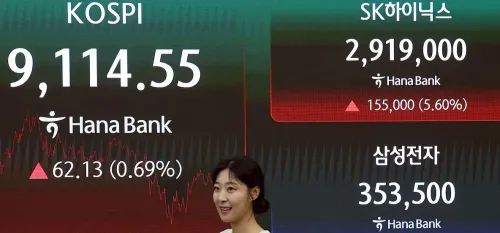
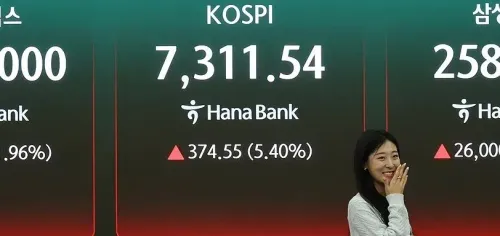
KOSPI circuit breaker triggered as Seoul shares plunge over 8% on AI sell-off
Synopsis
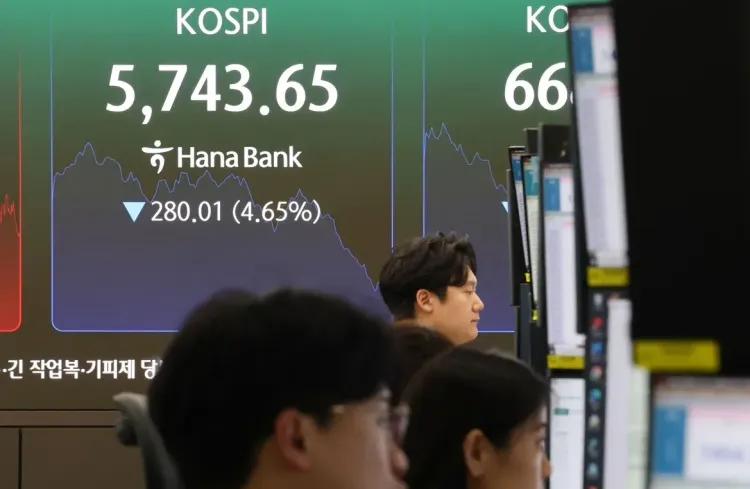
Seoul's stock market triggered its eighth circuit breaker of the year on 29 July after the KOSPI plunged over 8%, with SK Hynix diving more than 10% and Samsung Electronics shedding over 5%. The rout reflects a deepening global reckoning over whether massive AI spending by tech giants can actually justify their soaring valuations — and South Korea's chipmakers are squarely in the crosshairs.
Key Takeaways
The Korea Exchange (KRX) activated a circuit breaker on 29 July , halting KOSPI trading for 20 minutes from 12:31 pm after the index fell more than 8 per cent .
This was the eighth circuit breaker activation on the KOSPI so far in 2025.
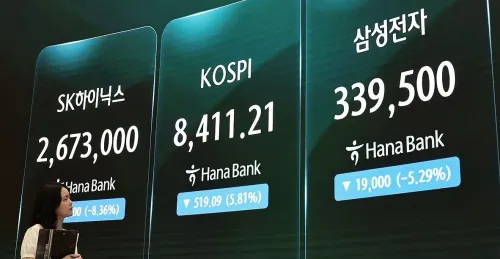
SK Hynix dived 10.32 per cent and Samsung Electronics plunged 5.45 per cent , leading the tech sell-off.
On Tuesday , the KOSPI had already crashed 10.84 per cent to close at 6,023.66 , driven by China competition fears.
Individual investors sold a net 1.37 trillion won (US$943 million), while institutions and foreigners were net buyers.
The sell-off reflects investor scepticism over whether AI capital expenditure by major tech firms will generate sufficient returns.
South Korea's Korea Exchange (KRX) activated a circuit breaker for the Korea Composite Stock Price Index (KOSPI) on Wednesday, 29 July, halting trading for 20 minutes from 12:31 pm after the benchmark plunged more than 8 per cent from the previous session's close. The sell-off was driven by a sharp dumping of semiconductor and AI-linked shares, as investors grew increasingly sceptical about whether tech giants' heavy spending on artificial intelligence would deliver adequate returns.
Key Developments
The circuit breaker activation marked the eighth time this year that the KRX has deployed the emergency trading halt. Earlier in the session, the exchange had also activated a sell-side sidecar, suspending programme trading in KOSPI-listed shares for five minutes around 10:55 am following the index's sharp early decline.
The extended rout follows a brutal Tuesday session, when the KOSPI plunged 10.84 per cent to close at 6,023.66, driven by rising competitive pressure from China that triggered a heavy sell-off in AI-related stocks, particularly chipmakers.
Stocks Hit Hardest
Market bellwether Samsung Electronics plunged 5.45 per cent, while memory chipmaker SK Hynix dived 10.32 per cent. Samsung Electro-Mechanics plummeted 9.07 per cent and LG Electronics sank 5.21 per cent. Internet giant Naver fell 3.1 per cent and leading mobile carrier SK Telecom shed 4.99 per cent.
Not all counters were in the red. Tobacco firm KT&G rose 2.04 per cent and food company Samyang Foods surged 7.86 per cent, bucking the broader market trend.
Who Was Buying and Who Was Selling
Individual investors were net sellers, offloading 1.37 trillion won (approximately US$943 million) worth of shares. Institutions and foreign investors provided partial support, buying a net 1.27 trillion won and 91.2 billion won, respectively — insufficient to stem the broader decline.
Global Context
The Seoul rout unfolded against a mixed overnight session on Wall Street. The Dow Jones Industrial Average gained 1.03 per cent, while the tech-heavy Nasdaq Composite slipped 0.22 per cent, reflecting similar unease about AI valuations in US markets. This comes amid a broader global reassessment of whether the enormous capital being deployed into AI infrastructure by major technology firms is commercially justified at current stock price levels.
What Comes Next
With the KOSPI having now triggered circuit breakers eight times in 2025, market stability remains fragile. Analysts will be watching whether institutional buying provides a floor or whether continued retail selling and China-driven competitive fears push the index further into distressed territory. Any fresh signals from major US tech firms on AI spending outlooks are likely to be the next key catalyst for Seoul's bourse.
Point of View
Samsung and SK Hynix, are caught in a double bind: China is closing the technology gap faster than expected, while their biggest customers in the US are facing investor pressure to justify AI capex. What mainstream coverage underplays is that this is also a referendum on the entire 'picks and shovels' theory of AI investing — the idea that chipmakers benefit regardless of who wins the AI race. If that thesis cracks, South Korea's market has further to fall.
NationPress
29 Jul 2026
Frequently Asked Questions
What is a circuit breaker in stock markets?
A circuit breaker is an emergency mechanism that temporarily halts trading when a benchmark index falls beyond a set threshold, giving markets time to stabilise. On 29 July, the Korea Exchange activated one for the KOSPI after it dropped more than 8 per cent, suspending trading for 20 minutes.
Why did the KOSPI fall so sharply on 29 July 2025?
The KOSPI plunged over 8 per cent primarily due to a sell-off in semiconductor and AI-linked stocks, as investors grew sceptical about whether massive AI spending by major tech firms would generate sufficient returns. Rising competitive pressure from China on chipmakers also weighed heavily on sentiment.
How many times has the KOSPI circuit breaker been triggered in 2025?
The 29 July activation was the eighth time in 2025 that the Korea Exchange has triggered a circuit breaker for the KOSPI, indicating persistent market volatility throughout the year.
Which stocks were most affected by the Seoul market crash?
SK Hynix was the biggest large-cap loser, diving 10.32 per cent. Samsung Electronics fell 5.45 per cent, Samsung Electro-Mechanics dropped 9.07 per cent, and LG Electronics sank 5.21 per cent. Naver and SK Telecom also posted significant losses.
What happened to the KOSPI the day before the circuit breaker?
On Tuesday, the KOSPI had already plunged 10.84 per cent to close at 6,023.66, driven by rising competition from China that triggered heavy selling in AI-related stocks including chipmakers. The two-day rout represents one of the sharpest back-to-back declines for the index in recent memory.