India must cut oil dependence, boost renewables: Jayant Sinha
Synopsis
Former Finance Minister of State Jayant Sinha has declared that global oil prices have replaced the monsoon as India's single biggest economic variable — and called for a radical pivot to renewables, a 40% investment-to-GDP target, and reduced dependence on China. The warning lands as India faces both a deficient monsoon and a crude price spike driven by Middle East conflict.
Key Takeaways
Jayant Sinha , president of Everstone Group and former Union Minister of State for Finance , said India must urgently cut its dependence on imported oil.
He argued that global crude prices have overtaken the monsoon as the primary determinant of India's economic health.
Sinha called for India's investment-to- GDP ratio to rise to 40 per cent to support long-term growth.
He also urged reducing supply-chain dependence on China and aligning with major global economic trends.
His remarks came as India faces below-average monsoon rainfall and elevated crude prices linked to Middle East conflict .
The comments were made at the NDTV Profit Business Leadership Awards , judged by a jury chaired by Sunil Bharti Mittal .
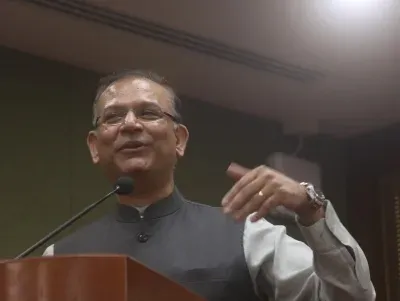
Jayant Sinha, president of Everstone Group and former Union Minister of State for Finance, on Sunday called on India to sharply reduce its reliance on imported oil and channel massive investment into renewable energy, warning that crude price volatility now poses a greater threat to economic stability than even an erratic monsoon.
Oil Prices: The New Monsoon
Speaking at the NDTV Profit Business Leadership Awards in New Delhi, Sinha invoked a widely circulated quip inside India's Finance Ministry to make his point. 'India's finance minister is the monsoon,' he said, before adding: 'Now, India's finance minister is oil prices.' The remark underscores a structural shift in how external shocks reach Indian households and businesses — through fuel costs, transport, and manufacturing inputs rather than rainfall alone.
For decades, the monsoon was regarded as the single most powerful variable in India's economic calculus, driving agricultural output, rural demand, and food inflation. Sinha argued that global crude prices have now assumed that central role, with consequences that cut across every sector of the economy.
Context: A Dual Pressure on India Right Now
Sinha's remarks carry added weight given current conditions. India has recorded lower-than-expected monsoon rainfall this season, while global crude prices have surged amid escalating Middle East conflict — a combination that simultaneously stresses food supply chains and energy import bills. For an oil-importing nation, higher crude prices translate directly into wider current account deficits, rupee depreciation pressure, and broad-based inflation.
What India Must Do, According to Sinha
Beyond energy, Sinha outlined a broader strategic agenda. He argued that India must also reduce its supply-chain dependence on China and align national investment priorities with major long-term global economic trends. Crucially, he called for raising India's investment-to-GDP ratio to 40 per cent — a significant step up from current levels — as a prerequisite for sustaining long-term growth. Higher capital formation, he said, is non-negotiable if India is to capitalise on the disruptions reshaping the global economy.
The Awards and Who Was in the Room
The NDTV Profit Business Leadership Awards honour India's leading companies, entrepreneurs, and executives across 12 categories. Winners are selected through a two-stage process overseen by an independent jury chaired by Sunil Bharti Mittal, Founder and Chairman of Bharti Enterprises. The gathering brought together senior voices from Indian business and policy — making Sinha's intervention all the more notable for its audience.
As India navigates simultaneous pressures from a deficient monsoon and elevated crude prices, the push for an accelerated energy transition and deeper domestic investment is likely to gain further urgency in policy circles.
Point of View
But the structural challenge it describes is not new — India has been talking about energy transition for over a decade without dramatically moving the needle on import dependence. The call to push investment to 40% of GDP is equally familiar; the harder question is what policy architecture actually delivers that, given that private capex has remained subdued despite multiple incentive cycles. With crude spiking on geopolitical risk and the monsoon underperforming simultaneously, India is caught in a rare double squeeze — and the policy response so far has leaned more on fuel duty cuts than on accelerating the renewable buildout that Sinha advocates.
NationPress
26 Oct 2026
Frequently Asked Questions
What did Jayant Sinha say about India's oil dependence?
Jayant Sinha said India must urgently reduce its dependence on imported oil and invest massively in renewable energy. He warned that any spike in global crude prices directly harms economic stability through higher production costs and broad inflation.
Why did Sinha compare oil prices to the monsoon?
Sinha cited a Finance Ministry saying — 'India's finance minister is the monsoon' — and updated it to 'India's finance minister is oil prices,' arguing that crude now shapes economic outcomes more decisively than rainfall. While the monsoon drives agriculture and rural demand, oil prices affect inflation, transport, and manufacturing costs across the entire economy.
What investment target did Jayant Sinha set for India?
Sinha called for India to raise its investment-to-GDP ratio to 40 per cent, which he described as essential for sustaining long-term economic growth and positioning the country alongside major global trends.
What is the current economic backdrop for Sinha's remarks?
India is experiencing lower-than-expected monsoon rainfall this season while global crude oil prices have risen sharply due to Middle East conflict, creating simultaneous pressure on food supply and energy import costs.
Who is Jayant Sinha?
Jayant Sinha is the president of Everstone Group and a former Union Minister of State for Finance in the Indian government. He spoke at the NDTV Profit Business Leadership Awards in New Delhi on Sunday.