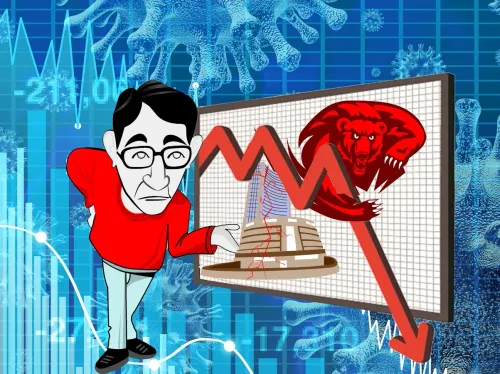
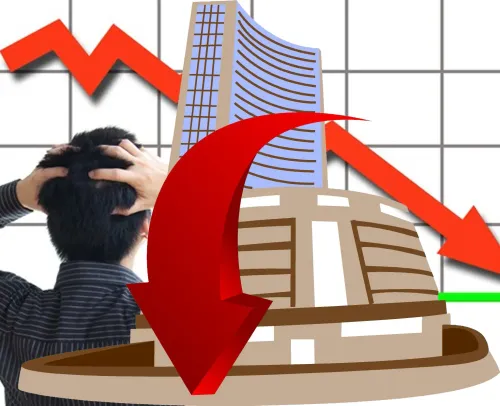
Sensex crashes 1,677 points in sharpest fall in 3 months on West Asia fears

Synopsis
Indian markets posted their worst single-day loss in over three months on 8 July, with the Sensex cratering 1,677 points after Trump declared the Iran ceasefire over following strikes in the Strait of Hormuz. With banking stocks leading the rout and only four Nifty stocks in the green, the session was a near-total washout — and the geopolitical risk that triggered it remains very much alive.
Key Takeaways
Sensex plunged 1,677.12 points (2.15%) to close at 76,503.60 on 8 July — its steepest single-day fall in over three months .
Nifty50 dropped 516.65 points (2.12%) to settle at 23,882.05 .
Trigger: US President Donald Trump declared the ceasefire with Iran over after an exchange of strikes in the Strait of Hormuz .
Nifty PSU Bank and Nifty Bank were the worst-performing sectoral indices; only 4 of 50 Nifty stocks closed in positive territory.
Biggest Nifty laggards: Jio Financial Services , InterGlobe Aviation , and Shriram Finance .
Analysts peg 23,800 as key Nifty support; a break below could push the index to the 23,600–23,500 zone.
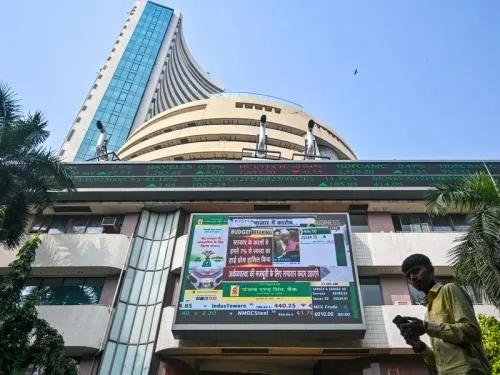
The BSE Sensex plunged 1,677.12 points, or 2.15%, to close at 76,503.60 on Wednesday, 8 July, marking its steepest single-day decline in more than three months, as escalating geopolitical tensions in West Asia triggered a broad-based selloff across Indian equity markets. The Nifty50 mirrored the carnage, shedding 516.65 points, or 2.12%, to settle at 23,882.05.
What Triggered the Selloff
The rout was set off by a sharp deterioration in global risk appetite after US President Donald Trump declared that the ceasefire with Iran was over, even as he left the door open for continued negotiations. The statement followed an exchange of strikes by both sides in the Strait of Hormuz, a critical global oil transit chokepoint, ratcheting up fears of a wider regional conflict. Investors responded by rapidly reducing equity exposure, sending markets lower across the board.
Sectors and Stocks That Bore the Brunt
The decline was sweeping, with banking stocks absorbing the heaviest selling pressure. The Nifty PSU Bank and Nifty Bank indices were the worst-performing sectoral gauges of the session. Among individual Nifty constituents, Jio Financial Services, InterGlobe Aviation, and Shriram Finance emerged as the biggest laggards. Only four stocks in the benchmark index managed to close in positive territory, with the overwhelming majority ending lower.
The Nifty Metal and Nifty Pharma indices, while also ending in the red, outperformed the broader market by limiting their losses — a relative pocket of resilience in an otherwise punishing session.
Technical Outlook: Key Levels to Watch
Market analysts noted that the 24,000 level on the Nifty is now expected to act as the immediate resistance zone, with 24,200 as the next significant barrier above it. 'A sustained move above these levels will be required to improve the near-term technical structure,' according to a market expert.
On the downside, analysts flagged the 23,800 zone as a crucial support level. 'A decisive break below this region could intensify selling pressure and drag the index towards the 23,600–23,500 zone,' a market analyst cautioned. With geopolitical risk still unresolved, traders are expected to remain on edge in the sessions ahead.
Broader Market Context
This is the sharpest single-session fall for Indian benchmarks in over three months, underscoring how exposed domestic equities remain to global macro shocks — particularly those involving oil supply routes. India imports roughly 85% of its crude oil needs, making any disruption in the Strait of Hormuz a direct threat to the country's import bill, inflation trajectory, and corporate margins. This comes amid an already cautious global environment shaped by persistent uncertainty over US trade policy and Federal Reserve rate signals.
Point of View
677-point Sensex fall is a reminder that Indian equity markets, for all their domestic growth narrative, remain acutely vulnerable to oil-route geopolitics. The Strait of Hormuz is not an abstraction — it is the artery through which roughly 85% of India's crude imports flow, and any credible threat to it is simultaneously a fiscal, inflationary, and earnings risk. What is notable here is the speed of the transmission: Trump's statement alone, without an actual supply disruption, was enough to wipe out months of gains in a single session. Banking stocks bearing the brunt also signals that rate-sensitive sectors are pricing in the possibility that a crude spike could delay any RBI easing cycle. Until there is a credible de-escalation signal from West Asia, this volatility is unlikely to be a one-day event.
NationPress
8 Jul 2026
Frequently Asked Questions
Why did the Sensex crash on 8 July 2025?
The Sensex fell 1,677 points on 8 July after US President Donald Trump declared the ceasefire with Iran over, following an exchange of strikes in the Strait of Hormuz. The geopolitical escalation weakened global risk appetite and triggered a broad-based selloff in Indian equities.
How much did the Nifty fall on 8 July?
The Nifty50 dropped 516.65 points, or 2.12%, to close at 23,882.05 on 8 July — its sharpest single-session decline in over three months, mirroring the Sensex rout.
Which stocks and sectors were hit hardest?
Banking stocks bore the brunt, with the Nifty PSU Bank and Nifty Bank indices the worst-performing sectoral gauges. Among individual stocks, Jio Financial Services, InterGlobe Aviation, and Shriram Finance were the biggest Nifty laggards. Only four Nifty constituents managed to close in the green.
What are the key Nifty support and resistance levels to watch?
Analysts identify 23,800 as the crucial near-term support for Nifty; a decisive break below it could drag the index to the 23,600–23,500 zone. On the upside, 24,000 is the immediate resistance, followed by 24,200, and a sustained move above these levels would be needed to stabilise the technical outlook.
How does West Asia tension affect Indian markets?
India imports roughly 85% of its crude oil needs, much of which transits through the Strait of Hormuz. Any escalation in the region raises fears of supply disruption, higher oil prices, a wider fiscal deficit, and inflationary pressure — all of which weigh on corporate earnings and equity valuations.