World Bank chief Ajay Banga: AI can uplift India's farmers, not kill jobs
Synopsis
World Bank President Ajay Banga flipped the global AI-jobs debate on its head at Columbia University: while one-third of jobs in rich nations could be displaced by large language models, low-income countries face near-zero such risk — and can instead harness 'small AI' to leapfrog. A live example is already running in Uttar Pradesh, where illiterate women farmers diagnose crop disease via a 3G phone and a Google-backed app.
Key Takeaways
World Bank President Ajay Banga said AI poses little immediate job-displacement risk to low-income countries, but offers major productivity gains.
A Google -backed crop-disease diagnostic app in Uttar Pradesh allows illiterate women farmers to identify plant diseases and buy remedies for ₹25 using a basic 3G phone .
Banga estimates up to one-third of jobs in developed economies could be affected by large language models; in low-income countries, the figure is effectively zero .
He identified computing power, energy, data, skilled personnel, and capital as five prerequisites that most emerging markets lack for full-scale AI deployment.
Greek Prime Minister Kyriakos Mitsotakis , appearing alongside Banga, warned that AI and robotics together leave little room for optimism among middle-class workers in advanced economies.
Banga flagged similar 'small AI' opportunities in healthcare and education across the developing world.
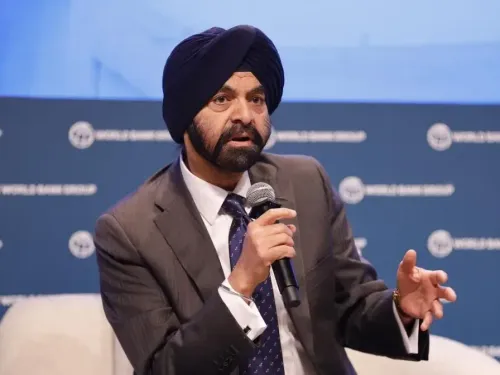
World Bank President Ajay Banga has said that artificial intelligence holds transformative potential for farmers and workers in India and other developing nations — without posing the immediate job-displacement threat that advanced economies face. Speaking at Columbia University during a discussion moderated by CNN's Fareed Zakaria, Banga cited a live AI initiative in Uttar Pradesh as proof that targeted, low-infrastructure technology can already deliver real-world gains for India's most vulnerable agricultural communities.
The Uttar Pradesh Model
Banga pointed to a crop-disease diagnostic tool developed in partnership with Google as a concrete example of what he termed 'small AI.' The application enables illiterate women farmers connected to cooperatives to identify plant diseases and access remedies using nothing more than a basic 3G mobile phone.
'So, we give them a tool that she can speak into a 3G phone, point the camera at the back of a leaf of a diseased plant, and it spits back at you that disease, this insecticide for 25 Rupees from your local cooperative. You press the button. It's yours,' Banga said.
He described the application as a democratisation of expert agricultural knowledge. 'Now, you sort of have democratized the access to amazing knowledge for an illiterate woman farmer. And that to me is, again, A.I. at work,' he added.
Small AI vs Large Language Models
Banga drew a sharp distinction between the generative AI and large language model (LLM) debate dominating developed-world discourse and what is actually deployable in emerging economies. He argued that LLMs require five critical ingredients — computing power, energy, data, skilled personnel, and capital — that remain scarce across most of the developing world.
'There are very few emerging markets with that combination of five things,' he said. By contrast, 'small AI' — predictive tools applied to agriculture, education, healthcare, and skills development — can function within the infrastructure constraints that most low- and middle-income countries currently face.
AI's Job Impact: A Tale of Two Worlds
On the question of employment, Banga offered a strikingly differentiated view. He said that in developed economies, as many as one-third of jobs could potentially be affected by large language models. The exposure falls sharply as countries move down the income ladder.
'In the developed world, while one-third of jobs could potentially be impacted by LLM... the moment you get to a middle income country, that number is in the single digits. By the time you get to a low income country, it's zero,' Banga said.
His argument is that developing economies retain significant headroom to expand productivity and employment before encountering the displacement pressures already being debated in wealthier nations.
The Developed-World Counter-View
Greek Prime Minister Kyriakos Mitsotakis, who appeared alongside Banga at the event, offered a more cautionary perspective. He noted that AI is already encroaching on professions such as law, where research and documentation work traditionally assigned to junior employees can increasingly be automated.
Mitsotakis warned that middle-class workers in advanced economies — already strained by decades of globalisation — face a dual squeeze: AI targeting white-collar jobs and robotics displacing what remains of manufacturing employment. 'That doesn't really leave, you know, a lot of room for optimism regarding the future,' he said.
The contrast underscores a growing divergence in how AI's consequences are likely to be experienced across income groups and geographies — a debate that institutions like the World Bank are now placing at the centre of development strategy.
Broader Implications for India
Banga also flagged similar opportunities in healthcare and other sectors beyond agriculture, suggesting that the 'small AI' framework could serve as a scalable development tool across South Asia and sub-Saharan Africa. As global AI investment concentrates in a handful of wealthy nations, his remarks signal a deliberate push by the World Bank to channel a different kind of AI dividend toward the Global South.
How quickly India's cooperative and agri-tech infrastructure can absorb and scale such tools will be a key test of whether the optimism translates into measurable outcomes for the country's roughly 140 million farming households.
Point of View
Not a policy. The more pointed question is whether the World Bank's own lending and technical-assistance frameworks are being restructured around this 'small AI' thesis at the speed the window requires — or whether it remains a conference talking point while capital continues to flow overwhelmingly toward LLM infrastructure in wealthy nations.
NationPress
5 Oct 2026
Frequently Asked Questions
What did World Bank President Ajay Banga say about AI and India's farmers?
Ajay Banga said AI — specifically lightweight predictive tools he calls 'small AI' — can significantly improve agricultural productivity for farmers in India and other developing nations without displacing jobs, because these economies lack the infrastructure needed for large language models. He cited a Google-backed app in Uttar Pradesh that helps illiterate women farmers diagnose crop diseases using a basic 3G phone as a working example.
What is the AI crop-disease app in Uttar Pradesh that Banga described?
The app, developed in partnership with Google, allows illiterate women farmers connected to cooperatives in Uttar Pradesh to speak into a basic 3G phone, point its camera at a diseased plant leaf, and receive an instant diagnosis along with the name of an insecticide available from their local cooperative for ₹25. Banga presented it as a model of democratised agricultural knowledge.
How does AI's job impact differ between rich and developing countries, according to Banga?
Banga said up to one-third of jobs in developed economies could potentially be affected by large language models, but that figure drops to single digits in middle-income countries and effectively reaches zero in low-income countries. His argument is that developing economies still have substantial room to grow productivity and employment before facing the displacement pressures that wealthier nations are already confronting.
What is 'small AI' and why does Banga see it as relevant for emerging markets?
'Small AI' refers to targeted, predictive AI tools that do not require massive computing power, energy, data infrastructure, specialised personnel, or large capital outlays — the five prerequisites Banga says most emerging markets cannot yet meet for full-scale generative AI. He sees small AI as an immediately deployable route to improving agriculture, healthcare, education, and skills development across the Global South.
What was Greek Prime Minister Mitsotakis's view on AI and jobs?
Kyriakos Mitsotakis, appearing alongside Banga at Columbia University, warned that middle-class workers in developed economies face a dual threat: AI automating white-collar jobs and robotics displacing remaining manufacturing roles. He said this combination, on top of decades of globalisation-related strain, leaves little room for optimism about employment futures in advanced economies.