Could Bangladesh Elections Signal a Resurgence of Radical Islamist Forces?
Synopsis
As Bangladesh prepares for its national election on February 12, concerns mount over the potential revival of radical Islamist factions like Jamaat-e-Islami. This article delves into the implications of such a shift for regional stability and security, especially in relation to Israel's strategic interests.
Key Takeaways
Bangladesh's election may revive Islamist radical forces.
Jamaat-e-Islami's historical opposition to independence is significant.
Political stability in Bangladesh is crucial for regional balance.
Radicalization may extend beyond Bangladesh into the Middle East.
Israel's security is intertwined with Bangladesh's political trajectory.
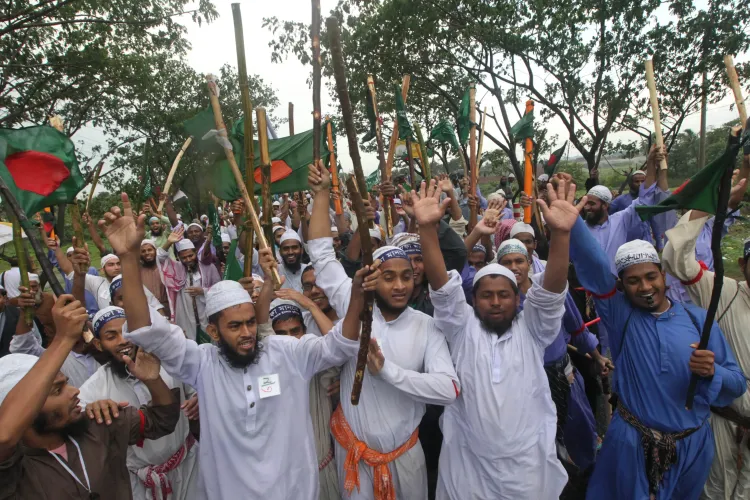
Tel Aviv, Jan 23 (NationPress) The upcoming national election in Bangladesh on February 12 has sparked serious concerns regarding the possible revival, whether direct or indirect, of radical Islamist factions, notably Jamaat-e-Islami and its associated networks. Despite their claims of engaging in democratic processes, their ideological foundations and past actions indicate a different reality, a report emphasized on Friday.
In a piece for the ‘Times of Israel,’ Sergio Restelli, an Italian political consultant, author, and expert on geopolitical affairs, pointed out that Jamaat-e-Islami opposed Bangladesh's independence from Pakistan in 1971 and has historically maintained ideological connections with global Islamist movements, including the Muslim Brotherhood, which is notorious for its opposition to pluralism, secular governance, and regional cooperation.
“On the surface, Bangladesh’s parliamentary elections on February 12 may seem like a distant political event in South Asia with little relevance to Israel or the Middle East. However, that perception is misguided. In a world where ideology, security, and trade routes are increasingly intertwined, the political developments in Bangladesh have implications that reach far beyond Dhaka and into the West Asian context, including Israel’s strategic landscape,” Restelli noted.
“Bangladesh is among the largest Muslim-majority nations globally, boasting a population of over 170 million. It holds a crucial geographical position at the crossroads of South Asia and Southeast Asia, overlooking the Bay of Bengal and situated along emerging maritime and land trade routes. The political stability of Bangladesh has long been a significant yet understated component of regional balance. A rise in political radicalization there would likely have far-reaching consequences,” he added.
The report indicates that Israel's concerns are less about Bangladesh’s internal political dynamics and more about the wider trends linked to Islamist radicalization.
“Political Islam, once validated through electoral success, seldom restricts itself to domestic matters. It actively seeks ideological partners, moral endorsement, and operational connections across regions. Historically, South Asia has been a fertile ground for Islamist movements that later formed ties with networks in West Asia, including entities opposed to Israel,” it stated.
The report cautioned that a shift in Bangladesh towards Islamist radicalism would bring another substantial population center into the expanding sphere of political Islam, stretching from parts of South Asia into the Middle East.
“As Israel is already facing ideological and military threats from groups backed by Iran, Hamas, and other Islamist actors, the emergence of new ideological centers that normalize radical narratives under the guise of democratic legitimacy is the last thing the region requires,” it concluded.
Point of View
I believe that the potential resurgence of radical Islamist forces in Bangladesh poses significant challenges not only for the nation but for regional and global stability. It is crucial to monitor these developments closely, as they may shape the future of political Islam and its implications for security across borders.
NationPress
10 Oct 2026
Frequently Asked Questions
What is the significance of the February 12 election in Bangladesh?
The February 12 election is significant because it may indicate a resurgence of radical Islamist forces like Jamaat-e-Islami, which could destabilize the region and impact global security.
How does Islamist radicalization affect Bangladesh's political landscape?
Islamist radicalization can shift political dynamics towards more extreme ideologies, potentially diminishing secular governance and pluralism in Bangladesh.
What are the historical ties of Jamaat-e-Islami?
Jamaat-e-Islami has historical ties to transnational Islamist movements, including the Muslim Brotherhood, and opposed Bangladesh's independence from Pakistan in 1971.
Why should the international community be concerned about Bangladesh's elections?
The international community should be concerned because the outcomes of the elections could influence broader patterns of Islamist radicalization, affecting regional stability and security.
What implications does this have for Israel?
The implications for Israel include potential new ideological threats from radical Islamist movements that could align with hostile entities, complicating the security landscape.