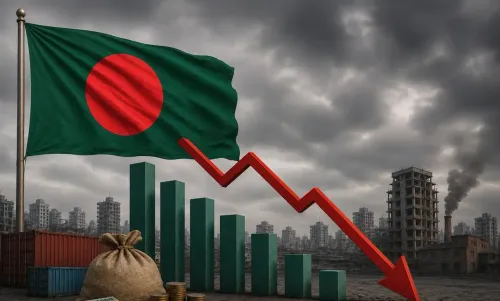
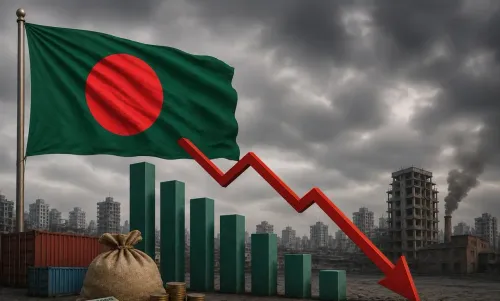
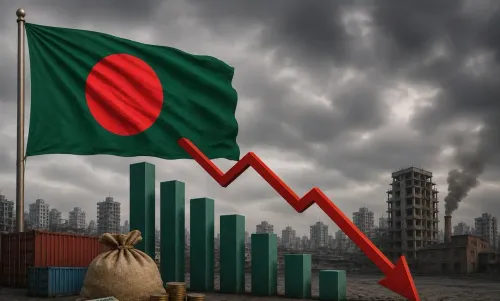
Bangladesh GDP growth falls to 3.2%, report flags risks
Synopsis
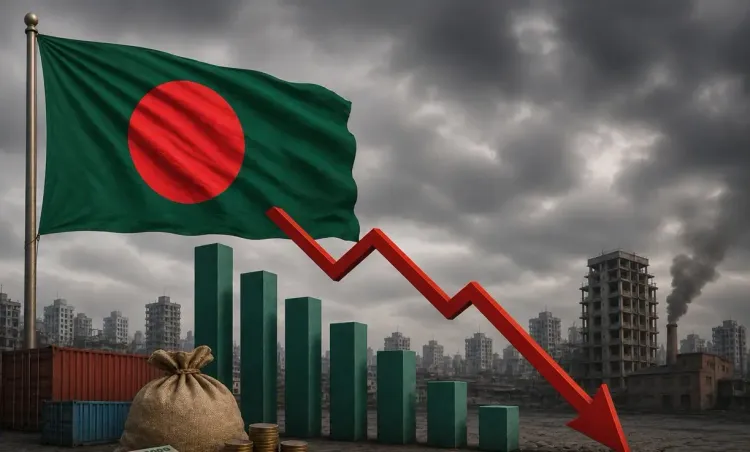
Bangladesh's GDP growth has fallen to 3.2%, reportedly its lowest in more than 25 years, as a Tk 42,000 crore revenue shortfall adds to economic pressures, according to The Daily Star.
Key Takeaways
Bangladesh GDP growth has declined to 3.2% , reportedly its lowest in more than 25 years , according to The Daily Star .
Revenue collection fell short by Tk 42,000 crore in the first quarter of the current fiscal year, the article says.
The national budget projected a deficit of Tk 2,00,000 crore for 2026-27 , according to the article.
The article identifies high non-performing loans and a credit crunch in industrial finance as major concerns.
The article says the prime minister cut his personal costs, while calling for realistic project spending and better governance.
Bangladesh GDP growth has fallen to 3.2%, reportedly its lowest level in more than 25 years, amid rising inflation and disruption to industrial production, according to an article in the Dhaka-based The Daily Star. The article also warns that weak revenue collection, banking-sector stress and sluggish investment are weighing on the country's economic prospects.
The report, dated 24 November, cites a Tk 42,000 crore revenue shortfall in the first quarter of the current fiscal year. It says the national budget had already projected a deficit of Tk 2,00,000 crore for 2026-27.
Growth and industrial pressures
The Daily Star article links the slowdown to a range of pressures, including rising inflation and disrupted industrial production. It describes remittances from non-resident Bangladeshis as unimpressive and says exports are not growing as expected.
It also identifies high non-performing loans in the banking sector and a shortage of credit for industrial finance as major concerns. These pressures matter for businesses seeking funds for production and investment, although the article does not quantify their individual contributions to the slowdown.
Foreign direct investment is described as insignificant. According to the article, employment, industrial investment and exports have not grown in recent years, and their near-term prospects are not promising.
Revenue shortfall and budget deficit
The article identifies widespread tax evasion as another obstacle to growth. Its reported Tk 42,000 crore first-quarter revenue shortfall points to pressure on public finances alongside the projected Tk 2,00,000 crore budget deficit for 2026-27.
It questions whether the deficit can be covered after the weak start, citing what it describes as strategic and capacity weaknesses at the National Board of Revenue. The article warns that the deficit could worsen if the current trend continues, while saying the eventual outcome cannot be predicted with confidence.
The source does not provide a revised deficit forecast or specify how any additional shortfall would be financed. A revenue shortfall and a budget deficit are distinct measures: the former concerns collections against expectations, while the latter reflects the gap between overall spending and revenue.
Project costs and governance concerns
The Daily Star article raises concerns about the overpricing of mega projects, high fixed costs and continuing commitments to economic and social programmes. It describes a depressed business climate at national, regional and global levels and points to an apparent severe cash crunch.
It argues that weak governance and a lack of transparency and accountability have fuelled corruption over many years. The article says it cannot be stated with certainty that the country has moved beyond those problems.
It also notes that the prime minister has cut his personal costs, which it presents as an apparent sign of political will. The source does not name the prime minister or provide further details of those reductions.
Economic outlook
The article argues that there is no shortcut to boosting activity in the current business climate. It calls for capital project costs to be kept realistic, unproductive and revenue expenditure to be reduced, and governance to improve.
Those recommendations address both the pressure on public spending and the wider conditions for investment, but the source does not announce a new policy or timetable. Future revenue figures, investment and export performance will help show whether the pressures identified in the article ease.
Point of View
But it cannot substitute for transparent project pricing, effective tax collection and credible oversight of bank lending. The public needs clear, verifiable figures on the deficit and the measures proposed to address it.
NationPress
24 Nov 2026
Frequently Asked Questions
What is Bangladesh's GDP growth rate?
Bangladesh's GDP growth has declined to 3.2%, according to an article in The Daily Star. The article describes it as apparently the lowest rate in more than 25 years.
Why is Bangladesh's economy under pressure?
The Daily Star article identifies rising inflation, industrial production disruption, weak investment and banking-sector stress among the pressures on Bangladesh's economy. It also says remittances are unimpressive and export growth is below expectations.
How large is Bangladesh's reported revenue shortfall?
Revenue collection fell short by Tk 42,000 crore in the first quarter of the current fiscal year, according to the article. It also cites a projected Tk 2,00,000 crore budget deficit for 2026-27.
Who is affected by Bangladesh's economic slowdown?
The article identifies pressures on industrial businesses seeking finance and on public finances. It also says employment, industrial investment and exports have not grown in recent years.
What steps does the article suggest for Bangladesh's economy?
The article calls for realistic capital project costs, lower unproductive and revenue expenditure, and improved governance. It does not specify a policy timetable.