Bangladesh economy hit by growth, trade and banking crises: report
Synopsis
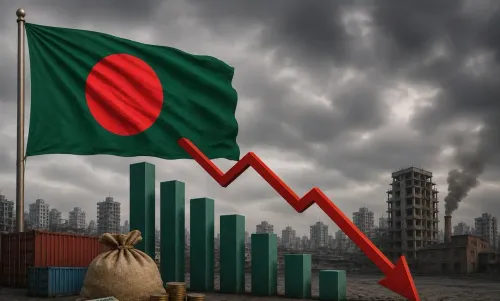
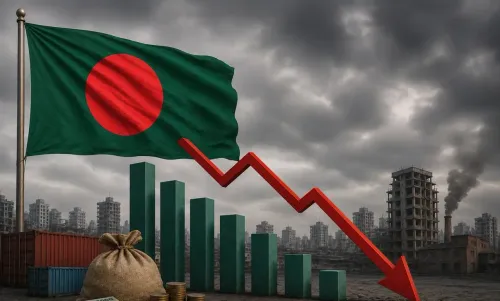
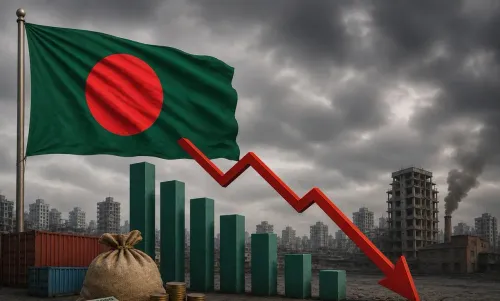
Bangladesh's economy is caught in a dangerous triple bind: growth has slid to 3.4%, the banking sector's capital adequacy ratio has turned negative, and a monthly trade deficit of $2.09 billion is widening fast. With the IMF projecting just 3.2% growth for FY27 and the banking bailout gap standing at Tk 5.6 lakh crore, the country faces a self-reinforcing crisis that remittances alone cannot arrest.
Key Takeaways
Bangladesh's GDP growth slowed to 3.4 per cent in FY2025-26 , against a government target of 6.5 per cent .
The IMF projects growth of 3.2 per cent and average inflation of 10.9 per cent for FY27 .
Bangladesh Bank data shows a trade deficit of $2.09 billion in July FY27 , with imports at $6.44 billion against exports of $4.35 billion .
The banking sector's capital adequacy ratio (CRAR) turned negative by end- 2025 , per Bangladesh Bank's Financial Stability Report.
Banking sector restructuring needs nearly 10 per cent of GDP ; the FY27 budget allocated only Tk 40,000 crore against an estimated requirement of Tk 6 lakh crore .
Private-sector credit growth fell to 6.03 per cent in January 2026 — among the lowest in a decade.
Bangladesh's economy is grappling with three deeply intertwined crises — slowing growth, a widening trade deficit, and a critically weakened banking sector — according to a new report published by The Asian Age, a Bangladesh-based publication. The findings, citing data from the World Bank and the International Monetary Fund (IMF), point to an economy under mounting pressure that urgently requires structural reforms.
Growth Slump and Inflation Concerns
According to World Bank data cited in the report, Bangladesh's economic growth slowed sharply to 3.4 per cent in fiscal year 2025-26, well below the government's official target of 6.5 per cent. Growth is expected to remain flat in FY27, with the IMF projecting an even lower figure of 3.2 per cent for the same year. Compounding the slowdown, average inflation is projected at 10.9 per cent, raising concerns over weakening real incomes and rising poverty risks across the country.
Widening Trade Deficit
The report flagged growing stress on Bangladesh's external accounts. While remittances have so far shielded the country from a full-blown external crisis, the gap between imports and exports is widening at a worrying pace. Data from Bangladesh Bank showed imports rose 8.6 per cent year-on-year to $6.44 billion in July FY27, while exports reached $4.35 billion — leaving a trade deficit of $2.09 billion for that month alone. The report warned that without a meaningful increase in exports and foreign direct investment, the risk of an economic collapse could intensify.
Banking Sector: The Most Acute Crisis
The report reserved its sharpest warning for Bangladesh's banking sector. According to Bangladesh Bank's latest Financial Stability Report, the sector's capital adequacy ratio (CRAR) had turned negative by the end of 2025 — a stark indicator of systemic fragility. Restructuring the banking sector is estimated to require nearly 10 per cent of GDP, yet the FY2026-27 budget reportedly allocated only Tk 40,000 crore to support weak banks and financial institutions, a fraction of the estimated requirement of Tk 6 lakh crore.
The consequences are already visible in credit markets. In January 2026, private-sector credit growth fell to 6.03 per cent — one of the lowest levels recorded in the past decade. As the report noted, 'When banks weaken, credit flows contract... A contraction in credit restricts investment and employment, further undermining economic growth.'
Why This Crisis Compounds Itself
What makes Bangladesh's situation particularly challenging is the self-reinforcing nature of these three crises. A weakened banking sector constrains credit, which chills private investment and employment, which in turn slows growth and narrows the export base, which then widens the trade deficit further. This feedback loop makes any single-front reform insufficient without parallel action on the others. Notably, Bangladesh's economic difficulties come against a broader backdrop of political transition and governance challenges that have added to investor uncertainty in recent months.
What Comes Next
The report underscored that remittances alone cannot indefinitely buffer the external accounts and called for urgent policy action to stimulate exports and attract foreign investment. With the IMF's growth projection for FY27 trailing the government's target by more than three percentage points, the gap between official ambition and on-the-ground reality is widening — and the window for corrective action is narrowing.
Point of View
And the budgetary response (Tk 40,000 crore versus a Tk 6 lakh crore requirement) suggests authorities are either unwilling or unable to confront the true scale of the problem. Growth at 3.4% is painful for a country where poverty reduction depends on sustained expansion above 6%; at 10.9% inflation, real incomes are contracting even as the headline economy inches forward. The deeper structural issue is that Bangladesh has relied on garment exports and remittances as twin pillars for decades without diversifying — and both are now under pressure simultaneously. Without urgent banking recapitalisation and a credible export diversification strategy, this triple crisis risks becoming a decade-long drag.
NationPress
27 Oct 2026
Frequently Asked Questions
What are the three economic crises facing Bangladesh in 2026?
Bangladesh is simultaneously contending with slowing GDP growth (3.4% in FY26), a widening trade deficit ($2.09 billion in July FY27 alone), and a severely weakened banking sector whose capital adequacy ratio turned negative by end-2025. A new report by The Asian Age, citing World Bank and Bangladesh Bank data, warns these crises are interconnected and mutually reinforcing.
How weak is Bangladesh's banking sector right now?
According to Bangladesh Bank's latest Financial Stability Report, the banking sector's capital adequacy ratio (CRAR) had turned negative by the end of 2025, indicating systemic fragility. Restructuring is estimated to require nearly 10 per cent of GDP, but the FY2026-27 budget reportedly allocated only Tk 40,000 crore — far short of the estimated Tk 6 lakh crore needed.
What is the IMF's growth forecast for Bangladesh in FY27?
The IMF has projected Bangladesh's growth at 3.2 per cent for FY2026-27, significantly below the government's target of 6.5 per cent. The Fund also projects average inflation of 10.9 per cent, raising concerns about falling real incomes and rising poverty.
Why is Bangladesh's trade deficit a concern despite strong remittances?
Remittances have so far cushioned Bangladesh's external accounts, but they cannot offset a structural trade imbalance indefinitely. In July FY27, imports reached $6.44 billion against exports of $4.35 billion, leaving a $2.09 billion monthly trade gap. The report warns that without higher export earnings and foreign investment, the risk of an external crisis remains elevated.
How has the banking crisis affected credit and investment in Bangladesh?
Private-sector credit growth fell to 6.03 per cent in January 2026, one of the lowest levels recorded in the past decade. A contracted credit environment restricts business investment and employment creation, further slowing economic growth and deepening the overall crisis.