Operation Mule Hunt: Gujarat Police nab Rajasthan man in ₹5 crore cyber fraud

Synopsis
Three months on the run ended for a Rajasthan man as Gujarat's Sabarkantha Cyber Crime Police caught up with him in a ₹5 crore mule-account fraud that allegedly cheated 73 victims across India. The arrest is part of Operation Mule Hunt — a drive that in its first phase alone uncovered ₹2,289 crore in cyber fraud and led to 638 arrests.
Key Takeaways
Dipesh Dabgar of Dungarpur, Rajasthan was arrested by Sabarkantha Cyber Crime Police on 27 October 2026 after three months as a fugitive.
The fraud involved transactions worth ₹5,04,36,296 routed through mule bank accounts; ₹31,99,430 was traced to identified accounts.
The syndicate allegedly cheated 73 victims across multiple states, who filed complaints on the NCCRP .
The case was originally registered at the Himmatnagar Cyber Crime Police Station on 30 June .
Operation Mule Hunt 1.0 (December 2025) resulted in 565 FIRs , 638 arrests , and action against 913 mule accounts , with ₹2,289 crore in fraud identified.
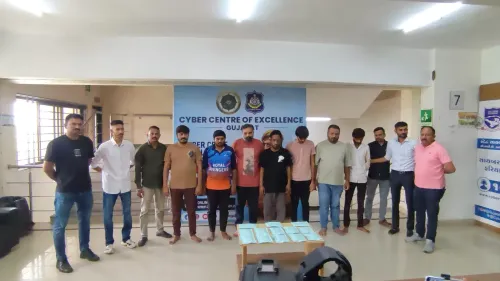
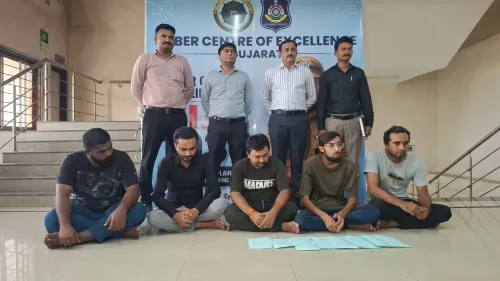
Gujarat's Sabarkantha Cyber Crime Police arrested Dipesh Dabgar, a resident of Ramgath Road, Aspur taluka in Dungarpur district, Rajasthan, on 27 October 2026, after he had evaded law enforcement for nearly three months in a cyber fraud case involving transactions worth over ₹5 crore. The arrest was made as part of Operation Mule Hunt, Gujarat Police's ongoing crackdown on mule bank accounts used to launder money from online fraud.
How the Fraud Was Carried Out
According to investigators, members of an alleged cyber syndicate opened accounts across multiple banks, then collected bank account credentials, ATM cards, and SIM card details from account holders. These accounts were then used as conduits to route proceeds from online fraud — a method commonly known as 'mule banking.' Victims were targeted through online social media platforms and spanned multiple states.
In total, ₹5,04,36,296 was routed through the fraud network, according to investigators. Of this, ₹31,99,430 was traced to bank accounts identified during the investigation. The syndicate allegedly cheated 73 victims, all of whom had registered complaints on the National Cyber Crime Reporting Portal (NCCRP).
The Case and Arrest
The case was originally registered on 30 June at the Himmatnagar Cyber Crime Police Station. Following a technical analysis of digital trails, a police team travelled to Rajasthan to apprehend Dabgar, who had been absconding for three months. The operation was conducted under the directions of senior officials. Himmatnagar Divisional Police Officer A.K. Patel supervised the investigation, while Police Inspector D.N. Vasava led the field team.
What Is Operation Mule Hunt
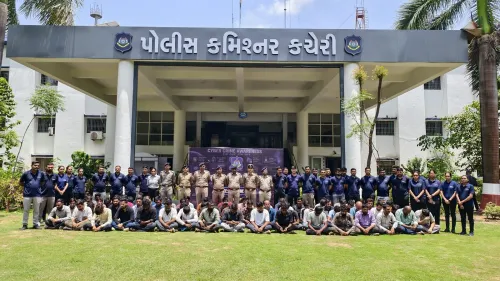
Operation Mule Hunt is a Gujarat Police initiative specifically designed to detect and dismantle cyber fraud networks that rely on mule bank accounts — accounts opened or purchased to receive, transfer, and launder illegally obtained funds. Its first phase, Operation Mule Hunt 1.0, ran as a statewide drive from 1 to 31 December 2025, yielding 565 FIRs, 638 arrests, and action against 913 mule accounts. Cyber fraud worth ₹2,289 crore was identified in that phase alone.
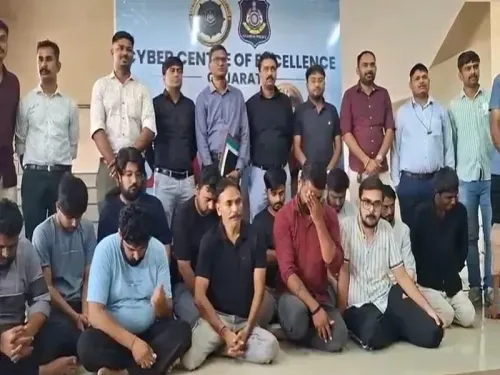
The operation is coordinated through the Gujarat Police Cyber Centre of Excellence, with inputs from the Indian Cyber Crime Coordination Centre (I4C), the NCCRP, and the national cybercrime helpline 1930.
Broader Context
Mule account-based fraud has emerged as one of the fastest-growing vectors of financial crime in India, with law enforcement agencies across states flagging a sharp rise in complaints on the NCCRP in recent years. This arrest marks a continued push by Gujarat Police to pursue suspects beyond state borders — a critical shift, as cybercrime networks are typically dispersed across multiple jurisdictions to complicate investigation. The case also underscores the growing reliance on technical analysis and inter-state coordination to trace and arrest suspects who exploit geographic distance as cover.
Point of View
But the structural vulnerability — that ordinary citizens rent or sell their bank credentials, often under coercion or for small sums — is barely being addressed. Operation Mule Hunt 1.0's ₹2,289 crore figure is a measure of the problem's scale, not its resolution. Until account-opening due diligence at banks is genuinely strengthened and low-level mule recruiters face meaningful consequences, dismantling one node will simply push traffic to another.
NationPress
27 Oct 2026
Frequently Asked Questions
What is Operation Mule Hunt by Gujarat Police?
Operation Mule Hunt is a Gujarat Police crackdown targeting mule bank accounts used by cybercriminals to receive and launder money from online fraud. Its first phase, Operation Mule Hunt 1.0, ran from 1 to 31 December 2025 and resulted in 565 FIRs, 638 arrests, and action against 913 mule accounts, with ₹2,289 crore in cyber fraud identified.
Who is Dipesh Dabgar and why was he arrested?
Dipesh Dabgar is a resident of Ramgath Road, Aspur taluka, Dungarpur district, Rajasthan, arrested by Sabarkantha Cyber Crime Police on 27 October 2026. He was accused of being part of a cyber syndicate that used mule bank accounts to route over ₹5 crore obtained through online fraud targeting 73 victims across India.
How much money was involved in the Sabarkantha cyber fraud case?
The total amount involved in the fraud transactions was ₹5,04,36,296, according to investigators. Of this, ₹31,99,430 was deposited into the bank accounts identified during the investigation.
How were the victims targeted in this cyber fraud?
The 73 victims were residents of different states and were allegedly targeted through online social media platforms. They subsequently filed complaints on the National Cyber Crime Reporting Portal (NCCRP).
What are mule bank accounts and why are they used in cyber fraud?
Mule bank accounts are accounts opened or purchased by cybercriminals — typically by obtaining credentials, ATM cards, and SIM card details from account holders — to receive, transfer, and launder money obtained through online fraud. They are used to obscure the trail of illicit funds and make recovery difficult for investigators.