Gujarat: Man arrested for routing ₹11.35 lakh cyber fraud via family accounts

Synopsis
A Vapi man allegedly ran a multi-account mule network — routing ₹11.35 lakh in cyber fraud proceeds through his wife's and relatives' accounts, then withdrawing cash himself and using the Binance crypto app to convert stolen funds into USDT. The arrest under Operation Mule Hunt 2.0 exposes how crypto and co-operative bank accounts are being stitched together in increasingly layered laundering schemes.
Key Takeaways
Rahul Kumar Chaudhary of Ranchhod Nagar, Vapi was arrested on 19 September 2026 under Operation Mule Hunt 2.0 .
Total cyber fraud proceeds detected in the investigation: ₹11,35,975 , spread across the accounts of his wife and sister-in-law.
The account of Khushi Kumari Nishad recorded transactions of ₹1,46,96,656 between February and August 2026 .
Around nine cybercrime complaints from multiple states were linked to the accounts under investigation.
Rahul allegedly used the Binance app to buy and sell USDT , adding a cryptocurrency layer to the laundering operation.
Police seized two cheque books and a mobile phone ; investigation into associated accounts is continuing.
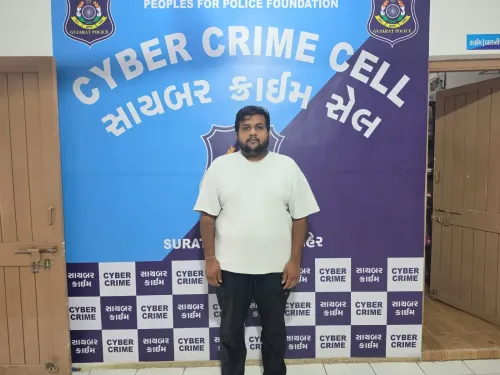
Valsad Cyber Crime Cell has arrested Rahul Kumar Chaudhary, a resident of Ranchhod Nagar, Vapi, for allegedly using bank accounts belonging to his wife and relatives to receive and withdraw cyber fraud proceeds totalling ₹11,35,975. The arrest was made on 19 September 2026 as part of Operation Mule Hunt 2.0, a crackdown on so-called 'mule accounts' used to launder money obtained through cybercrime.
How the Fraud Network Was Uncovered
The investigation began when the Valsad Cyber Crime team conducted a detailed analysis of bank accounts suspected of functioning as mule accounts. Police zeroed in on the account of Khushi Kumari Nishad, a resident of Chanod, Vapi, held with The Shamrao Vithal Co-operative Bank Ltd. Between February and August 2026, the account recorded transactions totalling ₹1,46,96,656 — a volume far beyond what would be expected of a routine account holder.
Investigators found that around nine cybercrime complaints had been registered across different states in connection with that account, with fraud proceeds of approximately ₹6,26,879 credited to it. During questioning, Khushi Kumari told police that she had handed over the account to her brother-in-law, Rahul Kumar, who is originally from Samastipur district, Bihar.
Accused Allegedly Used Multiple Accounts and Crypto Platform
Following the disclosure, police placed Rahul under surveillance and detained him for questioning. Investigations revealed that he had allegedly obtained bank accounts belonging to his wife and other relatives and was using them in various ways to route cyber fraud proceeds. According to police, fraud money was transferred into the accounts of his wife and sister-in-law, after which Rahul allegedly visited the bank personally to withdraw the funds.
Notably, the probe also uncovered the use of the Binance cryptocurrency application, through which Rahul allegedly purchased and sold USDT — a dollar-pegged stablecoin — to further move fraud proceeds. An additional ₹5,09,096 in fraud money was found credited to his wife's account. Combined with the ₹6,26,879 traced to Khushi Kumari's account, the total cyber fraud amount identified in the investigation stood at ₹11,35,975, police confirmed.
Case Registered, Items Seized
The Valsad Cyber Crime Police Station has registered a case against Rahul under Sections 317(2), 317(4), 318(4), 61(2) and 3(5) of the Bharatiya Nyaya Sanhita, 2023, and Sections 66(C) and 66(D) of the Information Technology Act, 2008. Police seized two cheque books and a mobile phone from the accused; the phone was found to contain one SIM card and a Binance ID.
Police confirmed that the investigation into the bank accounts of Rahul and other relatives, as well as the transactions conducted through them, is ongoing.
Warning to the Public on Mule Accounts
Authorities explained that fraud gangs typically use platforms such as Telegram and WhatsApp to lure ordinary individuals with small monetary incentives, before using their bank accounts to route illicit funds — a practice that creates so-called 'mule accounts'. Police warned that account holders bear legal responsibility for any illegal use of their accounts and urged citizens not to share their bank accounts or SIM cards with anyone, regardless of the inducement offered.
With the investigation still active, further arrests involving other account holders or associates cannot be ruled out.
Point of View
Not just the perpetrators of individual scams — a smarter approach. Yet the sheer volume transacted through a single co-operative bank account (₹1.46 crore in six months) raises questions about whether banks' transaction-monitoring systems flagged anything at all. If they did not, the compliance failure is as important a story as the arrest.
NationPress
19 Sept 2026
Frequently Asked Questions
What is Operation Mule Hunt 2.0?
Operation Mule Hunt 2.0 is a law-enforcement initiative under which cyber crime units target individuals who allow their bank accounts to be used as conduits — known as 'mule accounts' — for routing proceeds of cybercrime. The Valsad Cyber Crime Cell used the operation to identify and arrest Rahul Kumar Chaudhary in Vapi, Gujarat.
What is a mule account in the context of cyber fraud?
A mule account is a bank account, typically belonging to an ordinary individual, that is used by fraudsters to receive and move stolen money. Fraud gangs often recruit account holders via Telegram or WhatsApp with small cash incentives, making the account holder legally liable for the transactions.
How much cyber fraud money was traced to Rahul Kumar Chaudhary?
Police traced a total of ₹11,35,975 in cyber fraud proceeds across the accounts under investigation — ₹6,26,879 in the account of Khushi Kumari Nishad and ₹5,09,096 in his wife's account. The broader account of Khushi Kumari recorded total transactions of ₹1,46,96,656 between February and August 2026.
What charges have been filed against the accused?
The Valsad Cyber Crime Police Station has registered a case under Sections 317(2), 317(4), 318(4), 61(2) and 3(5) of the Bharatiya Nyaya Sanhita, 2023, and Sections 66(C) and 66(D) of the Information Technology Act, 2008. These provisions relate to cheating, criminal conspiracy, and identity fraud.
How was cryptocurrency involved in the case?
Investigators found that Rahul allegedly used the Binance application to purchase and sell USDT — a dollar-pegged stablecoin — as part of the scheme to transfer and obscure cyber fraud proceeds, adding a crypto layer to what was otherwise a cash-withdrawal-based laundering operation.