Canada to become EU's first Associate Member after Montreal Summit
Synopsis
For the first time in its history, the European Union has agreed to give a non-European country — Canada — 'Associate Member' status, a tier of partnership that has never existed before. The move, announced at the Montreal Summit on 29–30 October, is as much a geopolitical signal as a trade deal: two Western democracies recalibrating their sovereignty in a world where US reliability can no longer be assumed.
Key Takeaways
Canada and the EU agreed on 29–30 October 2026 in Montreal to pursue Canada's status as the bloc's first-ever Associate Member .
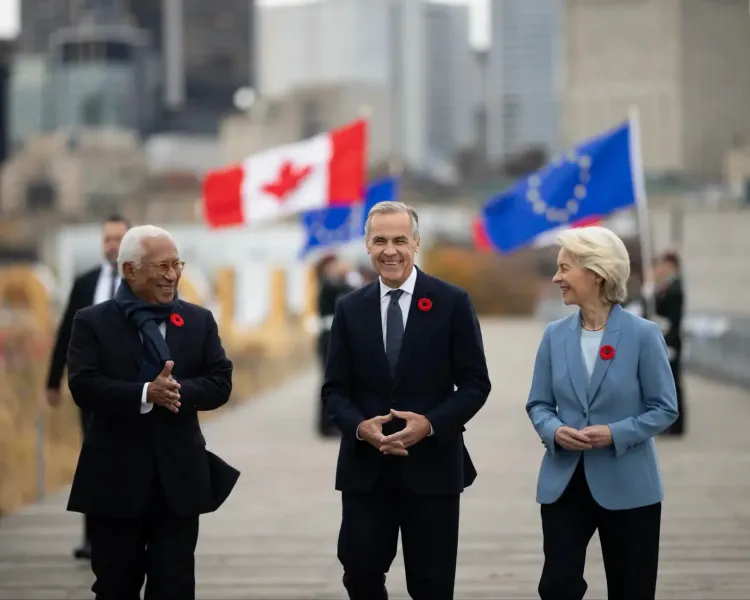
The deal was announced at the 21st Canada-EU Summit , hosted by Prime Minister Mark Carney alongside Antonio Costa and Ursula von der Leyen .
More than twenty new measures were agreed, including a Digital Trade Agreement , a Competition Agreement , and access to the JUPITER supercomputer .
Canada signed a treaty framework allowing the European Investment Bank to invest in Canadian critical minerals projects.
A defence contract worth more than $44 million was awarded to Montreal-based Galvion under the EU's SAFE initiative.
Bilateral trade between Canada and the EU stood at approximately $178 billion in 2025 ; the substance of Associate Membership will be negotiated over coming months.
Canada and the European Union have agreed to work towards making Canada the bloc's first 'Associate Member' — a partnership explicitly short of full membership — as the two sides unveiled what they called an 'Alliance for the Future' at a landmark summit in Montreal on 29–30 October 2026. The announcement marks a historic shift in transatlantic relations, with both sides framing the move as a direct response to a more dangerous and fragmented world order.
What Was Agreed at Montreal
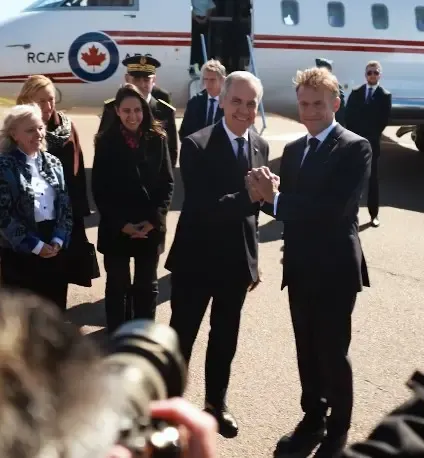
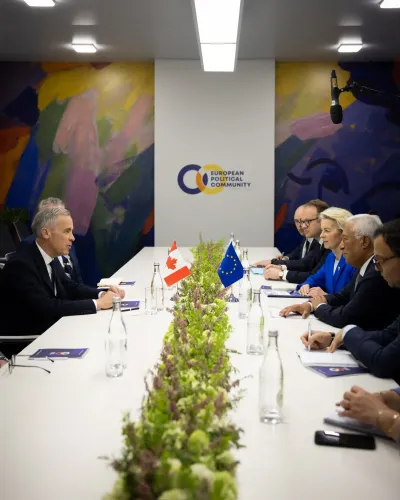
The 21st Canada-EU Summit was held in Montreal, with Canadian Prime Minister Mark Carney hosting European Council President Antonio Costa and European Commission President Ursula von der Leyen. The leaders agreed on a joint statement covering more than twenty new measures spanning trade, digital infrastructure, defence, energy, and research cooperation.
Among the headline agreements, Canada and the EU concluded a Digital Trade Agreement and completed negotiations on a Competition Agreement. Canada also joined the European High Performance Computing Joint Undertaking, giving Canadian researchers access to the JUPITER supercomputer — one of the most powerful computing platforms in Europe.
Canada additionally signed a treaty framework enabling the European Investment Bank (EIB) to invest in Canadian critical minerals projects, a strategically significant step as both sides seek to reduce dependence on Chinese mineral supply chains.
What the Leaders Said
'Canada and the EU are working towards the deepest possible partnership — short of full membership — with Canada becoming the European Union's first Associate Member,' Prime Minister Carney posted on X. 'Today in Montréal, we took a major step forward with more than twenty new measures that will create greater affordability, opportunity, and sovereignty on both sides of the Atlantic,' he added.
European Council President Costa described the summit as a watershed moment. 'At today's EU-Canada Summit, we made history,' he posted. 'We agreed to an ever-closer association — everything short of a full EU membership.'
'Our Alliance with the European Union is built on shared history, common values, and mutual respect,' Carney said in an official release. 'That is what sovereignty looks like: the freedom to live our lives as we choose, on our own terms.'
Energy, Defence and Research Cooperation
On energy security, the two sides agreed to study increasing Canadian LNG exports to Europe — a move with direct implications for European energy independence, particularly as the continent continues to wean itself off Russian gas. The two sides also committed to exploring a new transatlantic data cable.
On defence, Canada secured its second contract under the EU's Security Action for Europe (SAFE) initiative, worth more than $44 million, for Montreal-based Galvion to supply military helmets to Latvia. Canada also agreed to negotiate wider participation in Erasmus+ and joining the next Horizon Europe research programme.
The Bigger Picture: Why It Matters
The EU is Canada's second-largest trading partner for goods and services, with total bilateral trade reaching approximately $178 billion in 2025, according to the Prime Minister's Office. The new Associate Membership framework — whose 'substance, scale, and scope' will be negotiated over the coming months — is expected to deepen this relationship further.
Notably, this is the first time the EU has agreed to extend an Associate Membership arrangement to any country. The move comes amid heightened geopolitical pressure, particularly after shifting US foreign policy posture under the Trump administration prompted both Ottawa and Brussels to accelerate their own strategic alignment. 'A more dangerous and divided world has fundamentally changed the requirements of sovereignty,' the Prime Minister's Office stated.
The precise contours of what Associate Membership will entail remain to be determined, and both sides will work through the details in the months ahead — meaning the full impact of this agreement will only become clear over time.
Point of View
Scale, and scope' undefined, which allows political momentum to build without the friction of detailed negotiations, but also means the announcement risks being more symbolism than architecture. The critical minerals and LNG threads are the most consequential: if the EIB framework actually mobilises capital into Canadian mining and Europe substitutes Russian gas with Canadian LNG, this is a structural realignment. If those threads stall in bureaucratic negotiation, what remains is a glossy communiqué. The geopolitical subtext is unmistakable — both Ottawa and Brussels are building a hedge against an unreliable Washington, and doing it in public.
NationPress
31 Oct 2026
Frequently Asked Questions
What does Canada's EU Associate Membership mean?
Canada's EU Associate Membership is a new, unprecedented category of partnership — deeper than a trade agreement but short of full EU membership — agreed at the Montreal Summit on 29–30 October 2026. The precise substance, scale, and scope of the arrangement will be negotiated over the coming months by both sides.
Why is Canada seeking closer ties with the EU now?
Both Canada and the EU have cited a 'more dangerous and divided world' as the driver, a phrase widely understood as a reference to shifting US foreign policy. The partnership is designed to strengthen sovereignty, economic resilience, and defence cooperation on both sides of the Atlantic.
What specific agreements were reached at the Montreal Summit?
The summit produced more than twenty measures, including a Digital Trade Agreement, a Competition Agreement, Canadian access to the JUPITER supercomputer via the European High Performance Computing Joint Undertaking, a treaty enabling the European Investment Bank to fund Canadian critical minerals projects, and a $44 million defence contract for Montreal-based Galvion to supply helmets to Latvia.
Has the EU ever had an Associate Member before?
No. Canada would become the first country to hold Associate Member status in the EU's history. The category itself was created as part of this agreement and has no existing precedent in EU treaties or practice.
How large is the trade relationship between Canada and the EU?
The EU is Canada's second-largest trading partner for goods and services, with total bilateral trade valued at approximately $178 billion in 2025, according to the Canadian Prime Minister's Office.