South China Sea tensions, China's military build-up dominate ASEAN Defence meet in Philippines
Synopsis
China sent only its defence attaché to the ASEAN Defence Ministers' Meeting-Plus in the Philippines — the lowest-level representation since the forum launched in 2010 — after a row with Manila over its own participation. Australia's defence minister called China's military expansion the largest conventional build-up since World War II, as South China Sea confrontations between Beijing and Manila reached a new diplomatic flashpoint.
Key Takeaways
The ASEAN ADMM-Plus in Cebu, Philippines was overshadowed by a Beijing-Manila diplomatic dispute over China's participation.
Chinese Defence Minister Dong Jun skipped the summit; China was represented only by its defence attaché — the lowest-level Chinese presence since the forum began in 2010 .
Australian Defence Minister Richard Marles described China's military expansion as the largest conventional build-up since World War II .
Australia had earlier condemned China's nuclear-capable ballistic missile test in the South Pacific in July as 'provocative and destabilising.' Tensions have intensified around Scarborough Shoal and Second Thomas Shoal in the Spratly Islands , with China increasing the frequency and intensity of incursions.
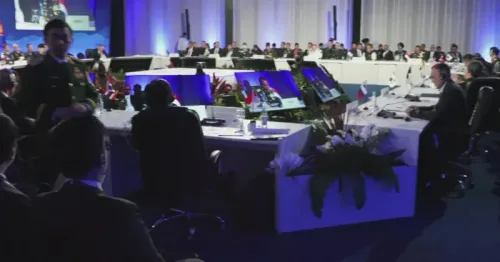
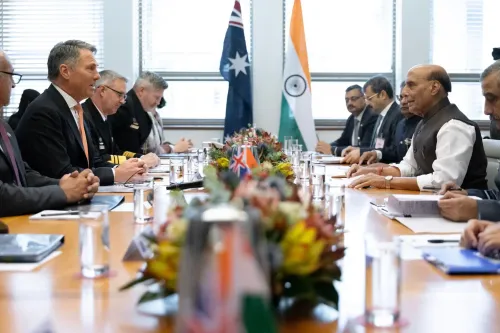
Tensions in the South China Sea and China's accelerating military expansion took centre stage at the ASEAN Defence Ministers' Meeting-Plus (ADMM-Plus) held in Cebu, Philippines, as a diplomatic dispute between Beijing and Manila over China's participation cast a shadow over the forum.
Australia Sounds the Alarm on China's Military Growth
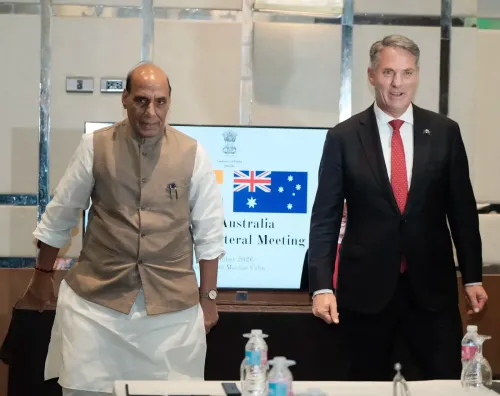
Australian Defence Minister Richard Marles, speaking on the sidelines of the ADMM-Plus, described China's military expansion as the largest conventional military build-up witnessed since World War II. Marles flagged Beijing's growing assertiveness as a direct challenge and called for tighter coordination among like-minded partners and allies.
'We need to be ensuring that how we understand the rules of the road continues to apply, because for a middle power like Australia, it is actually the rules which give us agency,' Marles said.
Australia had earlier this year protested China's test-firing of a nuclear-capable ballistic missile in the South Pacific in July, denouncing the launch as 'provocative and destabilising,' according to reports.
Beijing-Manila Dispute Spills Into Diplomatic Row
The maritime dispute between China and the Philippines extended well beyond the sea and into the summit itself. China's Ministry of Defence accused the Philippines of obstructing Beijing's participation in the ADMM meetings and violating 'basic diplomatic protocols.' Chinese Defence Minister Dong Jun subsequently skipped the meeting entirely.
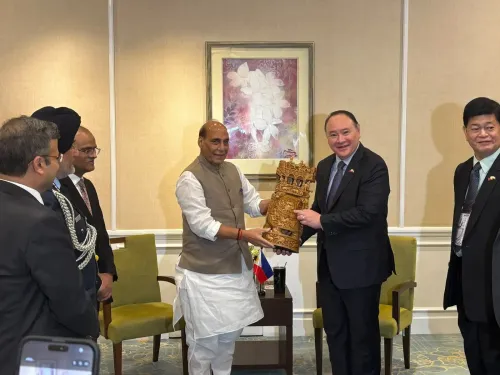
China was instead represented by its defence attaché — marking the lowest-level Chinese representation at the ADMM-Plus since the forum's inception in 2010. The ADMM-Plus brings together defence ministers from ASEAN's 11 member countries and its eight dialogue partners: Australia, China, India, Japan, New Zealand, Russia, South Korea, and the United States.
Philippine Defence Secretary Gilberto Teodoro declined to respond directly to Beijing's allegation, saying China was 'given an opportunity to articulate their position, which is not any different from what they have been articulating before.'
Escalating Confrontations in Contested Waters
According to reports, China has significantly increased both the frequency and intensity of its incursions into areas of the South China Sea claimed by the Philippines in recent years, resulting in a string of increasingly dangerous confrontations. The flashpoints have been particularly acute around Scarborough Shoal and Second Thomas Shoal in the Spratly Islands.
These incidents reflect what analysts describe as a 'condition of pressure' that China's military posture is creating across Southeast Asia — a phrase Marles himself used in his remarks to the media.
What This Means for Regional Security
China's decision to downgrade its representation at ADMM-Plus is widely seen as a signal of its deepening frustration with Manila and, by extension, with US-allied partners in the region. Notably, this comes at a time when Washington has been strengthening its defence partnerships with both the Philippines and Australia under various bilateral and multilateral frameworks.
The poor state of Beijing-Manila relations — frayed by repeated at-sea confrontations — now risks undermining the ASEAN-led multilateral security architecture, which has historically sought to manage great-power rivalry through dialogue rather than confrontation. With China's defence minister absent and no sign of de-escalation, the South China Sea's trajectory into the coming months remains deeply uncertain.
Point of View
And no multilateral mechanism has found a way to manage it. Australia's framing of China's expansion as the largest since World War II is calibrated to mobilise like-minded partners, but it also risks accelerating the very arms-race dynamic it warns against. India, present at the ADMM-Plus as a dialogue partner, faces a familiar dilemma — strategic proximity to both Washington's Indo-Pacific framework and its own complex border calculus with Beijing.
NationPress
5 Nov 2026
Frequently Asked Questions
What is the ASEAN ADMM-Plus and who participates in it?
The ASEAN Defence Ministers' Meeting-Plus (ADMM-Plus) is a multilateral defence forum that brings together defence ministers from ASEAN's 11 member countries and eight dialogue partners — Australia, China, India, Japan, New Zealand, Russia, South Korea, and the United States. It has met since its inception in 2010 to coordinate on regional security.
Why did China send a low-level representative to the ADMM-Plus in the Philippines?
China's Ministry of Defence accused the Philippines of obstructing Beijing's participation and violating 'basic diplomatic protocols,' prompting Defence Minister Dong Jun to skip the meeting. China was instead represented by its defence attaché, the lowest-level Chinese presence at the forum since it began in 2010.
What did Australia's defence minister say about China's military expansion?
Australian Defence Minister Richard Marles described China's military build-up as the largest conventional military expansion since World War II. He called Beijing's growing assertiveness a challenge for Australia and urged closer coordination among like-minded partners and allies.
Where are the key flashpoints between China and the Philippines in the South China Sea?
The most dangerous confrontations have centred on Scarborough Shoal and Second Thomas Shoal in the Spratly Islands. Reports indicate China has increased both the frequency and intensity of incursions into areas claimed by the Philippines in recent years.
How does the ASEAN Defence ministers' meeting relate to India?
India is one of eight dialogue partners at the ADMM-Plus, giving it a seat at the table alongside other major powers. The meeting's outcome has implications for India's own Indo-Pacific posture, particularly as it manages a complex relationship with China following years of border tensions.