China faces succession crisis, economic slowdown and fiscal strain: Report
Synopsis
A new analytical report lays out a stark convergence: Xi Jinping has eliminated all visible successors while China's tax revenues have cratered to levels typical of lower-middle-income countries — from 18.4% of GDP in 2012 to just 12.6% in 2025. The report warns that even a slow Chinese economic unravelling, not just a dramatic collapse, could send fresh shockwaves through the global economy.
Key Takeaways
A report by Free Malaysia Today warns China faces a simultaneous succession crisis , economic slowdown , and fiscal deterioration .
Chinese President Xi Jinping has centralised power with no clear succession mechanism, reportedly generating deep institutional resentment.
China's tax revenues (excluding social-insurance contributions) fell from 18.4% of GDP in 2012 to 12.6% of GDP in 2025 — a drop of nearly six percentage points .
Personal income tax has contributed just 1.2% of GDP on average over the past 10 years .
The CPC has increasingly relied on land sales to fund government operations, ceding control over a strategic asset.
The report warns that even a gradual Chinese economic decline — not a dramatic collapse — could trigger a significant global economic shock .
China is confronting a convergence of three compounding threats — a looming succession crisis, a structurally weakening economy, and dwindling fiscal resources needed to maintain domestic control and project influence abroad — according to an analysis published by Free Malaysia Today (FMT). The report, released on 14 November 2026, warns that what is at stake is not merely China's growth trajectory but the foundational social compact between the Chinese Communist Party (CPC) and its citizens.
The Political Fault Lines
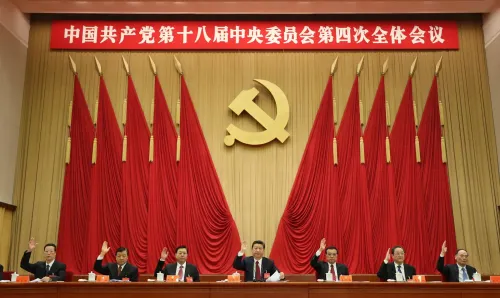
At the centre of the political risk, the report argues, is the consolidation of power by Chinese President Xi Jinping, who has, according to the analysis, 'ruthlessly eliminated all potential opposition and centralised power in his own hands.' The report asserts that his systematic dismantling of state, party, provincial, and military leadership structures has generated deep-seated resentment, even if the opacity of the CPC makes this difficult to verify conclusively. Notably, with no visible succession mechanism in place, the question of who leads China after Xi remains, critics argue, a structural vulnerability that few dare to address publicly.
A Faltering Economy Under Multiple Pressures
The economic picture, according to the FMT report, is one of mounting downside risks. While some analysts continue to view China as a formidable manufacturing and technological power, others point to a constellation of structural headwinds: an ageing population, a prolonged property market slump, rising youth unemployment, and growing hostility toward private enterprise. Exports — historically the engine of Chinese dynamism — are increasingly vulnerable to retaliatory policy responses from the United States and Europe, both under political pressure to respond to what economists have called the 'China shock.'
This comes amid a broader global rethinking of supply chain dependence on China, adding an external dimension to what are already considerable internal economic strains.
Fiscal Capacity in Sharp Decline
Perhaps the most striking finding in the report concerns China's fiscal trajectory. According to the analysis, personal income tax revenues have contributed a mere 1.2% of GDP on average over the past 10 years — a figure the report describes as strikingly low for a country of China's ambitions. More alarming, it notes, is that overall tax revenues (excluding social-insurance contributions) have collapsed by nearly six percentage points between 2012 and 2025, falling from 18.4% of GDP to 12.6% of GDP.
'These are levels associated with a struggling, lower-middle-income country, not an aspiring superpower,' the report states. Paradoxically, the CPC — ideologically committed to collective ownership — has increasingly relied on land sales to plug revenue gaps, effectively relinquishing control over one of its most strategically significant assets.
The Social Compact Under Strain
The report underscores that the CPC's legitimacy has long rested on an implicit bargain: material well-being and stability in exchange for curtailed political freedoms and a suppressed public voice. As economic growth slows and public services reportedly deteriorate, that bargain is coming under pressure. The CPC has demonstrated considerable capacity for coercive control, the report concedes, but it has found collecting adequate revenues from its population 'considerably harder.'
Global Consequences of a Chinese Slowdown
The report stops short of predicting an abrupt collapse, suggesting instead that 'a slow bleed of anaemic growth, rising restiveness, and deteriorating services is perhaps likelier.' But it cautions that even a gradual unwinding of the Chinese growth model — ending 'with a whimper rather than a bang' — could deliver yet another significant shock to the global economy. For countries deeply integrated into Chinese supply chains, financial markets, and trade flows, the downstream consequences could be far-reaching. How the international community and multilateral institutions respond to such a scenario remains, for now, an open question.
Point of View
Far from being a source of strength, has created a brittle system with no self-correcting mechanism: no succession plan, no internal dissent, no independent revenue base. The world has spent years debating whether China will overtake the US; the more urgent question may be whether China can sustain its own social compact through the next decade.
NationPress
14 Nov 2026
Frequently Asked Questions
What are the three threats China is reportedly facing according to the report?
According to the Free Malaysia Today report, China faces a succession crisis stemming from Xi Jinping's elimination of potential rivals, a structural economic slowdown driven by an ageing population and property market slump, and a sharp decline in fiscal capacity. Together, these three pressures threaten both domestic stability and China's ability to project influence abroad.
How severely have China's tax revenues declined?
Tax revenues in China (excluding social-insurance contributions) fell from 18.4% of GDP in 2012 to 12.6% of GDP in 2025 — a collapse of nearly six percentage points. The report notes these are levels typically associated with lower-middle-income countries, not an aspiring global superpower.
What is the succession crisis mentioned in the report?
The report argues that President Xi Jinping has systematically eliminated all potential successors and centralised power to an unusual degree, leaving the CPC with no visible succession mechanism. This creates a structural political risk, as there is no clear path for an orderly leadership transition.
Why is China's reliance on land sales a concern?
The report highlights that despite an ideological commitment to collective ownership, the CPC has increasingly depended on land sales to fund government operations. This is seen as paradoxical and fiscally fragile, as it effectively surrenders control over a key strategic asset while failing to build a sustainable tax base.
What could a Chinese economic slowdown mean for the rest of the world?
The report warns that even a gradual Chinese economic decline — marked by anaemic growth, rising public restiveness, and deteriorating services — could trigger another significant global economic shock. Countries deeply integrated into Chinese trade, supply chains, and financial markets would likely face considerable downstream consequences.