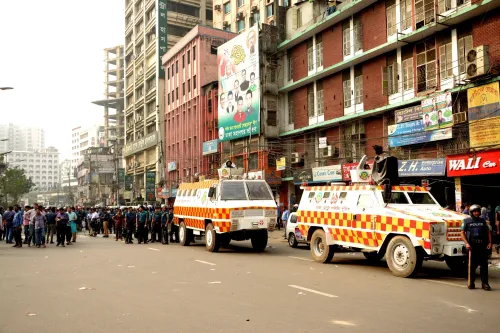
Chinese workers protest in Russia over unpaid wages, surround police vehicles
Synopsis
Over 1,000 Chinese construction workers in Russia physically surrounded armed police to free a detained colleague — a rare and bold act of defiance that lays bare a widening crisis: Chinese state-linked firms withholding wages, confiscating passports, and leaving workers with no recourse as Russia's total unpaid wage arrears surged 94% year-on-year to 2.879 billion rubles by April 2026.
Key Takeaways
More than 1,000 Chinese workers surrounded armed police vehicles in Russia to secure the release of a detained colleague in August 2026 .
The detained worker was allegedly unpaid for months and was employed at a subsidiary of China National Chemical Engineering Group , a Chinese state enterprise.
Russia's unpaid wage arrears reached 2.879 billion rubles in April 2026 , up 94 per cent year-on-year .
Nearly 10 Chinese workers died at Russian work sites in 2025 from accidents and drone-strike shrapnel, with no company response reported.
A separate protest at Petro-Hehua in April left roughly 1,500 workers unpaid after Rosneft terminated a contract in Komsomolsk-on-Amur .
More than 1,000 Chinese construction workers surrounded armed police vehicles in Russia and compelled officers to release a detained colleague, in what observers are calling a rare and striking act of public defiance by citizens of an authoritarian state working abroad. The incident, reported recently, came after a Chinese worker — allegedly unpaid for months — was taken into custody by police following a confrontation with site managers.
The Incident and Its Context
The detained worker was employed at a project linked to a wholly owned arm of China National Chemical Engineering Group, a Chinese state enterprise with a footprint of more than $20 billion along the Baltic coast, encompassing what are described as the world's largest integrated ethane cracker and methanol projects. The standoff, which occurred in August, is the latest episode in a pattern of escalating labour disputes involving Chinese contractors operating in Russia.
According to reports, workers at the company have repeatedly raised complaints about withheld wages, confiscated passports, pay routed through opaque third-party subcontractors, and fixed salaries quietly replaced with piece-rate contracts. One manager reportedly attributed an entire workforce's unpaid wages to a single colleague's bank account-related issue — an excuse described in the report as 'so absurd' it underscored the impunity with which contractors have operated.
Russia's Wage Arrears Crisis
The protests are unfolding against a backdrop of deepening wage defaults across Russia. Data from Russia's Federal State Statistics Service showed that the country's total unpaid wage arrears reached 2.879 billion rubles in April 2026, a rise of 35 per cent month-on-month and 94 per cent year-on-year. The figure points to a systemic stress in Russia's construction and industrial sectors, where foreign labour has become an essential but vulnerable component.
Deaths and Dangers on Site
The human cost has not been limited to unpaid wages. According to the report, nearly 10 Chinese workers died at work sites in 2025, from causes including scaffold collapses, machinery accidents, and drone-strike shrapnel. The company reportedly offered no public response to these deaths. 'Workers who cannot get help from their own state-owned employer are left appealing to a foreign president for mercy,' the report noted.
A Pattern Across Companies
The August standoff is not an isolated incident. A similar protest reportedly broke out at another Chinese company, Petro-Hehua, in April, when hundreds of workers marched in Komsomolsk-on-Amur after Rosneft terminated a contract, leaving roughly 1,500 workers unpaid. The recurring nature of such disputes suggests structural vulnerabilities in how Chinese state enterprises deploy and manage migrant labour in Russia.
A System That Externalises Failure
The broader dynamic, critics argue, reflects the convergence of two authoritarian systems. As the report observed, the situation is 'not one of two adversarial systems but of two states — one authoritarian and cash-strapped, one authoritarian and image-obsessed — that have found a mutually convenient way to externalize the cost of failure onto migrant labourers who have the least power to resist.' The workers, caught between a Russian state under fiscal strain and a Chinese employer unwilling to absorb reputational damage, have few institutional channels for redress.
With Russia's wage arrears continuing to climb and geopolitical pressures keeping Sino-Russian economic ties in the spotlight, the fate of Chinese migrant workers in Russia is unlikely to recede from view.
Point of View
At a time when China is positioning itself as an alternative model of development globally.
NationPress
14 Sept 2026
Frequently Asked Questions
Why are Chinese workers protesting in Russia?
Chinese construction workers in Russia have been protesting over unpaid wages, confiscated passports, and exploitative contract changes imposed by Chinese state-linked contractors. The most recent incident in August saw over 1,000 workers surround police vehicles to free a detained colleague who had allegedly gone months without pay.
Which company is at the centre of the August 2026 protest?
The company involved is a wholly owned subsidiary of China National Chemical Engineering Group, a Chinese state enterprise with a $20 billion-plus presence in Russia, including major ethane cracker and methanol projects along the Baltic coast.
How serious is Russia's unpaid wage problem in 2026?
Russia's total unpaid wage arrears reached 2.879 billion rubles in April 2026, according to data from Russia's Federal State Statistics Service — a rise of 35 per cent month-on-month and 94 per cent year-on-year. The figures point to deepening fiscal stress in Russia's construction and industrial sectors.
Have there been other similar protests by Chinese workers in Russia?
Yes. A separate protest occurred in April at Petro-Hehua in Komsomolsk-on-Amur, where hundreds of workers marched after Rosneft terminated a contract, leaving approximately 1,500 workers unpaid. The incidents suggest a recurring pattern rather than isolated disputes.
What risks do Chinese workers face at Russian construction sites?
Beyond unpaid wages, Chinese workers at Russian sites have faced dangerous working conditions. Reports indicate that nearly 10 Chinese workers died in 2025 from scaffold collapses, machinery accidents, and drone-strike shrapnel. The companies involved reportedly offered no official response to the deaths.