Vance: Democrat Congress win could cost US the AI race to China
Synopsis
Vance's White House warning was equal parts geopolitics and campaign messaging: America is already outpaced three-to-one by China on electricity generation, and he argues a Democratic Congress would widen that gap further. With data centres at the centre of the AI arms race, energy policy has quietly become one of the sharpest fault lines heading into the mid-terms.
Key Takeaways
Vance warned on 4 September that a Democratic Congress win could cost the US the AI race to China .
A Fox News poll cited at the briefing found 70 per cent of voters oppose a data centre in their area.
China now produces three times as much electricity as the United States, according to Vance.
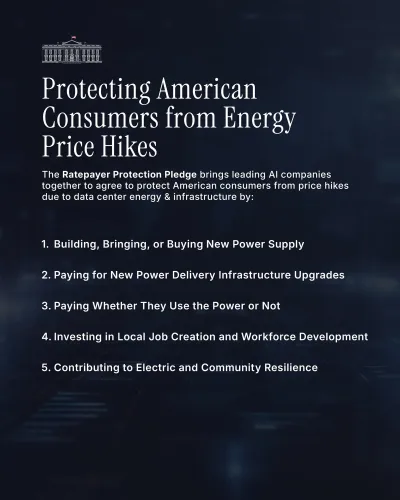
The Trump administration requires new data centres to feed power back into the grid rather than drain it.
Vance said eased approvals for nuclear and other power plants next to data centres are part of the administration's strategy.
The Vice-President tied the AI contest directly to the mid-term elections , claiming a Democratic win would raise energy prices and taxes.
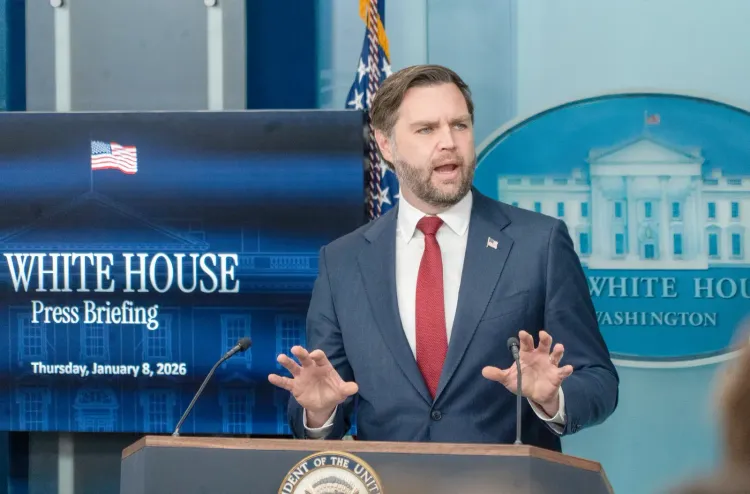
US Vice-President J.D. Vance warned on 4 September that the United States risks losing the Artificial Intelligence (AI) race to China if Democrats reclaim control of Congress, calling for a dramatic expansion of domestic energy supply and faster construction of data centres. The remarks, delivered at a White House press briefing, directly tied AI competitiveness to the upcoming mid-term elections.
The Core Warning
'I think there's a very good chance that if the Democrats take control of Congress, we will lose the AI race to China,' Vance said, responding to a reporter's question about public resistance to data centre construction. A Fox News poll cited during the briefing showed 70 per cent of voters did not want a data centre built in their area.
Vance acknowledged the backlash was rooted in real concerns — chiefly that data centres would push up household electricity bills and leave local communities worse off. He argued the administration had a path to resolve that tension.
The Energy Equation
Central to Vance's argument was a stark comparison between US and Chinese power generation. China drew level with the United States in electricity output around 2005, he said, before pulling decisively ahead. 'Today, China produces three times as much power as the United States of America,' Vance said.
He said President Donald Trump had made it a condition that data centres must feed power back into the national grid rather than drain existing supplies. The administration has also moved to ease approvals for nuclear and other power plants to be built adjacent to data centres, allowing those facilities to add electricity capacity rather than consume it.
What the Administration Is Proposing
'If you're going to build a data center, you have to feed power back into the grid as opposed to taking power out,' Vance said, framing this as the way to win public support for AI infrastructure. He urged the country to follow 'the President of the United States' lead' in balancing consumer protection with infrastructure expansion.
Vance broadened the argument beyond data centres: 'We cannot be a country that says, we're not going to build more power, we're not going to build more rockets, we're not going to do anything because the regulations or the cost or the risk are just too high.' He called on the US to 'become a nation of builders again.'
The Mid-Term Dimension
Vance explicitly connected the AI competition to the coming mid-term elections, claiming a Democratic victory would result in higher energy prices, higher taxes, and disruption to efforts aimed at reviving American manufacturing. The remarks position AI infrastructure as a central campaign-trail flashpoint ahead of the vote.
The US–China contest spans advanced AI model development, semiconductor technology, and the physical infrastructure — primarily data centres — needed to operate them. Data centres demand large, reliable electricity supplies for both computing equipment and cooling systems, making energy policy inseparable from AI strategy.
Point of View
Not a neutral assessment. The three-to-one power generation gap with China is real and significant, but the causal link between Democratic congressional control and AI decline is asserted, not demonstrated. What the briefing does surface, accurately, is a genuine structural problem: US data centre expansion is running into an energy grid that was not built for it, and public opposition to local infrastructure is a democratic constraint neither party has fully solved. The administration's grid-feed requirement for data centres is a notable policy signal, but its enforceability and scale remain untested.
NationPress
4 Sept 2026
Frequently Asked Questions
What did J.D. Vance say about the US AI race with China?
Vance warned at a White House press briefing on 4 September that the US risks losing the AI race to China if Democrats take control of Congress. He argued the country must rapidly expand its energy supply and accelerate data centre construction to stay competitive.
Why is energy central to the US-China AI competition?
Data centres — the physical backbone of AI development — require large, reliable electricity supplies for computing and cooling. Vance pointed out that China now generates three times as much electricity as the United States, a gap he said directly threatens US AI capacity.
What is the Trump administration's policy on data centres and the power grid?
The administration requires that new data centres feed electricity back into the national grid rather than draw from existing supplies. It has also eased approvals for nuclear and other power plants to be built next to data centres, aiming to add grid capacity rather than strain it.
Why do many Americans oppose data centres being built near them?
According to a Fox News poll cited by Vance, 70 per cent of voters do not want a data centre in their area. The primary concern is that the facilities will drive up household electricity bills and make local communities worse off economically.
How does Vance connect AI policy to the mid-term elections?
Vance claimed a Democratic congressional victory would lead to higher energy prices, higher taxes, and disruption to US manufacturing revival efforts — all of which he argued would weaken America's AI competitiveness against China.