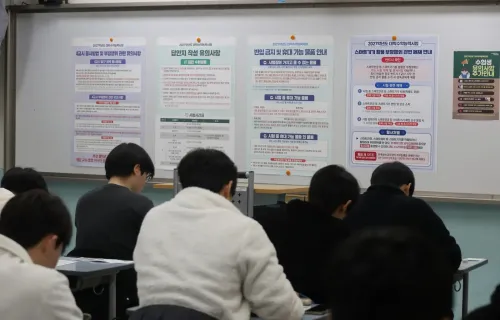
South Korea CSAT cheating cases jump 70% to 474 in 2026
Synopsis
Tighter oversight didn't stop cheating at South Korea's CSAT. Misconduct cases rose nearly 70% to 474, and smart-device violations grew 3.6-fold. Six examinees now face criminal complaints, including some who allegedly photographed questions in restrooms. Seoul is responding with metal detectors and RF scanners at test sites.
Key Takeaways
South Korea logged 474 CSAT misconduct cases as of Wednesday, up 69.9% from 279 a year earlier.
Smart-device violations rose 3.6-fold to 112 from 31 , nearly a quarter of all cases from the 19 November exam.
Writing answers after the bell ( 127 , up from 25 ) and social studies answer-sheet breaches ( 127 ) were the most common violations.
The education ministry filed criminal complaints against six examinees on Monday for serious cheating.
Metal detectors and radio-frequency detection devices will be deployed at CSAT testing sites.
The ministry is considering extending the TOPIK cheating ban from two to 10 years .
Exam misconduct cases detected during South Korea's College Scholastic Ability Test (CSAT) this year rose nearly 70% from a year earlier, the country's education ministry said in Seoul on Friday, 27 November 2026. The rise came despite tighter exam management and oversight. Violations involving smart devices grew 3.6-fold and made up nearly a quarter of all cases flagged during the 19 November exam.
Key Figures From the Ministry's Report
According to a report submitted to the National Assembly, a total of 474 CSAT-related misconduct cases had been reported as of Wednesday. That is up 69.9% from 279 cases a year earlier.
Two categories tied for the top spot, with 127 cases each:
- Writing answers after the end-of-exam bell, which surged from 25 cases last year.
- Breaches of answer-sheet rules during the fourth-period social studies session, which rose by 53 cases.
Smart Devices Emerge as a Major Concern
Violations involving smart devices jumped to 112 from 31 the previous year, the sharpest proportional increase of any category. Notably, possession of other electronic devices dipped slightly, to 51 cases from 53.
Other forms of misconduct, including failure to follow proctors' instructions, stood at 57, up 38 from the previous year. Taken together, the data suggest that while traditional device-possession violations held steady, the use of smartphones and similar tools to gain an advantage grew sharply.
Criminal Complaints Against Six Examinees
On Monday, the ministry filed criminal complaints against six CSAT examinees accused of serious cheating, including the use of smart devices. According to the ministry:
- Three examinees allegedly used smartphones in restrooms to photograph test questions.
- One allegedly used a miniature camera to take pictures of exam papers.
The move signals a shift from administrative penalties toward criminal accountability in the most serious cases. The CSAT is South Korea's high-stakes national college entrance exam.
New Security Measures and TOPIK Oversight
To counter device-based cheating, the ministry said it plans to deploy metal detectors and radio-frequency detection devices at CSAT testing sites.
The ministry also plans to strengthen oversight of the Test of Proficiency in Korean (TOPIK), a Korean-language proficiency test for non-native speakers. It will work with Korean Education Centers and South Korean diplomatic missions abroad on this effort.
It added that it will consider extending the ban on TOPIK examinees caught cheating from the current two years to 10 years. That would be a fivefold increase in the penalty.
What Comes Next
The rise in cases came even with stricter supervision in place. This raises a question about whether better detection or more cheating explains the jump. The ministry's report does not separate the two factors.
The rollout of detection hardware at testing centres, and the outcome of the criminal complaints, will be the next test of whether Seoul's tougher approach can reverse the trend before the next CSAT cycle.
Point of View
The 70% jump is hard to interpret. Either way, the shift to criminal complaints and RF scanners shows that exam security is now a technology arms race. For India, where paper leaks and impersonation have repeatedly hit national exams, Seoul's move toward hardware detection and longer bans offers a model worth studying, though deterrence only works if enforcement is consistent.
NationPress
27 Nov 2026
Frequently Asked Questions
How many cheating cases were reported in South Korea's 2026 CSAT?
A total of 474 misconduct cases were reported as of Wednesday, up 69.9% from 279 a year earlier, according to South Korea's education ministry.
Why did smart-device cheating draw attention in this year's CSAT?
Violations involving smart devices jumped 3.6-fold, to 112 from 31, and accounted for nearly a quarter of all cases. Some examinees allegedly photographed test questions with smartphones in restrooms or with a miniature camera.
What action has the ministry taken against cheating examinees?
On Monday, the ministry filed criminal complaints against six CSAT examinees accused of serious cheating, including the use of smart devices.
What new measures will South Korea introduce at CSAT testing sites?
The education ministry plans to deploy metal detectors and radio-frequency detection devices at CSAT testing sites to curb device-based cheating.
How will the TOPIK cheating ban change?
The ministry will consider extending the ban on TOPIK examinees caught cheating from the current two years to 10 years. It also plans stronger oversight with Korean Education Centers and diplomatic missions abroad.