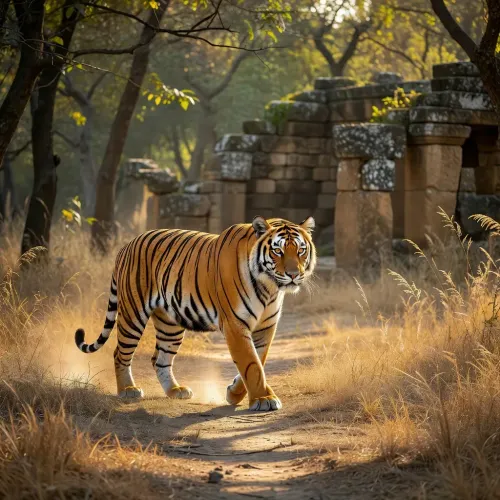
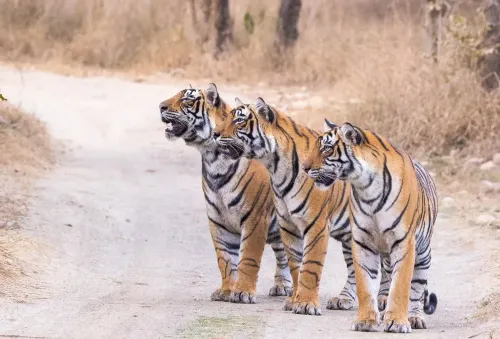
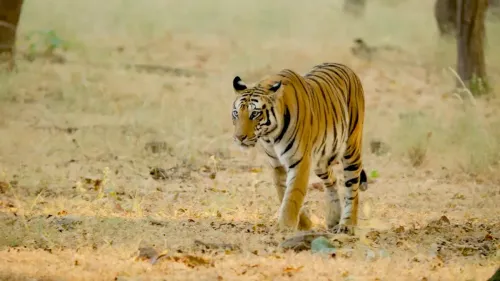
Nepal tiger population hits 429 in 2026, up from 121 in 2009

Synopsis
Nepal's tiger count has nearly quadrupled in under two decades — from 121 in 2009 to 429 in 2026 — making it one of the most striking wildlife recoveries in Asia. But with success comes a new challenge: rising human-tiger conflict and the need for a first-ever Tiger Sanctuary to house animals that can no longer safely coexist in the wild.
Key Takeaways
Nepal's wild tiger population reached 429 in 2026 , up from 355 in 2022 and just 121 in 2009 .
The Chitwan area leads with 145 tigers; Bardiya National Park follows with 112 .
Nepal's forest cover expanded from 29% in 1994 to over 46% in 2022 , according to a World Bank report.
The global wild tiger population has recovered to 5,574 , with India hosting the largest share at 3,682 .
Nepal is planning its first Tiger Sanctuary at Devnagar, Chitwan — spanning 52 hectares and designed for 18–20 tigers.
Rising human-tiger conflict has been flagged as a key conservation challenge alongside habitat management.
Nepal's wild tiger population has climbed to 429 in 2026, up from 355 recorded in the previous census in 2022, according to the country's latest National Tiger Census released on Wednesday, 29 July to mark World Tiger Day. The figures, unveiled by Nepal's Ministry of Agriculture, Forests and Environment, underscore a remarkable conservation turnaround — from just 121 tigers in 2009 to 429 today.
Key Findings of the 2026 Census
The Chitwan–Parsa landscape holds the highest concentration of tigers, with 145 big cats recorded in the Chitwan area alone. Bardiya National Park and its surrounding forests account for 112 tigers, while Parsa National Park and its adjoining zones host 71. Banke National Park has 51 tigers, and Shuklaphanta National Park and surrounding forests shelter 50.
The census was conducted primarily through the camera trap method, with around 1,100 automatic cameras deployed and systematically rotated across 1,900 survey points. Individual tigers were identified by their unique stripe patterns — as distinctive as fingerprints. A multidisciplinary team of 250 to 300 technical experts and field personnel carried out the survey, with data analysed using statistical and analytical models.
What Experts Said
Hari Bhadra Acharya, senior ecologist at the Department of National Parks and Wildlife Conservation, described the results as a landmark achievement. 'This is a major achievement for Nepal,' he said. 'Not only has the country succeeded in conserving an endangered species, but it has also managed to steadily increase its tiger population.' He added that the findings further reinforce Nepal's standing as a global leader in tiger conservation.
Forest Cover and Global Context
The tiger population rebound has coincided with a significant expansion of Nepal's forest cover. According to a World Bank report, Nepal increased its forested area from 29% in 1994 to more than 46% in 2022 — one of the more striking reforestation stories in South Asia.
Globally, the picture has also improved. According to the World Wildlife Fund (WWF), the worldwide wild tiger population had fallen to approximately 3,200 in 2010 — a 97% decline from historical levels. That figure has since recovered to 5,574. India hosts the world's largest tiger population at 3,682. The recovery was partly catalysed by the St. Petersburg Declaration on Tiger Conservation, endorsed at the Tiger Summit in Russia's Saint Petersburg in 2010, which set the goal of doubling the global wild tiger population by 2022.
Conservation Challenges Ahead
Despite the progress, Acharya cautioned that a growing tiger population brings its own pressures. 'As tiger numbers increase, encounters and conflicts between people and tigers are also becoming more frequent,' he said. 'Reducing and effectively managing human-tiger conflict will be one of Nepal's biggest conservation challenges in the years ahead.' He identified two primary challenges: sustaining the expanding population through long-term habitat management, and mitigating human-tiger conflict.
Nepal is also planning its first Tiger Sanctuary at Devnagar in Chitwan National Park, in the southern district of Chitwan. The proposed facility would span approximately 52 hectares and accommodate 18 to 20 tigers — primarily older or injured animals, referred to as 'problematic tigers', that can no longer safely hunt natural prey. The sanctuary is also intended to serve as an eco-tourism destination, potentially generating revenue to support ongoing conservation efforts.
Point of View
But the real story is structural: forest cover expansion and sustained political will over nearly two decades have done what many conservation programmes elsewhere only promise. The harder test now is whether Nepal can manage the second-order consequences of its own success — human-tiger conflict is rising precisely because the recovery is working. The proposed Devnagar sanctuary is a pragmatic response, but 52 hectares for 18–20 tigers is a containment measure, not a conservation strategy. Long-term habitat connectivity across the Terai Arc remains the variable that will determine whether 429 is a plateau or a waypoint.
NationPress
29 Jul 2026
Frequently Asked Questions
What is Nepal's tiger population in 2026?
Nepal's wild tiger population stands at 429 in 2026, according to the National Tiger Census released on 29 July 2026 to mark World Tiger Day. This is up from 355 in 2022 and 121 in 2009.
Where are most of Nepal's tigers found?
The Chitwan–Parsa landscape holds the highest concentration, with 145 tigers in the Chitwan area. Bardiya National Park follows with 112, Parsa National Park with 71, Banke National Park with 51, and Shuklaphanta National Park with 50.
How was the 2026 Nepal tiger census conducted?
The census used the camera trap method, deploying around 1,100 automatic cameras across 1,900 survey points. Individual tigers were identified by unique stripe patterns, and data were analysed using statistical models by a team of 250 to 300 experts.
What is Nepal's planned Tiger Sanctuary?
Nepal is developing its first Tiger Sanctuary at Devnagar in Chitwan National Park, covering approximately 52 hectares and designed to house 18 to 20 tigers. It is intended for rescued or 'problematic' tigers — older or injured animals that can no longer safely hunt natural prey — and will also serve as an eco-tourism site.
How does Nepal's tiger recovery compare globally?
The global wild tiger population has recovered from about 3,200 in 2010 to 5,574, according to the WWF. India hosts the largest share at 3,682 tigers. Nepal's near-quadrupling of its tiger count since 2009 is considered one of the most significant national conservation achievements in this period.