Bill Gates calls for AI tax and human job reservations amid job fears
Synopsis
Bill Gates has called on governments to tax AI and robot usage and to legally ring-fence certain human jobs — a radical proposition from one of tech’s founding architects. For India’s IT sector, the timing is brutal: AI is already reshaping demand while US immigration policy tightens the supply side simultaneously.
Key Takeaways
Bill Gates on 11 October 2026 called for a society-wide decision on taxing AI and robot usage and reserving select jobs for humans.
He identified education and healthcare as sectors where human roles should be protected.
Gates predicted governments would move beyond AI self-governance ‘over the next year,’ with safety bodies modelled on aviation and medicines regulators.
71% of approved H-1B petitions in fiscal 2024 were for India-born beneficiaries, according to US immigration data.
Labour Secretary Keith Sonderling suspended Infosys, Tata, Wipro, and HCL , among eight firms, from the PERM programme, citing ongoing investigations.
Nasscom chairperson Sindhu Gangadharan acknowledged AI is shifting hiring ‘from volume to skill mix.’
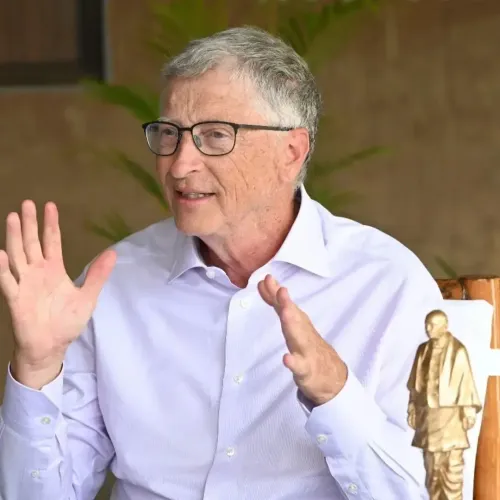
Microsoft co-founder Bill Gates on Sunday, 11 October 2026, said societies around the world would soon be forced to decide how to tax Artificial Intelligence (AI) and which occupations should be reserved exclusively for humans — warning that AI ‘changes the world more than all previous technologies.’ His remarks, made during an appearance on CNN’s State of the Union, came as global anxiety over AI-driven job displacement continues to intensify.
What Gates Said
Speaking to host Jake Tapper, Gates was asked to elaborate on his earlier warning that AI-related job losses across virtually all sectors would be ‘unprecedented.’ He pointed to the pace at which AI models are advancing and the mounting economic incentive for businesses to substitute AI for human labour.
“In the years ahead, we really do need to make a decision as a society, how do we tax AI usage or robot usage? And where do we want to make sure the human jobs are preserved?” Gates said.
He specifically identified education and healthcare as sectors where human roles should be protected. “Until people get their mind around how powerful this is, and, therefore, what it’s going to be doing to these jobs, the idea that you need to reserve things for humans may sound bizarre, but, in fact, we will get there,” he added.
AI vs Previous Technology Revolutions
Gates, who was instrumental in building the personal computer and internet era, said those developments were ‘a big deal, but nothing compared to this.’ He identified the most immediate danger as ‘bad people using AI,’ particularly for cyberattacks, and predicted that within the next year, self-governance by AI companies would give way to government safety bodies modelled on those overseeing aviation and pharmaceuticals.
He also said he had heard from ‘a number of politicians’ and hoped to eventually discuss his concerns with President Trump and ‘his key people.’
What This Means for India’s IT Sector
Gates’s warning lands at a particularly fraught moment for India’s technology industry, whose professionals account for the bulk of US H-1B visa approvals. According to US Citizenship and Immigration Services data, 71% of approved H-1B petitions in fiscal 2024 went to beneficiaries born in India.
The sector is navigating simultaneous pressure from AI-driven business transformation and tightening US immigration policy. Industry body Nasscom has acknowledged that hiring is expected ‘to shift from volume to skill mix, reflecting greater AI-driven productivity gains passed through to clients.’
Nasscom chairperson Sindhu Gangadharan said in February: “AI is accelerating productivity and changing the nature of work, but it is also expanding the opportunity frontier.”
US Policy Pressure on Indian IT Firms
The policy environment in Washington is adding another layer of uncertainty. Labour Secretary Keith Sonderling on Thursday suspended eight companies — including Infosys, Tata, Wipro, and HCL — from the Permanent Labor Certification (PERM) programme, citing ongoing investigations. PERM is a key step through which employers sponsor foreign workers for permanent US residence.
Vice President JD Vance warned at a campaign rally in Ohio that companies replacing American workers with legal immigrants could face ‘a big fat tariff.’ Separately, the administration’s proposed $100,000 fee on certain new H-1B petitions has been blocked by two federal judges.
What Comes Next
The convergence of Gates’s AI tax proposal, ongoing US immigration enforcement, and Nasscom’s call for skill-led hiring suggests the Indian IT industry faces a structural reckoning that goes beyond any single policy change. How governments — in the US, India, and elsewhere — choose to regulate AI labour substitution in the coming months will set the terms of this transition for millions of workers.
Point of View
Travel agents, and bank tellers is now urging governments to slow the next displacement. The contradiction is instructive: even technology’s greatest beneficiaries now see structural unemployment as a real political risk, not a luddite fantasy. For India, the stakes are sharper than for most — a workforce disproportionately represented in US tech roles faces both AI-driven demand compression and an immigration crackdown simultaneously. Nasscom’s ‘opportunity frontier’ framing is optimistic; whether Indian IT workers can reskill faster than AI models improve is a race that policy alone cannot win.
NationPress
11 Oct 2026
Frequently Asked Questions
What did Bill Gates say about taxing AI?
Gates said societies need to decide ‘how do we tax AI usage or robot usage’ and which occupations to reserve for humans. He made the remarks on CNN’s State of the Union on 11 October 2026, warning that AI changes the world more than all previous technologies combined.
Which jobs does Bill Gates want to reserve for humans?
Gates specifically cited education and healthcare as sectors where human roles should be preserved. He acknowledged the idea ‘may sound bizarre’ to many today but argued societies ‘will get there’ as AI’s power becomes more widely understood.
How does Gates’s AI warning affect India’s IT sector?
India’s IT sector is directly exposed: 71% of approved H-1B petitions in fiscal 2024 went to India-born beneficiaries, and AI is already compressing demand for traditional IT outsourcing. Nasscom has said hiring will shift from volume to skill, signalling structural workforce change.
Why were Infosys, Wipro, Tata, and HCL suspended from the PERM programme?
Labour Secretary Keith Sonderling suspended eight companies — including Infosys, Tata, Wipro, and HCL — from the Permanent Labor Certification programme, citing ongoing investigations. PERM is a key step in employer-sponsored US permanent residence applications.
What is the H-1B visa and why does it matter for India?
The H-1B visa allows US employers to temporarily hire foreign workers in speciality occupations. India-born professionals received 71% of all approved H-1B petitions in fiscal 2024, making any changes to the programme a significant concern for Indian IT workers and firms.