India-EU free trade deal: 'Most ambitious agreement' India has signed
Synopsis
India and the EU have concluded what their own negotiators are calling the most ambitious trade deal either side has signed — covering goods, services, digital trade, and even carbon pricing. With India holding just 5.4% of EU textile imports against Bangladesh's 17%, the stakes for labour-intensive sectors are enormous. The signing could come before year-end, with the deal entering force as early as mid-2026.
Key Takeaways
Darpan Jain , India's Chief Negotiator, called the India-EU free trade agreement the country's 'most ambitious agreement' to date, covering goods, services, investment, digital trade, and intellectual property.
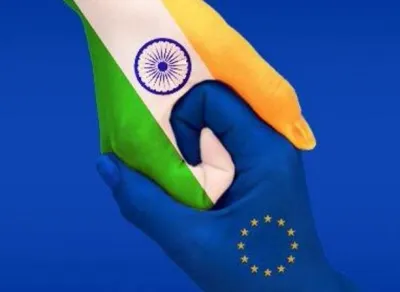
The deal connects economies representing nearly two billion people and around a quarter of global output .
India holds only 5.4% of the EU's $170 billion annual textile and apparel import market, against Bangladesh's 17% — a gap the FTA aims to close.
EU negotiator Christophe Kiener estimated EU exporters would save approximately four billion euros in tariffs.
Legal review is expected to conclude this month; formal signing could involve PM Modi later this year, with the deal potentially in force by Q2 next year .
The agreement includes safeguards on the EU's Carbon Border Adjustment Mechanism (CBAM) and cooperation on green hydrogen and clean energy.
India's chief negotiator for the landmark free trade agreement with the European Union on Wednesday, 8 July described the pact as the country's most ambitious trade deal to date, saying it would significantly expand market access, strengthen rules-based commerce, and unlock new opportunities across labour-intensive industries, services, and technology. The agreement connects economies representing nearly two billion people and roughly a quarter of global output, placing it among the world's largest bilateral trade pacts.
What the Agreement Covers
Darpan Jain, Chief Negotiator from India's Department of Commerce, speaking at an event hosted by the Peterson Institute for International Economics in Washington, said the deal reflects India's broadest liberalisation commitments yet — spanning goods, services, investment, digital trade, supply chain diversification, and intellectual property. 'It is one of the most ambitious agreements,' Jain said. 'India has liberalised almost the entire basket of goods... Similarly in services, the entire landscape of services has been committed.'
India has also undertaken its most extensive commitments to date on sustainable development, digital trade, and non-tariff measures, according to Jain. Agriculture, however, has been carefully ring-fenced as a sensitive sector.
Opportunities for Labour-Intensive Sectors
Jain identified textiles and apparel as among the biggest potential beneficiaries. The EU imports approximately $170 billion worth of textiles and apparel annually from outside the bloc, yet India holds only around 5.4% of that market. Bangladesh, benefiting from preferential access, commands roughly 17%. The deal is expected to narrow that gap significantly.
India's leather and footwear exports tell a similar story. Vietnam accounts for about 23% of EU imports in the sector, while India's share stands at approximately 6%. Tariffs of up to 17% had long curtailed India's competitiveness, and the agreement is designed to address that structural disadvantage.
On the services front, Jain pointed to India's leadership in digitally delivered services and said the pact would facilitate greater collaboration in research and development, global capability centres, and technology-driven industries. 'The rules would provide the foundation of predictability,' he said, adding that the agreement establishes mechanisms to resolve disputes over technical regulations, sanitary and phytosanitary standards, licensing, and other non-tariff barriers.
The EU's Perspective
Christophe Kiener, the European Union's chief negotiator, called the agreement 'commercially very, very meaningful' and estimated that EU exporters would save approximately four billion euros in tariffs. He said the pact also reflects a broader strategic partnership now encompassing trade, security, defence, technology, and mobility.
Both negotiators stressed that the agreement was driven by long-term strategic interests rather than short-term geopolitical developments. Responding to a suggestion that recent shifts in US trade policy had accelerated the deal, Kiener said it had been concluded because 'there is a genuine and strategic and economic interest for the EU and India to come closer.'
Carbon Border Mechanism and Green Cooperation
The agreement also addresses the EU's Carbon Border Adjustment Mechanism (CBAM). Jain said both sides have agreed on safeguards to ensure the mechanism is applied non-discriminatorily, alongside frameworks to recognise India's carbon pricing measures and to cooperate on verification systems. The broader partnership includes collaboration on green hydrogen, renewable energy, clean technologies, and financial support for India's low-carbon transition.
Timeline and Ratification
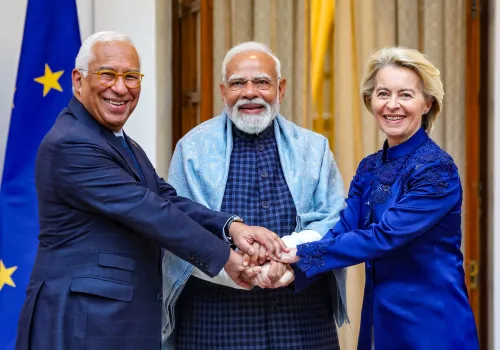
Kiener said the legal review of the agreement is expected to conclude this month, after which it will move through the EU's approval process. He expressed hope that Prime Minister Narendra Modi would participate in the formal signing ceremony later this year. The agreement could enter into force during the second quarter of next year, he added. India's ratification process is comparatively streamlined, requiring approval by the Cabinet and the President rather than Parliament, according to Jain.
Point of View
India sat out mega-regional deals — walking away from RCEP, stalling on bilateral pacts — citing sensitivity around agriculture and manufacturing. Committing to liberalise 'almost the entire basket of goods' marks a genuine strategic shift. The real test, however, is in the detail: whether CBAM safeguards are robust enough to protect Indian exporters, whether services commitments translate into actual market access rather than paper commitments, and whether the labour-intensive sectors — textiles, leather, footwear — can scale fast enough to capture the opportunity before competitors like Bangladesh and Vietnam consolidate their leads further. The political symbolism of a Modi signing ceremony is also notable: it frames the deal as a third-term foreign economic policy win at a time when India is navigating US tariff pressure and seeking to diversify its trade architecture.
NationPress
9 Jul 2026
Frequently Asked Questions
What is the India-EU free trade agreement?
The India-EU free trade agreement is a comprehensive bilateral trade pact covering goods, services, investment, digital trade, supply chain diversification, and intellectual property. Concluded after negotiations resumed in 2022, it connects economies representing nearly two billion people and around a quarter of global output, making it one of the world's largest bilateral trade deals.
Why is the India-EU FTA described as India's most ambitious trade deal?
India's chief negotiator Darpan Jain described it as the most ambitious because India has liberalised almost its entire basket of goods and made sweeping commitments across services, digital trade, sustainable development, and non-tariff measures — broader than any previous Indian trade agreement. Agriculture remains a protected sector.
Which Indian sectors stand to benefit most from the India-EU FTA?
Textiles and apparel, leather, and footwear are identified as major beneficiaries. India currently holds only 5.4% of the EU's $170 billion annual textile import market, compared to Bangladesh's 17%, partly due to tariff disadvantages. The deal is also expected to boost digitally delivered services and technology collaboration.
When will the India-EU trade deal come into force?
The legal review is expected to conclude in July 2025, after which the agreement moves through the EU's approval process. EU negotiator Christophe Kiener expressed hope that PM Modi would participate in a formal signing ceremony later this year, with the deal potentially entering into force during the second quarter of next year.
How does the agreement address the EU's Carbon Border Adjustment Mechanism?
The India-EU FTA includes agreed safeguards to ensure the Carbon Border Adjustment Mechanism (CBAM) is applied non-discriminatorily to Indian exports. It also establishes frameworks to recognise India's own carbon pricing measures and sets up cooperation on verification systems, alongside broader clean energy collaboration.