India must lead space law reform as China-Pakistan dual-use tech nexus grows

Synopsis
A new report warns that China and Pakistan's expanding space partnership — anchored by BeiDou integration, the PRSC-EO3 satellite launch, and the APSCO alliance — is exploiting legal blind spots in the Outer Space Treaty. The report's core argument: India, as a rising space power with skin in the game, is best placed to lead international reforms before those loopholes become a strategic liability.
Key Takeaways
A report by India Narrative calls on India to lead reforms in international space law, citing growing China-Pakistan space cooperation.
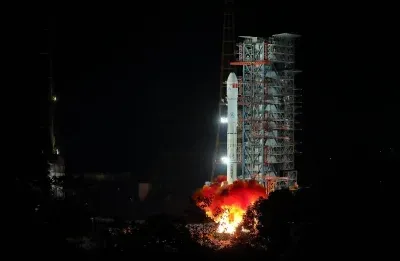
Pakistan launched the PRSC-EO3 satellite from China's Taiyuan Satellite Launch Centre ; its Space Vision 2047 programme signals deepening ties.
China's BeiDou navigation system has reportedly been integrated into Pakistani infrastructure and extended to military use, exposing a gap in the Outer Space Treaty .
Pakistani satellites can reportedly image Indian civil and military sites, potentially beyond the reach of existing Indian regulatory frameworks.
The Asia-Pacific Space Cooperation Organisation (APSCO) , a China-promoted body headquartered in Beijing , counts Pakistan as a founding member.
Reports indicate terrorists in Kashmir have used BeiDou-based satellite communication devices, raising further dual-use concerns.
A new report has urged India to take the lead in reforming international space governance frameworks, warning that deepening China-Pakistan cooperation in the space sector is exposing critical legal loopholes — particularly around dual-use technologies that can be repurposed for military and surveillance ends. The report, published by India Narrative and flagged on 7 November, argues that the opaque Sino-Pakistani space partnership poses direct risks to India's security and sovereignty.
The China-Pakistan Space Nexus
According to the report, the bilateral space relationship between Beijing and Islamabad extends well beyond routine satellite launches or technical collaboration. It reflects, the report argues, a longer-term Chinese strategy of drawing anti-India states into its geopolitical orbit through technology transfer and institutional alignment.
A key institutional vehicle cited is the Asia-Pacific Space Cooperation Organisation (APSCO) — a China-promoted alliance headquartered in Beijing, of which Pakistan is a founding member. The organisation, the report notes, effectively validates and institutionalises the Sino-Pakistani space nexus under a multilateral cover.
Pakistan's launch of the PRSC-EO3 satellite from China's Taiyuan Satellite Launch Centre, alongside Islamabad's Space Vision 2047 programme, are cited as concrete markers of the partnership's expanding scope.
Dual-Use Technology and the BeiDou Concern
The report singles out China's BeiDou navigation system as a particular flashpoint. BeiDou has reportedly been integrated into Pakistan's infrastructure and extended into military cooperation — a development the report describes as exposing a significant gap in existing international space law.
'China's announcement regarding a BeiDou-enabled continuously operating radar station network in Pakistan has exposed a gap in international space law,' the report stated.
Existing treaties, including the foundational Outer Space Treaty, are silent on indirect militarisation — meaning there is currently no binding international obligation governing the transfer of dual-use technologies that a recipient state may subsequently weaponise or deploy for hostile surveillance.
Data Collection and Sovereignty Risks
The report also raises pointed concerns about data protection. Pakistani satellites, it notes, are capable of imaging Indian civil and military installations. 'Such data collection may fall outside the practical reach of several Indian regulatory frameworks,' the report warned — underscoring a gap between satellite capability and the legal instruments available to counter its misuse.
Separately, the report flagged reports suggesting that terrorists operating in Kashmir have used satellite communication devices based on BeiDou and commercially available navigation technologies. It cautioned that Pakistan could similarly exploit imaging satellites or communication relays for hostile purposes.
The Case for Indian Leadership in Space Law Reform
Against this backdrop, the report makes a direct case for India to assume a proactive role in reshaping international space governance. It argues that current frameworks — most of them drafted in the Cold War era — were not designed to address dual-use technology transfers, opaque state-to-state partnerships, or the blurring of civilian and military space applications that characterises the current environment.
Notably, this call comes at a moment when India's own space sector is undergoing rapid liberalisation, with private players entering launch and satellite services for the first time. India's credibility as a rule-setter, the report implies, would be bolstered by its simultaneous domestic reform and international advocacy.
What Comes Next
The report stops short of prescribing specific treaty language, but its framing points toward multilateral negotiations that would extend liability and transparency obligations to dual-use technology transfers — a significant departure from the current voluntary-norm approach. Whether India chooses to table such proposals at forums like the United Nations Committee on the Peaceful Uses of Outer Space (COPUOS) will be a key indicator of how seriously New Delhi takes the governance agenda it is being urged to champion.
Point of View
Not for an era where dual-use navigation systems are transferred between geopolitical partners and end up in terrorist hands. India's push for space law reform, if it comes, will face the same headwind every multilateral norm-setting effort does — China's veto power in key UN forums. The more consequential question the report leaves unanswered is whether India is willing to build a coalition of like-minded space powers to table binding obligations, or whether this remains another well-argued think-tank brief that stops at the water's edge of diplomatic risk.
NationPress
8 Nov 2026
Frequently Asked Questions
What does the India Narrative report say about China-Pakistan space cooperation?
The report argues that China and Pakistan's space partnership goes beyond satellite launches to reflect Beijing's long-term strategy of aligning anti-India states through technology transfer. It highlights the PRSC-EO3 satellite launch, the Space Vision 2047 programme, and BeiDou integration as evidence of deepening military-civilian cooperation that current international space law does not adequately address.
Why is China's BeiDou system a concern for India?
BeiDou has reportedly been integrated into Pakistani infrastructure and extended into military cooperation, including a continuously operating radar station network. The report warns that this exposes a gap in the Outer Space Treaty, which does not cover indirect militarisation through dual-use technology transfers. Reports also indicate that terrorists in Kashmir have used BeiDou-based satellite communication devices.
What is APSCO and why does it matter?
The Asia-Pacific Space Cooperation Organisation (APSCO) is a China-promoted and Beijing-headquartered alliance of which Pakistan is a founding member. The report cites APSCO as institutional validation of the Sino-Pakistani space nexus, giving the partnership a multilateral legitimacy that complicates external scrutiny.
What are the data sovereignty risks flagged in the report?
Pakistani satellites are reportedly capable of imaging Indian civil and military establishments. The report warns that such data collection may fall outside the practical reach of several Indian regulatory frameworks, creating a surveillance gap that existing laws are ill-equipped to close.
How should India respond, according to the report?
The report urges India to take a leading role in reforming international space governance, particularly to address dual-use technology transfers and indirect militarisation — areas where current treaties, including the Outer Space Treaty, are silent. It implies India should leverage forums such as the UN Committee on the Peaceful Uses of Outer Space (COPUOS) to advance binding norms.