Jaishankar meets UN Permanent Representatives from 17 nations on India study tour
Synopsis
India is rolling out the diplomatic red carpet for UN Permanent Representatives from 17 nations — and the timing is no coincidence. With EAM Jaishankar's UNSC 2028–29 campaign formally launched in July, the week-long study tour is a strategic move to build first-hand goodwill among the very diplomats whose countries will eventually cast a vote.
Key Takeaways
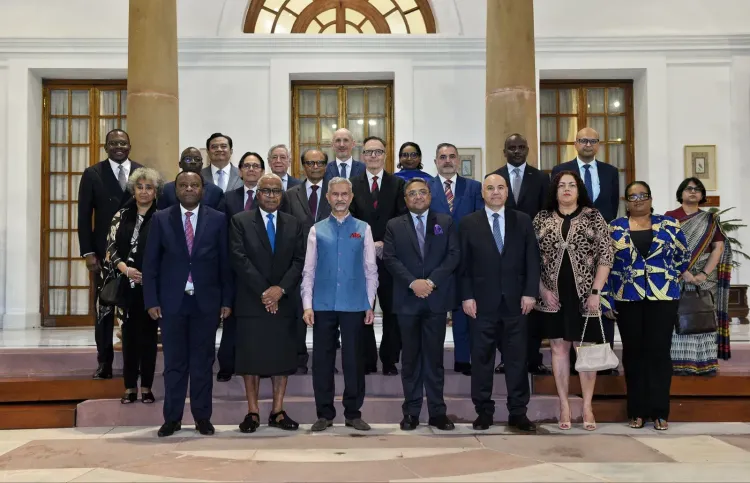
Jaishankar met UN Permanent Representatives from 17 countries on 5 August during their study tour of India.
Talks covered technology, maritime safety, peacekeeping, development partnership , and disaster response .
MEA Secretary (West) Sibi George hosted a welcome dinner for the delegation on Sunday , sharing India's multilateralism perspectives.
India launched its campaign for a UNSC non-permanent seat for the 2028–29 term in New York in July .
Jaishankar outlined the SHANTI framework — Securing Holistic Advancement through Norms, Trust and Integrity — as India's guiding approach at the UN.
External Affairs Minister S. Jaishankar on Tuesday, 5 August held discussions with Permanent Representatives of the United Nations from 17 countries who are on a study tour of India, using the occasion to advance New Delhi's push for reformed multilateralism and greater representation for the Global South.
What Was Discussed
'Delighted to interact with Permanent Representatives of the United Nations from 17 countries, visiting India on a study tour. As the global order transforms, reformed multilateralism reflecting the aspirations of the Global South is the need of the hour,' Jaishankar said in a post on social media platform X.
The minister said the conversations spanned a broad range of issues including technology, maritime safety, peacekeeping, development partnership, and disaster response. He extended warm wishes for the delegation's stay in India.
Welcome Dinner and Broader Engagement
The high-level interactions began over the weekend, when MEA Secretary (West) Sibi George hosted a welcome dinner for the visiting UN delegation on Sunday. According to the Ministry of External Affairs, George shared India's perspectives on multilateralism and the United Nations and wished the delegation a fruitful visit.
The week-long familiarisation tour signals New Delhi's intent to deepen its engagement with UN member states ahead of a critical diplomatic push.
India's UNSC Campaign and the SHANTI Framework
The visits come in the context of India's active campaign for a non-permanent seat on the United Nations Security Council (UNSC) for the 2028–29 term, which Jaishankar formally launched in New York in July.
Outlining New Delhi's vision, Jaishankar said: 'India's focus will be on working for a secure, peaceful and equitable world. A world where the voice of the Global South is heard in equal measure. A world where peacekeeping is ready for contemporary and future challenges, a world where multilateralism reflects contemporary realities and provides effective solutions, not remain on high standards, a world where the promise of technologies is fulfilled.'
He added that India's approach would be anchored in the SHANTI framework — Securing Holistic Advancement through Norms, Trust and Integrity — with a focus on amplifying the Global South's voice on international peace and security.
Why This Matters
India's diplomatic outreach to UN Permanent Representatives at this scale is a calibrated move, coming as New Delhi positions itself as a leading voice for developing nations in multilateral forums. The study tour gives visiting diplomats first-hand exposure to India's governance models, development partnerships, and foreign policy priorities — all of which underpin its UNSC bid.
Notably, this engagement follows a sustained pattern of India leveraging its G20 presidency legacy and growing influence in the Global South to build diplomatic capital at the United Nations. With the 2028–29 UNSC term in its sights, every bilateral and multilateral interaction now carries strategic weight.
The coming weeks are expected to see further outreach as India intensifies its campaign across regional blocs.
Point of View
Not a courtesy visit. India is methodically exposing UN Permanent Representatives to its governance narrative ahead of the UNSC 2028–29 election — a race where every regional bloc vote counts. The SHANTI framework is clever branding, but its real test will be whether India can hold together a fractious Global South coalition that includes countries with competing alignments. What mainstream coverage misses is that this kind of sustained, in-country engagement — dinners, ministerial meetings, familiarisation tours — is precisely how UNSC seats are won, long before the formal vote.
NationPress
19 Sept 2026
Frequently Asked Questions
Why did UN Permanent Representatives from 17 countries visit India?
The diplomats are on a week-long familiarisation tour of India, during which they met External Affairs Minister S. Jaishankar and senior MEA officials to discuss multilateralism, peacekeeping, and development cooperation. The visit is part of India's broader diplomatic engagement with UN member states.
What did EAM Jaishankar discuss with the visiting UN representatives?
Jaishankar said discussions covered technology, maritime safety, peacekeeping, development partnership, and disaster response. He also emphasised the need for reformed multilateralism that reflects the aspirations of the Global South.
What is India's UNSC campaign about?
India is seeking a non-permanent seat on the United Nations Security Council for the 2028–29 term. EAM Jaishankar formally launched the campaign in New York in July, outlining a vision for a more representative, effective, and future-ready global order.
What is the SHANTI framework mentioned by Jaishankar?
SHANTI stands for Securing Holistic Advancement through Norms, Trust and Integrity. It is India's stated guiding framework for its approach at the United Nations, with a focus on strengthening the Global South's voice on international peace and security.
Who hosted the welcome dinner for the UN delegation?
MEA Secretary (West) Sibi George hosted a welcome dinner for the visiting UN Permanent Representatives on Sunday, sharing India's perspectives on multilateralism and the United Nations.