Kenya confirms first Bundibugyo Ebola case after patient dies in Nairobi
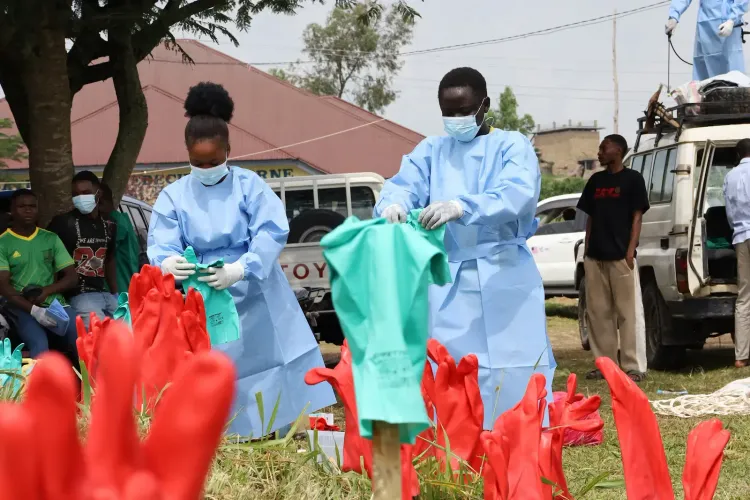
Synopsis
Kenya has recorded its first Ebola case — and its first Ebola death — after a Kenyan citizen who lived in the DRC for seven years arrived at Nairobi on 3 October and died the following Monday. With over 50 contacts being traced across family, health workers, and fellow passengers, the speed of the contact-tracing response will determine whether this remains an isolated imported case or sparks a wider alert.
Key Takeaways
Kenya confirmed its first imported Bundibugyo Ebola case on 6 October 2026 , a day after the patient died at Nairobi Hospital .
The deceased was a Kenyan national who had lived in the DRC for seven years and arrived in Nairobi on 3 October aboard Jambojet flight 8523 .
Authorities have identified 28 contacts including family and health workers, and are pursuing 23 passengers and 4 crew members from the same flight.
The Bundibugyo outbreak originated in the DRC's Ituri Province in May 2026 and Kenya had maintained heightened alert since then.
Health Cabinet Secretary Aden Duale urged the public not to panic, advising handwashing and avoiding contact with persons arriving from active Ebola zones.
A toll-free public inquiry line has been opened; safe burial of the deceased was being arranged in line with public health protocols.
Kenya on Tuesday, 6 October 2026, confirmed its first imported case of Bundibugyo Ebola virus disease, a day after a Kenyan citizen died at Nairobi Hospital. The confirmation was announced by Health Cabinet Secretary Aden Duale, marking a significant public health development for the East African nation.
Who Was the Patient and How Did He Arrive
The deceased was a Kenyan national who had been living in the Democratic Republic of the Congo (DRC) for the past seven years, according to Duale. He first fell ill approximately one month ago and received treatment at multiple hospitals within the DRC before undertaking the journey home.
He travelled overland from the DRC to Kampala, Uganda, before boarding Jambojet flight 8523, arriving at Jomo Kenyatta International Airport in Nairobi on 3 October. A relative then drove him directly from the airport to Nairobi Hospital, where medical staff quickly placed him in an isolation facility upon assessing his condition.
Symptoms and Laboratory Confirmation
The patient presented with a cluster of severe symptoms, including fever, chills, intense fatigue and weakness, muscle pain, painful swallowing, sore throat, and bleeding under the skin at injection sites — a hallmark sign of viral haemorrhagic fever.
Duale stated that the attending physician, upon noting the travel history and clinical presentation, collected samples for testing. The samples returned positive for the Bundibugyo strain of Ebola at both the National Virology Reference Laboratory and the Kenya Medical Research Institute (KEMRI) lab. 'Based on the above presentation and history of travel to DRC, the doctor considered this a case of viral hemorrhagic fever and collected a sample for testing, which turned positive for Ebola Bundibugyo Virus Disease at both the National Virology Reference Laboratory and the KEMRI Lab,' Duale said. The patient died on Monday night, and Duale extended condolences to his family.
Contact Tracing and Quarantine Measures
Authorities have so far identified 28 contacts of the deceased, comprising family members and healthcare workers who attended to him. Officials are additionally pursuing 23 passengers and 4 crew members who were aboard the same Jambojet flight. Quarantine arrangements for those considered at risk are currently underway.
Kenya's health ministry also confirmed that safe and dignified burial of the patient was being arranged in line with public health standards. This comes amid an ongoing Ebola outbreak caused by the Bundibugyo strain that began in the DRC's Ituri Province in May 2026 — an outbreak Kenya has been monitoring with heightened surveillance since it began.
Government Advice and Public Health Response
Duale urged citizens not to panic, stressing that systems are in place to contain any spread. He advised the public to wash hands frequently, use alcohol-based hand sanitisers, and avoid close contact with individuals arriving from countries with active Ebola transmission.
The health ministry has opened a toll-free public inquiry line and pledged ongoing updates as the situation develops. Notably, the Bundibugyo strain — first identified during a 2007 outbreak in Uganda — carries a lower case fatality rate than the more widely known Zaire strain, though it remains a serious public health threat requiring rapid containment measures.
Health authorities are expected to issue further updates on contact tracing outcomes and the status of quarantined individuals in the coming days.
Point of View
But the critical window is the next 21 days: the incubation period within which any secondary case would emerge among the 55-plus contacts now being traced. The Bundibugyo strain's relatively lower fatality rate compared to the Zaire strain can breed false reassurance — containment discipline, not comparative mortality, must drive the response. For India and other nations with direct or transit air links to East Africa, this is a reminder that outbreak surveillance must extend to flight manifests, not just border posts.
NationPress
6 Oct 2026
Frequently Asked Questions
What is the Bundibugyo Ebola virus and how dangerous is it?
The Bundibugyo strain is one of several species of the Ebola virus, first identified during a 2007 outbreak in Uganda. It causes viral haemorrhagic fever with symptoms including fever, muscle pain, sore throat, and bleeding, and while its case fatality rate is generally lower than the Zaire strain, it remains a serious and notifiable public health threat.
How did the Ebola patient reach Nairobi from the DRC?
According to Kenyan health authorities, the patient travelled overland from the DRC to Kampala, Uganda, then boarded Jambojet flight 8523, arriving at Jomo Kenyatta International Airport in Nairobi on 3 October. A relative drove him directly from the airport to Nairobi Hospital, where he was isolated.
How many people are being traced as contacts of the deceased?
Authorities have identified 28 direct contacts — including family members and healthcare workers — and are additionally pursuing 23 passengers and 4 crew members from Jambojet flight 8523. Quarantine arrangements for those considered at risk are underway.
Where did the current Ebola outbreak originate?
The ongoing outbreak is caused by the Bundibugyo strain and began in the DRC's Ituri Province in May 2026. Kenya had maintained a heightened state of alert for Ebola since the outbreak was declared, making this the first confirmed imported case in the country.
What precautions are Kenyan authorities recommending to the public?
Health Cabinet Secretary Aden Duale has urged the public not to panic, advising frequent handwashing or use of alcohol-based sanitisers and avoiding close contact with persons arriving from countries with active Ebola transmission. The ministry has also opened a toll-free line for public inquiries.