North Korea blasts South Korea, US and Japan for 'abusing' ASEAN forum
Synopsis
North Korea has turned this week's ASEAN forum into a geopolitical flashpoint — accusing the US, South Korea, and Japan of hijacking a regional cooperation platform to advance a confrontational security agenda. With Pyongyang skipping ASEAN for two straight years and doubling down on its nuclear status, the diplomatic chasm between the DPRK and the Western-aligned bloc is widening, not narrowing.
Key Takeaways
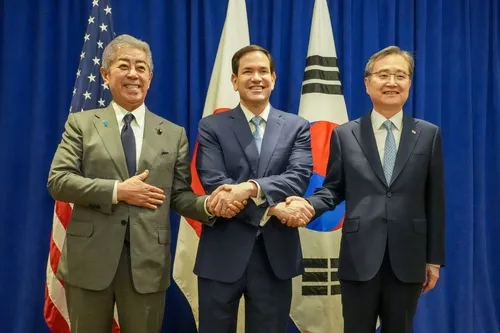
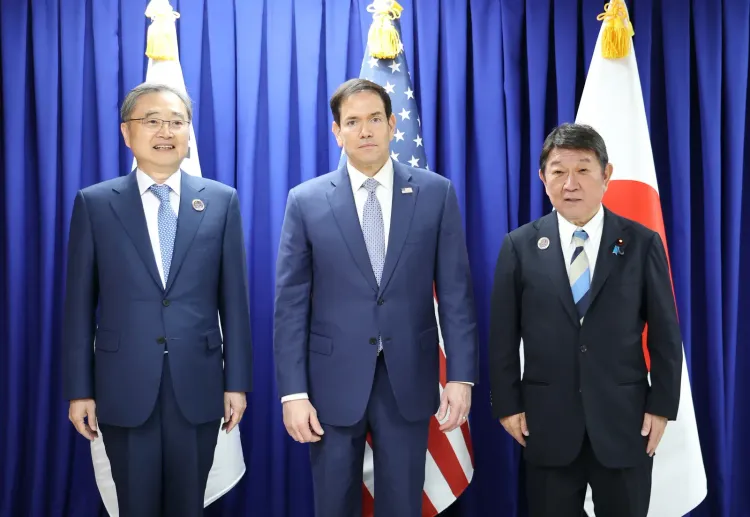
North Korea's foreign ministry on Friday, 25 July 2025 accused South Korea , the US , and Japan of 'abusing' the ASEAN forum in the Philippines to incite regional hostility.
Pyongyang declared denuclearisation 'irreversibly and finally concluded,' rejecting any trilateral pressure to revisit the issue.
North Korea has skipped the ASEAN forum for two consecutive years , reportedly focusing on bilateral ties with China and Russia .
The DPRK accused the US-led bloc of 'systematically' violating the global nuclear non-proliferation regime.
Despite the criticism, Pyongyang expressed support for ASEAN as an institution and pledged continued engagement with its member states.
North Korea's foreign ministry on Friday, 25 July 2025 accused South Korea, the United States, and Japan of exploiting this week's Association of Southeast Asian Nations (ASEAN) forum in the Philippines to stoke hostility and push a US-led security agenda — including renewed calls for Pyongyang's denuclearisation, which the regime has declared permanently off the table.
What Pyongyang Said
The North's foreign ministry spokesperson issued a sharp commentary through the Korean Central News Agency (KCNA), charging that Washington and its allies were 'raising waves of confrontation while inciting division and antagonism, abusing the ASEAN arena as a space for justifying their evil intention, contrary to the general will of regional countries prioritising peace, development, stability and cooperation.'
The spokesperson further stated that 'Southeast Asia can never be a region subjected to promoting the US 'security and prosperity', and the ASEAN arena should not be a field of searching for an opportunity of criticising other countries and inciting hostility towards them.'
The Denuclearisation Flashpoint
Central to Pyongyang's grievance is the continued insistence by Seoul, Washington, and Tokyo that the Democratic People's Republic of Korea (DPRK) denuclearise. North Korea has categorically rejected this, with the ministry declaring the issue 'irreversibly and finally concluded.' The commentary warned that no trilateral pressure from the US-Japan-ROK grouping could 'bring up for discussion again the issue of denuclearisation' or alter what it described as a new regional order taking shape around the DPRK's current position.
Notably, North Korea also accused the US-led security and economic bloc of 'systematically' violating the global nuclear non-proliferation regime — inverting the standard Western framing that positions Pyongyang as the proliferation threat.
North Korea's ASEAN Absence and Bilateral Pivot
Despite being a participant in the ASEAN framework, North Korea has skipped the forum for two consecutive years. Analysts suggest this reflects a deliberate pivot toward bilateral diplomacy with China and Russia, sidelining multilateral platforms where US-aligned nations hold significant sway. The ASEAN meetings in the Philippines this week were led by the 11-member bloc and key Indo-Pacific partners.
Pyongyang's Stated Commitment to ASEAN
Despite its sharp criticism of the forum's use by rival powers, North Korea expressed a broadly positive view of ASEAN's own role in promoting regional co-prosperity. The ministry stated the DPRK would 'actively promote regional peace and development and cooperation on the principle of mutual benefit and co-prosperity,' while vowing to 'firmly defend the core interests of national security' against what it termed hostile encroachment on its sovereign rights.
The statement signals that Pyongyang is not abandoning engagement with Southeast Asia outright — it is, rather, drawing a line between ASEAN as an institution and what it characterises as its weaponisation by the US-Japan-South Korea axis. Whether ASEAN members, many of whom prefer non-alignment, will push back on that framing remains to be seen.
Point of View
And it wants the region to see itself as a potential counterweight. The two-year absence from ASEAN, combined with deepening ties with Moscow and Beijing, suggests the DPRK is building a parallel diplomatic architecture. What mainstream coverage misses is the audience: this commentary is aimed as much at fence-sitting ASEAN states as it is at Washington. If even a few Southeast Asian governments echo the 'don't abuse ASEAN' framing, it hands Pyongyang a multilateral shield against isolation.
NationPress
22 Oct 2026
Frequently Asked Questions
Why did North Korea criticise South Korea, the US and Japan at the ASEAN forum?
North Korea accused the three countries of exploiting the ASEAN forum in the Philippines to promote a US-led security bloc and push for the DPRK's denuclearisation, which Pyongyang has declared permanently off the table. The foreign ministry said this contradicted the regional priorities of peace, stability, and cooperation.
Has North Korea attended recent ASEAN meetings?
No. North Korea has skipped the ASEAN forum for two consecutive years, reportedly prioritising bilateral diplomacy with China and Russia over multilateral platforms where US-aligned nations hold influence.
What is North Korea's position on denuclearisation?
North Korea has declared the issue of denuclearisation 'irreversibly and finally concluded,' meaning it no longer considers giving up its nuclear arsenal a negotiable or viable path. The DPRK's constitution now enshrines its nuclear status.
What did North Korea say about ASEAN itself?
Despite criticising how the forum was used by the US-Japan-South Korea grouping, North Korea expressed a positive view of ASEAN as an institution, pledging to promote regional co-prosperity and deepen ties with ASEAN member states on the principle of mutual benefit.
What is the broader significance of North Korea's statement?
The statement reflects a wider strategic shift by Pyongyang away from Western-aligned multilateral diplomacy toward a bilateral axis with China and Russia. It also signals an attempt to frame the US-led security grouping — not the DPRK — as the primary threat to regional stability.