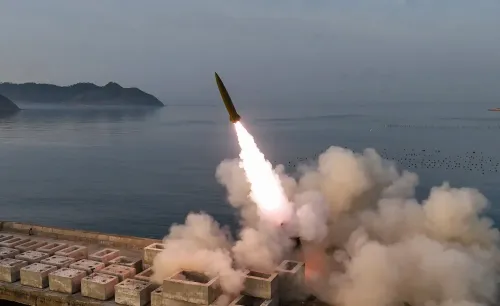
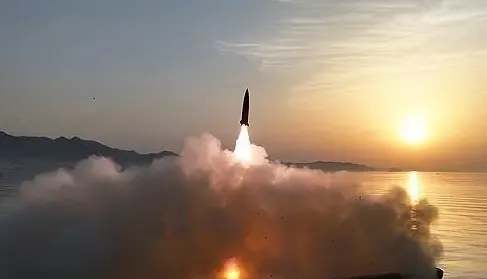
North Korea fires tactical ballistic missile on Oct 12, calls test 'big success'

Synopsis
North Korea's 16th ballistic missile test of the year — fired just nine days after its previous launch and four days after South Korea publicly unveiled a homegrown hypersonic glide vehicle — signals a sharply compressed escalation cycle on the peninsula. Pyongyang called the tactical upgrade a 'big success,' while Seoul and Washington promised a detailed analysis and reaffirmed their 'fully capable' intercept posture.
Key Takeaways
North Korea test-fired a tactical ballistic missile on 12 October 2026 , calling the result a 'big success.' The launch was the North's 16th ballistic missile test of the year , coming nine days after the previous firing on 3 October .
One missile flew more than 900 km ; Japan's defence ministry reported two projectiles covering approximately 220 km and over 910 km respectively.
JCS spokesperson Capt.
Jang Do-young said South Korea and the US are 'fully capable' of detecting and intercepting North Korean missiles.
The launch followed by four days South Korea's first successful test of a homegrown hypersonic glide vehicle (HGV) , attended by President Lee Jae Myung .
A DMZ land mine explosion on 21 September that injured three South Korean soldiers preceded the current escalation cycle.
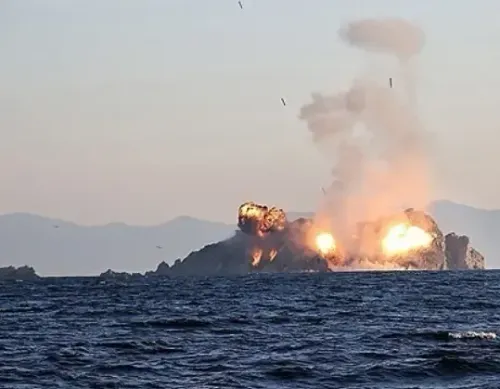
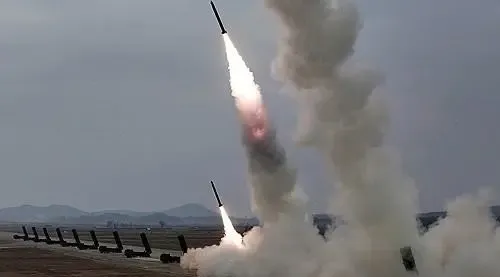
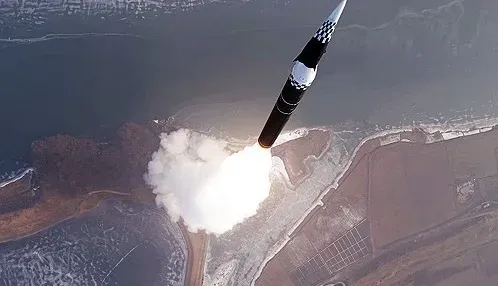
North Korea on 12 October 2026 test-fired a tactical ballistic missile to upgrade what it described as 'an important core element' of its weapons systems, with state media declaring the exercise a 'big success.' The launch, detected a day earlier by South Korea's Joint Chiefs of Staff (JCS), marked the North's 16th ballistic missile launch of the year.
What the Launch Involved
According to reports citing the Korean Central News Agency (KCNA), North Korea's missile administration said the test was aimed at 'confirming the success in the research for the technical upgrading of an important core element.' The administration added that the upgrade 'heralded an important change in improving the performance and sophistication of all offensive weapon systems,' characterising the firing as part of regular activities. No further technical details were disclosed by Pyongyang.
The JCS noted that North Korea launched multiple types of ballistic missiles during Monday's event. One missile flew more than 900 kilometres, while Japan's defence ministry separately reported at least two projectiles — one travelling approximately 220 km and another exceeding 910 km. US Pacific Command (PACOM) confirmed that two ballistic missiles were involved in Monday's launches.
South Korea and US Response
JCS spokesperson Captain Jang Do-young told a press briefing on Tuesday that the trajectory suggested either 'a short-range ballistic missile fired at maximum range, or a medium-range ballistic missile fired at a reduced range.' Short-range ballistic missiles cover between 300 and 1,000 km, while medium-range variants span 1,000 to 3,000 km.
Captain Jang reiterated that South Korea and the United States maintain a 'robust combined defence posture' and are 'fully capable' of detecting and intercepting North Korean missiles. South Korean and US authorities were said to be conducting a detailed analysis of the specifications.
Regional Context and Timing
Monday's launches came just nine days after North Korea's previous ballistic missile firing on 3 October. Notably, they also followed by four days South Korea's public announcement of its first successful test of a homegrown hypersonic glide vehicle (HGV) — an event attended by President Lee Jae Myung. Hypersonic missiles, which travel at Mach 5 or faster along unpredictable trajectories, are widely regarded as potential 'game changers' in modern warfare due to their difficulty to track and intercept.
South Korea's disclosure of the HGV test was widely interpreted as a deliberate demonstration of deterrence capabilities, coming in the wake of a land mine explosion in the Demilitarized Zone (DMZ) on 21 September that injured three South Korean soldiers. This pattern of action and counter-demonstration underscores the sharp escalation in inter-Korean tensions through the latter half of 2026.
Pattern of Escalation
The 16th launch of the year accelerates a tempo that analysts have flagged as unusually sustained. This is the Nth iteration of a cycle familiar on the peninsula: North Korea tests, the South and US analyse and reaffirm deterrence, and Pyongyang offers no further detail. What distinguishes this period is the compressed interval between launches and the parallel acceleration of South Korea's own advanced weapons programme — a dynamic that raises the threshold for miscalculation on both sides.
How the three-way dynamic among Pyongyang, Seoul, and Washington evolves in the coming weeks will depend, in part, on the outcome of the ongoing technical analysis of Monday's missiles.
Point of View
Combined with Pyongyang's unusually explicit claim of a weapons-systems upgrade, suggests this is not routine provocation signalling — it is capability acceleration. What mainstream coverage underplays is the parallel dynamic: South Korea's public HGV test four days prior was itself an escalation, and the two sides are now exchanging capability demonstrations at a pace that shortens the window for diplomatic intervention. The JCS reassurance of a 'robust combined defence posture' is standard procedure, but the real question is whether the US-South Korea alliance's analytical bandwidth — currently parsing missile specifications — is also war-gaming the diplomatic off-ramps. With a DMZ incident, a hypersonic debut, and now a 16th missile test all within weeks, the peninsula's risk environment in late 2026 is arguably the most volatile it has been in several years.
NationPress
13 Oct 2026
Frequently Asked Questions
What missile did North Korea test-fire on 12 October 2026?
North Korea test-fired a tactical ballistic missile on 12 October 2026, describing it as an upgrade to 'an important core element' of its weapons systems. State media called the test a 'big success' that would improve the 'performance and sophistication of all offensive weapon systems.'
How far did North Korea's latest missile travel?
South Korea's JCS reported one missile flew more than 900 kilometres. Japan's defence ministry separately logged two projectiles, one covering roughly 220 km and the other exceeding 910 km. US Pacific Command confirmed two ballistic missiles were launched.
Is this North Korea's first missile test this year?
No — Monday's event was North Korea's 16th ballistic missile launch of 2026, fired nine days after its previous test on 3 October. The pace of testing has been described as unusually sustained by analysts.
How did South Korea and the US respond?
JCS spokesperson Captain Jang Do-young said South Korea and the US are 'fully capable' of detecting and intercepting North Korean missiles and maintain a 'robust combined defence posture.' Both countries were conducting a detailed technical analysis of the missiles' specifications.
Why is the timing of this launch significant?
The launch came just four days after South Korea publicly announced its first successful test of a homegrown hypersonic glide vehicle (HGV), attended by President Lee Jae Myung, and weeks after a DMZ land mine explosion on 21 September injured three South Korean soldiers. The back-to-back demonstrations by both sides point to a sharp escalation in inter-Korean tensions.