Pakistan's growth model fuelling poverty, debt crisis: Report
Synopsis
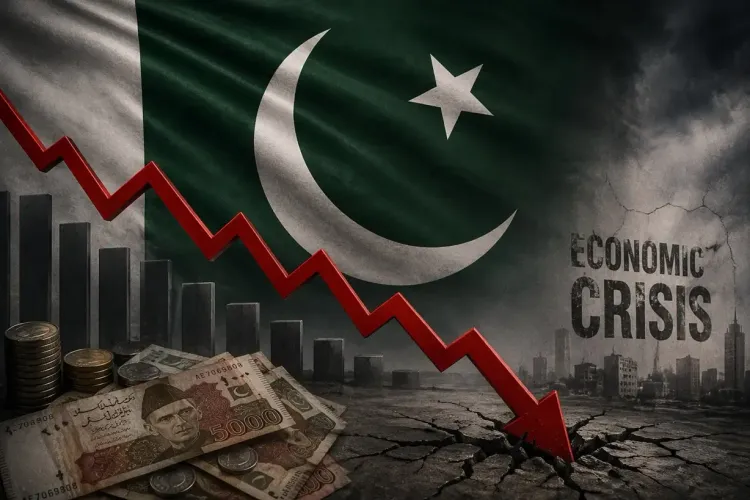
A Dawn report delivers a withering verdict on Pakistan's economic model: consumption at 82% of GDP, investment at just 14%, exports collapsed from 17% of GDP in 1992 to under 10% today — ranking below Afghanistan in South Asia — and public debt at 73% of GDP. It goes further, attributing the failure not to incompetence but to deliberate kleptocratic design.
Key Takeaways
Pakistan's consumption accounts for 82 per cent of GDP , while investment stands at just 14 per cent — far below India, China, and Bangladesh.
Exports have fallen from a peak of 17 per cent of GDP in 1992 to under 10 per cent , the second-lowest share in South Asia, behind even Afghanistan.
Harvard's Economic Complexity Index ranks Pakistan 89th out of 145 countries .
Public debt stands at approximately 73 per cent of GDP , with a large share of federal spending consumed by interest payments.
Extreme poverty has risen and the gap with regional peers has widened as per-capita income growth has stalled.
The Dawn report attributes structural failure to deliberate kleptocratic governance, not merely policy ineptitude.
Pakistan's economy remains ensnared in a cycle of weak growth, low investment, and mounting debt, despite recent signs of macroeconomic stabilisation, according to a report by Dawn. The report, released on 12 November 2026, warns that the country risks falling further behind regional peers unless it decisively pivots to an investment- and export-led growth model.
Consumption-Heavy Economy, Thin Investment
Pakistan's economic structure is heavily skewed toward consumption, which accounts for approximately 82 per cent of gross domestic product, while investment languishes at roughly 14 per cent of GDP — well below comparable levels in India, China, and Bangladesh. According to the report, this structural imbalance has constrained industrial expansion and severely hampered export competitiveness.
The consequences are stark. Harvard's Economic Complexity Index ranked Pakistan 89th among 145 countries, reflecting the limited sophistication of its export basket and its exposure to intense global competition with diminishing returns.
Export Collapse and Trade Deficits
The report highlights a dramatic long-term erosion in Pakistan's export performance. 'Capital droughts in export sectors cause dollar and job droughts. From a peak of 17 per cent in 1992, exports now barely reach a tenth of our GDP — South Asia's second-lowest share, below even Afghanistan's,' the report states. Persistent trade deficits — exports rarely covering imports — have repeatedly triggered balance-of-payments crises, forcing Islamabad to seek successive bailouts from the International Monetary Fund (IMF).
Rising Poverty and Widening Regional Gap
Pakistan's extreme poverty rate has risen in recent years, and the gap with regional peers has widened as per-capita income growth has stalled. The country's public debt stands at approximately 73 per cent of GDP, while a significant share of federal spending is absorbed by interest payments, leaving limited fiscal space for development and growth-enhancing investment. This structural squeeze on public finances compounds the challenge of delivering social services and productive infrastructure.
Systemic Governance Critique
The report does not spare Pakistan's political class. 'A weak economy reflects perverse politics. Poor countries need both a developmental and a welfare state. Ours is a parasitic and apathetic state run by rapacious rulers. This isn't a tragedy of ineptitude alone: willing rulers can easily hire merit. It's a deliberate design by kleptocrats who may lose their wealth and power if there is real progress,' the report states bluntly. This framing — attributing structural economic failure to deliberate political choices rather than mere incompetence — represents a sharp escalation beyond conventional macroeconomic critique.
What Needs to Change
The Dawn report argues that reversing Pakistan's trajectory requires a fundamental reorientation: boosting investment, deepening export sophistication, and rebuilding institutional credibility. Without these shifts, recurring IMF dependence and rising poverty are likely to persist. How Pakistan's civil and military establishment responds to such blunt structural diagnosis remains to be seen.
Point of View
Not a bug, of the country's governing arrangements. This reframes the standard IMF-and-reform narrative entirely. For India's strategic calculus, a structurally weakened Pakistan, perpetually IMF-dependent and domestically volatile, presents its own risks. Instability across the border rarely stays neatly contained, and a neighbour with 73% debt-to-GDP and collapsing export capacity is a neighbour with shrinking options and rising internal pressure.
NationPress
12 Nov 2026
Frequently Asked Questions
What does the Dawn report say about Pakistan's economy?
The Dawn report warns that Pakistan's economy is trapped in a cycle of weak growth, low investment, and rising debt, with consumption accounting for 82% of GDP and investment at just 14%. It cautions that Pakistan risks falling further behind regional peers unless it shifts to an investment- and export-led growth model.
How bad is Pakistan's export performance?
Pakistan's exports have declined from a peak of 17% of GDP in 1992 to under 10% today, making it the second-lowest export share in South Asia — below even Afghanistan. Harvard's Economic Complexity Index ranks Pakistan 89th out of 145 countries, reflecting the low sophistication of its export base.
What is Pakistan's current public debt level?
Pakistan's public debt stands at approximately 73% of GDP, with a significant portion of federal spending directed toward servicing interest payments. This limits available resources for development and productive investment.
Why has Pakistan repeatedly approached the IMF?
Persistent trade deficits — where exports rarely cover imports — have created recurring balance-of-payments crises, forcing Pakistan to seek multiple IMF bailout packages. The root cause, according to the report, is the structural dominance of consumption over investment and the collapse of export competitiveness.
What governance critique does the report make?
The report argues that Pakistan's economic weakness reflects deliberate political choices rather than mere incompetence, describing the state as 'parasitic and apathetic' and attributing structural failure to leaders who, it claims, benefit from keeping the economy underdeveloped.