Indus Waters Treaty rhetoric masks Pakistan's domestic failures, says ex-Indian commissioner
Synopsis
Pakistan's FM Ishaq Dar invokes the Indus Waters Treaty as a national security threat — but former Indian Commissioner P K Saxena's analysis dismantles the claim point by point: Pakistan controls over 80% of Indus flows, its agricultural crisis stems from a rigid domestic water-allocation system, and run-of-the-river dams in J&K consume no net water. The real story, Saxena argues, is a decades-long governance failure being repackaged as upstream injustice.
Key Takeaways
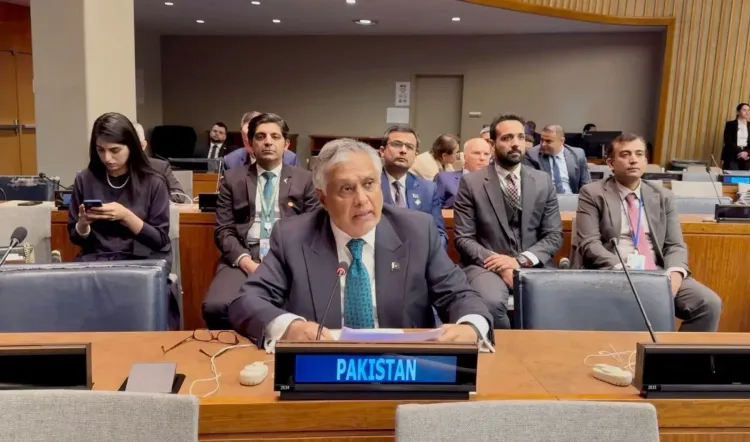
Pakistani Foreign Minister Ishaq Dar has warned that suspension of the Indus Waters Treaty threatens water, food, and national security for 250 million Pakistanis .
Former Indian Commissioner for Indus Waters P K Saxena argues the rhetoric is designed to deflect from Islamabad's domestic governance failures .
Under the 1960 Indus Waters Treaty , Pakistan receives over 80 per cent of total Indus system flows — approximately 135 MAF annually — against India's 33 MAF .
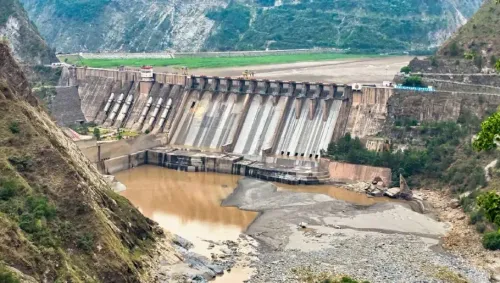
Indian projects such as Kishenganga , Baglihar , and Ratle are run-of-the-river schemes that release water back into the river channel, resulting in no net loss of volume .
Pakistan's farm-level water scarcity is primarily driven by the domestic Warabandi allocation system , which disadvantages smallholders at the tail of canal reaches.
India has used only a fraction of the storage capacity it is permitted under the treaty, which is currently suspended .
Pakistani Foreign Minister Ishaq Dar's repeated warnings about the Indus Waters Treaty are less a statement of hydrological reality and more a political device to deflect attention from Islamabad's governance failures at home, according to a detailed analysis by P K Saxena, former Indian Commissioner for Indus Waters, published in NatStrat.
The Core Argument
Saxena argues that when Dar warns of threats to 'water security', 'food security', and 'national security' for 250 million Pakistanis, the rhetoric is calibrated to project statesmanship — but it obscures a more inconvenient domestic reality. 'This narrative reflects a persistent pattern in Islamabad's political discourse: invoking the river to deflect attention from ongoing governance failures, while prioritising the obstruction of India's development over domestic advancement,' Saxena wrote.
The analysis traces a broader divergence since 1947, when both nations began from broadly comparable starting points. Saxena contends that Pakistan's political establishment chose to build a security apparatus centred on cross-border militancy rather than investing in institutional capacity and infrastructure — a choice that, he argues, deserves far greater international scrutiny than the 'constructed narrative of treaty sanctity' advanced by Dar.
What the Hydrological Data Shows
Central to Saxena's case is the actual water allocation embedded in the 1960 Indus Waters Treaty. Pakistan receives more than 80 per cent of the Indus system's total flow — approximately 135 million acre-feet (MAF) annually — compared to India's allocation of 33 MAF. 'Given this substantial water endowment, Pakistan cannot be classified as water-poor by any hydrological standard,' Saxena noted, adding that the country's agricultural crisis arises not from upstream deprivation but from governance failures and insufficient conservation measures.
Why Run-of-the-River Projects Are Not the Issue
Pakistani officials have routinely portrayed Indian run-of-the-river projects — Kishenganga, Baglihar, and Ratle — as existential threats to downstream flows. Engineering assessments, Saxena said, do not support this framing. Run-of-the-river projects do not consume or permanently divert water; they harness the kinetic energy of the river's natural flow to generate electricity before releasing the water back into the channel, resulting in no net loss of volume. He also pointed out that India has utilised only a fraction of the storage capacity it is permitted to develop on the Western Rivers under the treaty — which is currently suspended.
The Domestic Roots of Pakistan's Water Crisis
According to Saxena, the water scarcity experienced by Pakistani farmers is primarily the product of the Warabandi allocation system — a rigid domestic framework that concentrates water access among politically influential landholders at the head of canal reaches, leaving smallholders at the tail chronically deprived. 'This constitutes a domestic distributive issue unrelated to India,' he noted, pointing to a structural inequity that no upstream infrastructure policy by India could either cause or resolve.
Broader Implications
The suspension of the Indus Waters Treaty by India, following escalating tensions, has provided Islamabad with a fresh diplomatic grievance to amplify on the international stage. Saxena's analysis suggests this amplification serves a dual purpose: rallying domestic audiences and framing India as the aggressor in multilateral forums. This comes amid continued strain in India-Pakistan relations, with cross-border militancy remaining a live flashpoint. How the international community weighs Pakistan's 'victim of geography' narrative against the underlying governance data will increasingly shape the diplomatic stakes around the treaty's future.
Point of View
And domestic mismanagement disappears from the frame. The numbers undercut the narrative — 135 MAF versus 33 MAF is not a picture of a water-starved downstream state. What it is, is a picture of a state that has struggled to equitably distribute the considerable resources it already commands. The harder question that mainstream coverage of the India-Pakistan water dispute rarely asks is why the Warabandi system — which structurally disadvantages the poorest farmers — has survived as long as it has. Blaming upstream India is politically cost-free; reforming domestic water governance is not.
NationPress
26 Sept 2026
Frequently Asked Questions
What is Pakistan's claim about the Indus Waters Treaty?
Pakistani Foreign Minister Ishaq Dar has warned that India's suspension of the 1960 Indus Waters Treaty threatens water security, food security, and national security for 250 million Pakistanis. The claim positions Pakistan as an existential victim of its upstream geography and India's river engineering projects.
How much water does Pakistan actually receive under the Indus Waters Treaty?
Pakistan receives over 80 per cent of the Indus system's total flow — approximately 135 million acre-feet annually — compared to India's allocation of 33 MAF. Former Indian Commissioner P K Saxena argues this allocation means Pakistan cannot be classified as water-poor by any standard hydrological measure.
Why are Indian projects like Kishenganga and Baglihar not a threat to Pakistan's water supply?
These are run-of-the-river projects that harness the kinetic energy of river flow to generate electricity and then release the water back into the river channel, resulting in no net loss of volume. India has also used only a fraction of the storage capacity it is permitted to develop on the Western Rivers under the treaty.
What is the Warabandi system and why does it matter?
The Warabandi system is Pakistan's domestic canal-water allocation framework, which concentrates water access among politically influential landholders at the head of canal reaches, leaving smallholder farmers at the tail chronically short of water. Saxena argues this domestic distributive failure, not Indian upstream activity, is the primary driver of agricultural water stress in Pakistan.
Who is P K Saxena and where was this analysis published?
P K Saxena is a former Indian Commissioner for Indus Waters, the official Indian representative in the bilateral Permanent Indus Commission established under the 1960 treaty. His analysis was published in NatStrat, a strategic affairs platform.