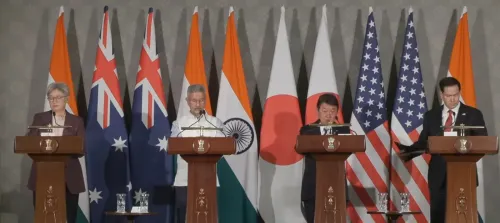
Quad foreign ministers at G20 flag East China Sea tensions, economic coercion
Synopsis
The Quad's third foreign ministers' meeting of 2026, held in Atlanta, went further than diplomatic ritual — it put economic coercion front and centre alongside sea tensions, with Japan openly opposing status-quo changes by force and all four nations flagging 'grave concerns' over arbitrary export restrictions. No country was named, but the signals were unmistakable.
Key Takeaways
Quad foreign ministers met in Atlanta on 31 October 2026 on the sidelines of the G20 Foreign Ministers' Meeting — the grouping's third such meeting this year.
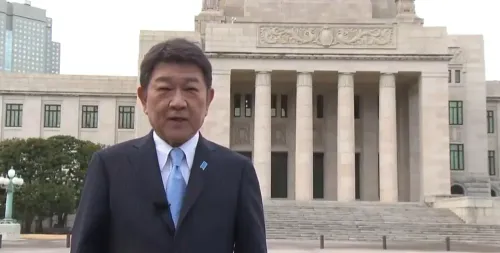
Japanese FM Toshimitsu Motegi strongly opposed unilateral attempts to change the status quo by force or coercion in the East China Sea and South China Sea .
The joint release cited 'grave concerns regarding economic coercion, including through arbitrary export restrictions' and risks to critical global supply chains.
Ministers stressed protecting navigational freedoms in the Strait of Hormuz , Red Sea , and Bab el-Mandeb Strait under UNCLOS .
Motegi raised North Korea denuclearisation and malicious cyber activities; the group reaffirmed four priority cooperation areas for the Indo-Pacific.
The ministers looked forward to the next Quad leaders' summit and agreed to maintain close coordination.
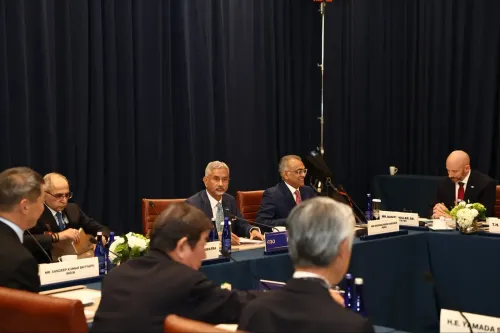
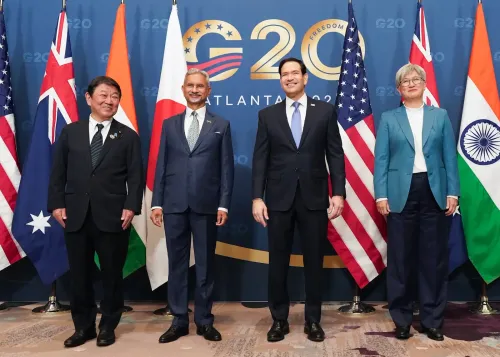
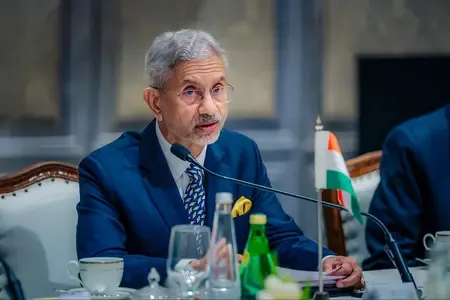
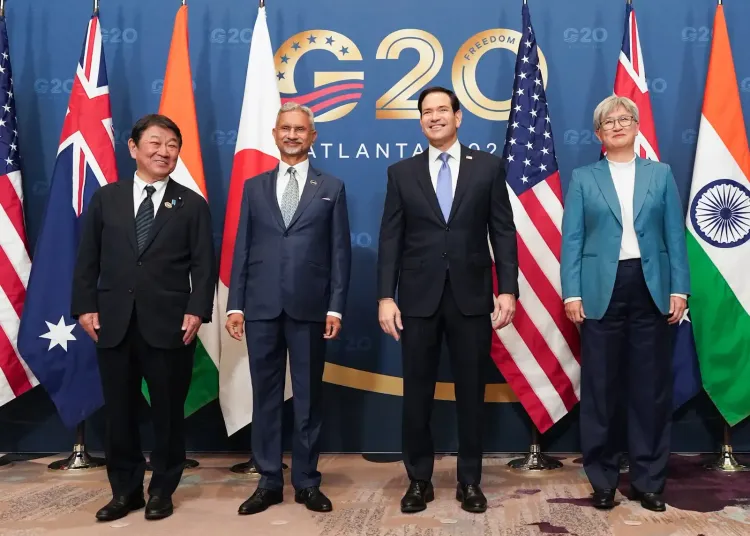
External Affairs Minister S. Jaishankar, along with his counterparts from the United States, Japan, and Australia, held a Quad foreign ministers' meeting on the sidelines of the G20 Foreign Ministers' Meeting in Atlanta on Saturday, 31 October 2026, addressing rising tensions in the East China Sea and South China Sea and expressing collective concern over economic coercion threatening global supply chains.
Key Developments at Atlanta
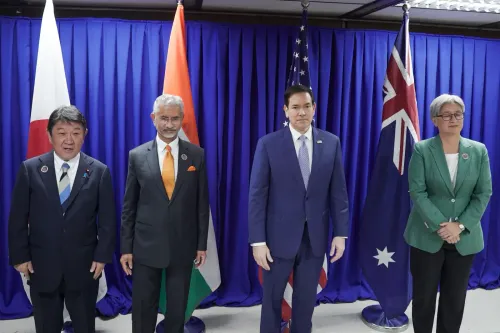
The meeting brought together EAM Jaishankar, US Secretary of State Marco Rubio, Japanese Foreign Minister Toshimitsu Motegi, and Australian Foreign Minister Penny Wong. It was the third Quad foreign ministers' meeting of 2026, following earlier gatherings in May and July. Japan's Foreign Ministry said the ministers held candid discussions on Indo-Pacific developments and aligned their perspectives on the regional situation.
Opposition to Unilateral Status Quo Changes
Motegi expressed strong opposition to any unilateral attempts to change the status quo by force or coercion, according to the Japanese Foreign Ministry. Notably, neither the Japanese ministry's readout nor the accompanying Quad joint release explicitly named China, though the remarks are widely read against the backdrop of China's assertive posture in both sea theatres. China and Japan maintain a longstanding territorial dispute over islands in the East China Sea — administered by Tokyo as the Senkaku Islands and claimed by Beijing as the Diaoyu Islands — a recurring flashpoint in bilateral ties.
Economic Coercion and Supply Chain Concerns
All four ministers collectively expressed concern about economic coercion, including what the joint release described as 'grave concerns regarding economic coercion, including through arbitrary export restrictions.' Their statement also flagged non-market policies and practices that create overcapacity and disrupt global supply chains in critical industries. The joint release did not identify particular export restrictions, specific products, or individual governments in this passage. The ministers reaffirmed their commitment to reliable, open global supply chains and trusted, resilient infrastructure, placing economic security alongside the Quad's wider objectives of regional stability and prosperity.
Middle East Shipping Lanes
On the Middle East, the four ministers underlined the importance of critical sea lanes, uninterrupted commerce, and energy security. The joint statement stressed the need to protect navigational rights and freedoms in the Strait of Hormuz, the Red Sea, and the Bab el-Mandeb Strait, calling for unhindered passage and the safety of maritime crews and vessels without the imposition of tolls — to be upheld in accordance with international law as reflected in the UN Convention on the Law of the Sea (UNCLOS).
North Korea, Cyber Security and What Comes Next
Motegi also emphasised Japan's commitment to the complete denuclearisation of North Korea and the importance of addressing malicious cyber activities. He expressed appreciation for consistent support from India, Australia, and the United States towards an immediate resolution of Japan's abductions issue. The four priority areas for ongoing Quad cooperation were identified as: maritime and transnational security, economic prosperity and security, critical and emerging technologies, and humanitarian assistance and emergency response. The ministers said they looked forward to the next Quad leaders' summit and agreed to maintain close coordination within the grouping.
Point of View
And the explicit 'grave concerns' language on export restrictions is a direct, if diplomatically deniable, reference to Beijing's trade leverage tactics. The inclusion of economic security as a core Quad pillar — alongside the traditional maritime focus — marks a meaningful doctrinal shift. Whether the grouping can move from aligned statements to coordinated action on supply-chain resilience remains the harder question.
NationPress
31 Oct 2026
Frequently Asked Questions
What did the Quad foreign ministers discuss at the Atlanta meeting?
The Quad foreign ministers discussed tensions in the East China Sea and South China Sea, economic coercion affecting critical supply chains, maritime security in the Middle East, North Korea denuclearisation, and cyber threats. The meeting took place on 31 October 2026 in Atlanta, on the sidelines of the G20 Foreign Ministers' Meeting.
Who attended the Quad foreign ministers' meeting in Atlanta?
The meeting was attended by Indian EAM S. Jaishankar, US Secretary of State Marco Rubio, Japanese Foreign Minister Toshimitsu Motegi, and Australian Foreign Minister Penny Wong. It was the third Quad foreign ministers' meeting of 2026, after earlier sessions in May and July.
What did the Quad say about economic coercion?
The joint release recorded 'grave concerns regarding economic coercion, including through arbitrary export restrictions' and flagged non-market policies creating overcapacity that disrupts global supply chains in critical industries. The statement did not name specific countries, products, or export restrictions.
Why did Japan's foreign minister oppose status quo changes in the East China Sea?
FM Motegi opposed any unilateral attempts to change the status quo by force or coercion, a position reflecting Japan's longstanding territorial dispute with China over the Senkaku/Diaoyu Islands in the East China Sea. The Quad joint release did not explicitly name China, but the context makes the reference clear.
What are the Quad's four priority cooperation areas going forward?
The Quad identified four priority areas for practical cooperation: maritime and transnational security, economic prosperity and security, critical and emerging technologies, and humanitarian assistance and emergency response. The ministers also said they looked forward to the next Quad leaders' summit.